ISBN:
9780323061438
Copyright:
2006
Publication Date:
10-06-2005
Page Count:
208
Imprint:
Mosby
List Price:
$64.99

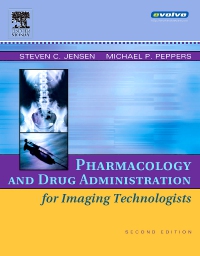
Pharmacology and Drug Administration for Imaging Technologists - Elsevier eBook on VitalSource, 2nd Edition
by Steven C. Jensen, PhD, RT(R) and Michael P. Peppers, PharmD, RPh
Elsevier eBook on VitalSource
ISBN:
9780323061438
Copyright:
2006
Publication Date:
10-06-2005
Page Count:
208
Imprint:
Mosby
List Price:
$64.99
Most review copies are eBooks – how fast!
A review copy request is most likely to be fulfilled as an eBook on VitalSource rather than a print product, unless no eBook is available. eBooks become available in as little as a few hours. Print products will take between 7 and 10 days to arrive. To request a print copy, please contact us through the Evolve Support Center for further assistance or contact your Elsevier Sales Rep.
This text is a complete resource for all the imaging technologies, not just plain film radiography. It provides introductory material on pharmacological nomenclature, drug classifications, pharmacokinetics, and drugs used in imaging. It also offers comprehensive coverage of diagnostic contrast agents, along with drug administration procedures, emergency responses to drug reactions, and legal and ethical aspects of medication administration.
-
- Updates on all contrast agents.
- New information on the use of contrast agents in ultrasound.
- New Drug Classifications chapter.
- New chapter on drug-related emergencies includes case studies.
- Evolve Resources for instructors include a 220-question test bank and an electronic image collection.
-
- Updates on all contrast agents.
- New information on the use of contrast agents in ultrasound.
- New Drug Classifications chapter.
- New chapter on drug-related emergencies includes case studies.
- Evolve Resources for instructors include a 220-question test bank and an electronic image collection.
- Objectives and Key Terms open each chapter.
- Learning exercises include true/false, fill-in-the-blank, multiple-choice, and short-answer questions at the end of each chapter, with answers at the end of the book.
- Did You Know? boxes offer interesting tidbits of historical or current pharmacology information, connecting the book's drug content to everyday situations.
- Clinical Alert icons point out possible adverse reactions and toxic effects.
- Discussion of pharmacodynamics and drug classifications focuses on radiopaque contrast media used in imaging procedures, using clearly written text and useful tables.
- Pharmacokinetics coverage describes how drugs are absorbed, metabolized, distributed, and eliminated.
- Complete coverage of emergency procedures in response to adverse reactions to contrast media includes crash cart procedures and drugs used to treat cardiac and/or respiratory arrest and how to administer them appropriately.
-
1 The Role of the Imaging Professional
Key Terms
Objectives
Introduction
Historical Perspective
Ethical and Legal Implications
Standard of Care
HIPAA NEW!
Conclusion
Learning Exercises
2 Principles of Pharmacology
Key Terms
Objectives
Introduction
Drug Nomenclature
Legend Drugs
The Legal Prescription
Controlled Substances
Herbal Products NEW!
Charting
Drug References
Learning Exercises
3 Biopharmaceutics and Pharmacokinetics
Key Terms
Objectives
Introduction
Biopharmaceutics
Pharmacokinetics
Conclusion
Learning Exercises
4 Pharmacodynamics
Key Terms
Objectives
Introduction
Mechanism of Action
Drug-Response Relationships
Half-Life
Therapeutic Index
Adverse Effects
Drug-Drug Interactions
Conclusion
Learning Exercises
5 Drug Classifications NEW!
Key Terms
Objectives
Inroduction
Cardiac Medications
Anticoagulant, Antiplatelet, Thrombolytic Medications
Analgesic Medications
Antihistamine Medications
Endocrine Medications
Central Nervous System Medications
Anti-Infectives
Chemotherapy
Conclusion
Learning Exercises
6 Classification, Chemistry, and Pharmacology of Contrast Agents
Key Terms
Objectives
Radiopaque Contrast Media
Pharmacology of Iodinated ROCM
Osmolality, Osmolarity, Osmotic Activity
Intravascular Radiopaque Contrast Media
Enteral Radiopaque Contrast Media
Paramagnetic Agents NEW!
Ultrasound Microbubble Agents NEW!
Conclusion
Learning Exercises
7 Pharmacodynamics of Radiopaque Contrast Media
Key Terms
Objectives
Iodinated Radiopaque Contrast Media
Diagnostic Pharmacodynamics
Adverse Pharmacodynamics
General Adverse Reactions
Paramagnetic Agent Adverse Reactions NEW!
Ultrasound Microbubble Agent Adverse Reactions NEW!
Screening
Drug-Drug Interactions
Barium Sulfate
Conclusion
Learning Exercises
8 Routes of Drug Administration
Key Terms
Objectives
Introduction
Oral Route
Sublingual and Buccal Routes
Topical Route
Rectal Route
Parenteral Route
Intravenous Injection Sites NEW!
Intravenous Equipment NEW!
Intravenous Procedure NEW!
Charting NEW!
Chest Tubes and Lines NEW!
General Administration Guidelines
Learning Exercises
9 Infection Prevention and Control
Key Terms
Objectives
Introduction
Fundamentals NEW!
Infections Prevention and Control NEW!
Medical Asepsis
Hand Washing and Gloves NEW!
Good Housekeeping NEW!
Bloodborne Virus Transmission to Healthcare Personnel NEW!
Conclusion
Learning Exercises
10 Anxiety, Phobia and Conscious Sedation NEW!
Key Terms
Objectives
Introduction
Conscious Sedation
Agents Used for Conscious Sedation
Barbituates
Benzodiazepines
Opiate Analgesics
Conclusion
Learning Exercises
11 Pharmacology of Emergency Medications
Key Terms
Objectives
Introduction
Cardiorespiratory Arrest
Emergency Medications for Cardiorespiratory Arrest
Other Cardiac Emergency Medications
Conclusion
Learning Exercises
Answer Section
Bibliography -
-
Ways of Reading
- The appearance of the text and page layout can be modified according to the capabilities of the reading system (font family and font size, spaces between paragraphs, sentences, words, and letters, as well as color of background and text)
- This e-publication is accessible to the full extent that the file format and types of content allow, on a specific reading device, by default, without necessarily including any additions such as textual descriptions of images or enhanced navigation
- No information about nonvisual reading is available
-
Conformance
- No information is available
-
Navigation
- Table of contents to all chapters of the text via links
- Page list to go to pages from the print source version
-
Rich Content
- No information is available
-
Hazards
- No information is available
-
Product Content
- No information is available
-
Legal Considerations
- No information is available
-
Additional Accessibility Information
- Page breaks included from the original print source
- For readers with color vision deficiency, use of color (e.g., in diagrams, graphics and charts, in prompts, or on buttons inviting a response) is not the sole means of graphical distinction or of conveying information
- E-publication includes basic navigation (usually less detailed than TOC-based navigation)
- Where links, controls or buttons are included in the content, the purpose or functionality of each link, control or button is apparent from the associated text alone - or where it is unclear, separate link, control or button descriptions are provided
- All (or substantially all) textual matter is arranged in a single logical reading order (including text that is visually presented as separate from the main text flow, e.g., in boxouts, captions, tables, footnotes, endnotes, citations, etc.). Non-textual content is also linked from within this logical reading order. (Purely decorative non-text content can be ignored).
- The language of the text has been specified (e.g., via the HTML or XML lang attribute) to optimise text-to-speech (and other alternative renderings), both at the whole document level and, where appropriate, for individual words, phrases or passages in a different language.
-
Ways of Reading


Most review copies are eBooks – how fast!
A review copy request is most likely to be fulfilled as an eBook on VitalSource rather than a print product, unless no eBook is available. eBooks become available in as little as a few hours. Print products will take between 7 and 10 days to arrive. To request a print copy, please contact us through the Evolve Support Center for further assistance or contact your Elsevier Sales Rep.

 as described in our