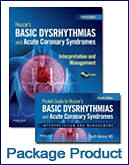

Huszar's Basic Dysrhythmias and Acute Coronary Syndromes: Interpretation & Management - Elsevier eBook on VitalSource, 4th Edition
Elsevier eBook on VitalSource
Now in full color and updated to reflect the 2010 ECC guidelines, Huszar’s Basic Dysrhythmias and Acute Coronary Syndromes, 4th Edition is structured to match the order in which your students learn specific skills: ECG components are presented first, followed by information on how to interpret ECGs to arrive at a diagnosis. More complex material follows basic skills, with advanced sections at the end. Packaged with a free companion CD with 200 practice rhythms and a free heart rate ruler, this edition has been updated throughout and comes loaded with extras designed to enhance your students’ learning.
-
- Updated content throughout ensures all chapters comply with the latest ECC guidelines.
- Full-color design makes it easier for you to follow the content and distinguish the sections of the text.
- Expansion of content for acute coronary syndromes, including description, diagnosis, and management, allows you to learn the latest standards in advanced cardiovascular care.
- Ten additional case studies with questions in the Arrhythmia Self-Assessment Test in Appendix C help you see the whole picture when interpreting an ECG rhythm.
-
- Updated content throughout ensures all chapters comply with the latest ECC guidelines and provide students with the latest, most accurate information available.
- Full-color design makes it easier for your students to follow the content and distinguish the sections of the text.
- Expansion of content for acute coronary syndromes, including description, diagnosis, and management, allows students to learn the latest standards in advanced cardiovascular care.
- Ten additional case studies with questions in the Arrhythmia Self-Assessment Test in Appendix C help students see the whole picture when interpreting an ECG rhythm.
-
-
 Pocket Guide for Huszar's Basic Dysrythmias and Coronary Syndromes - Elsevier eBook on VitalSourceElsevier eBook on VitalSource
-
-
1 Updated! Anatomy and Physiology of the Heart
2 Updated! The ECG: Basic Components and Lead Monitoring
3 Updated! Components of the Electrocardiogram
4 Updated! ECG Interpretation: Rhythm Determination
5 Updated! Sinus Rhythms
6 Updated! Atrial Dysrhythmias
7 Updated! Junctional Dysrhythmias
8 Updated! Ventricular Dysrhythmias
9 Updated! Atrioventricular Heart Blocks
10 Updated! Clinical Significance and Dysrhythmias
11 Updated! The 12-lead Electrocardiogram
12 Updated! Electrical Axes and Vectors
13 Updated! Bundle Branch and Fascicular Blocks
14 New! Pacemaker Rhythm Management
15 Updated! Misc ECG Changes Other Assorted ECG Findings
16 Expanded! Acute Coronary Syndromes
17 Expanded! Diagnostic ECG Changes in Specific Myocardial Infarctions
18 Expanded! Signs and Symptoms of Acute Coronary Syndromes
19 Completely revised! Management of Acute Coronary Syndromes
Appendix A: Methods of Determining the QRS Axis
Appendix B: Chapter Review Question Answer Keys
Appendix C: Dysrhythmia Interpretation: Self-Assessment
Appendix D: Self-Assessment Answer Keys
Expanded! Glossary
-
-
Ways of Reading
- The appearance of the text and page layout can be modified according to the capabilities of the reading system (font family and font size, spaces between paragraphs, sentences, words, and letters, as well as color of background and text)
- This e-publication is accessible to the full extent that the file format and types of content allow, on a specific reading device, by default, without necessarily including any additions such as textual descriptions of images or enhanced navigation
- No information about nonvisual reading is available
-
Conformance
- No information is available
-
Navigation
- Table of contents to all chapters of the text via links
- Page list to go to pages from the print source version
-
Rich Content
- No information is available
-
Hazards
- No information is available
-
Product Content
- No information is available
-
Legal Considerations
- No information is available
-
Additional Accessibility Information
- Page breaks included from the original print source
- For readers with color vision deficiency, use of color (e.g., in diagrams, graphics and charts, in prompts, or on buttons inviting a response) is not the sole means of graphical distinction or of conveying information
- E-publication includes basic navigation (usually less detailed than TOC-based navigation)
- Where links, controls or buttons are included in the content, the purpose or functionality of each link, control or button is apparent from the associated text alone - or where it is unclear, separate link, control or button descriptions are provided
- All (or substantially all) textual matter is arranged in a single logical reading order (including text that is visually presented as separate from the main text flow, e.g., in boxouts, captions, tables, footnotes, endnotes, citations, etc.). Non-textual content is also linked from within this logical reading order. (Purely decorative non-text content can be ignored).
- The language of the text has been specified (e.g., via the HTML or XML lang attribute) to optimise text-to-speech (and other alternative renderings), both at the whole document level and, where appropriate, for individual words, phrases or passages in a different language.
-
Ways of Reading

 as described in our