ISBN:
9780323073400
Copyright:
2011
Publication Date:
03-09-2010
Page Count:
512
Imprint:
Mosby
List Price:
$68.99

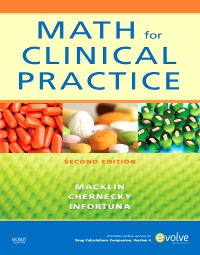
Math For Clinical Practice - Elsevier eBook on VitalSource, 2nd Edition
by Denise Macklin, RNC, BSN, CRNI, Cynthia C. Chernecky, PhD, RN, CNS, AOCN, FAAN and Mother Helena Infortuna, MTS, BS
Elsevier eBook on VitalSource
ISBN:
9780323073400
Copyright:
2011
Publication Date:
03-09-2010
Page Count:
512
Imprint:
Mosby
List Price:
$68.99
Was
$68.99
Now $62.09
Or $0.00 with a valid access code
Covering the ratio and proportion and formula methods, this comprehensive textbook presents a straightforward, real-world approach to the mathematical calculations used in the clinical setting. It features a unique, step-by-step process that teaches you to identify the information needed to perform a calculation, determine if information is missing, set up and perform the calculation, and check the answer to ensure accurracy. This systematic approach is designed to reduce human calculation errors and ensure patient safety. Common medications and methods of administration are used throughout the textbook, with more than 1,200 practice problems to help you master the math needed for clinical practice.
-
- Follows current TJC and ISMP safety recommendations
- Answer key is new to this edition and provides immediate feedback for practice problems
- Features the latest drug information in practice problems and photographs
-
- All content, examples, problems, and scenarios are clinically based and completely up to date
- More than 500 full-color illustrations show drug labels, parenteral and oral syringes, medicine cups, pumps, IV equipment, and more that are used in current clinical practice
- Promotes learning with more than 1,200 practice problems and comprehensive math review problems
- Safety Alert, Clinical Alert, and Human Error Alert boxes are incorporated throughout to promote safe practice
- Clinical Connections begin each chapter and explain how that topic relates to clinical practice
- Examples for each new topic are presented in a unique, step-by-step format: the prescription, what you HAVE, what you KNOW, what you WANT, critical thinking, answer for best care, human error check boxes, and does your answer fit the general guideline? Practice problems follow each set of examples to reinforce your understanding
-
-
 Math for Clinical PracticePaperback
-
-
Section I: Renewing Math Skills
1. Decimals: Relative Value, Addition, and Subtraction
2. Decimals: Multiplication and Division
3. Fractions: Reduction and Equations
Section II: Systems of Measurement
4. Units of Measure
5. Conversion
Section III: Calculations for the Clinical Setting
6. Percentages
7. Ratio and Proportion
8. Body Weight
Section IV: Reading Medication Labels and Using Syringes
9. Using Syringes
10. Oral Medications
11. Parenteral Medications
12. Reconstituting Medications
Section V: Methods of Administering Medications
13. Unit Dose, Card System, and Computerized Medication System
14. Medication Records
Section VI: Intravenous Fluid Calculations
15. Introduction to Intravenous Therapy
Section VII: Unique Calculations
16. Calculating Intravenous Heparin Dosages
17. Insulin
18. Calculating Sliding Scale Insulin Dosage
19. Intake and Output
Section VIII: Calculations in Special Care Units
20. Oncology
21. Pediatrics
22. Intensive Care Unit -
-
Ways of Reading
- The appearance of the text and page layout can be modified according to the capabilities of the reading system (font family and font size, spaces between paragraphs, sentences, words, and letters, as well as color of background and text)
- This e-publication is accessible to the full extent that the file format and types of content allow, on a specific reading device, by default, without necessarily including any additions such as textual descriptions of images or enhanced navigation
- All content can be read as read aloud speech or dynamic braille
-
Conformance
- For detailed accessibility information, see Elsevier's website at https://www.elsevier.com/about/accessibility
- For queries regarding accessibility information, contact [email protected]
- The publication was certified on 07-04-2026
-
Navigation
- Table of contents to all chapters of the text via links
- Page list to go to pages from the print source version
-
Rich Content
- No information is available
-
Hazards
- No information is available
-
Product Content
- No information is available
-
Legal Considerations
- Elsevier is committed to making our eBooks accessible and complying with applicable laws. Given our vast library of titles, there are some cases where making an eBook fully accessible presents unique challenges, and including full features could transform its nature to no longer serve its primary purpose or result in a disproportionate burden for the publisher. As a result this eBook may have limited accessibility. See more at https://www.elsevier.com/en-gb/about/accessibility.
- Please refer to our disproportionate burden or fundamental modification statements.
-
Additional Accessibility Information
- Page breaks included from the original print source
- E-publication includes basic navigation (usually less detailed than TOC-based navigation)
- All (or substantially all) textual matter is arranged in a single logical reading order (including text that is visually presented as separate from the main text flow, e.g., in boxouts, captions, tables, footnotes, endnotes, citations, etc.). Non-textual content is also linked from within this logical reading order. (Purely decorative non-text content can be ignored).
- The language of the text has been specified (e.g., via the HTML or XML lang attribute) to optimise text-to-speech (and other alternative renderings), both at the whole document level and, where appropriate, for individual words, phrases or passages in a different language.
-
Ways of Reading
Was
$68.99
Now $62.09
Or $0.00 with a valid access code

 as described in our