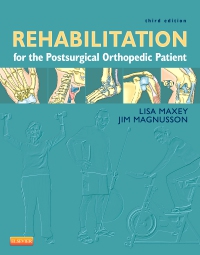

Rehabilitation for the Postsurgical Orthopedic Patient - Elsevier eBook on VitalSource, 3rd Edition
Elsevier eBook on VitalSource
With detailed descriptions of orthopedic surgeries, Rehabilitation for the Postsurgical Orthopedic Patient, 3rd Edition provides current, evidence-based guidelines to designing effective rehabilitation strategies. Coverage of each condition includes an overview of the orthopedic patient's entire course of treatment from pre- to post-surgery. For each phase of rehabilitation, this book describes the postoperative timeline, the goals, potential complications and precautions, and appropriate therapeutic procedures. New to this edition are a full-color design and new chapters on disc replacement, cartilage replacement, hallux valgus, and transitioning the running athlete. With chapters written by both surgeons and physical therapists, this resource provides valuable insights into the use of physical therapy in the rehabilitation process.
-
- New coverage of current orthopedic surgeries and rehabilitation includes topics such as disc replacement, cartilage replacement, hallux valgus, and transitioning the running athlete.
- New full-color design and illustrations visually reinforce the content.
- Updated Suggested Home Maintenance boxes in every chapter provide guidance for patients returning home.
- References linked to MEDLINE abstracts make it easy to access evidence-based information for better clinical decision-making.
-
- NEW coverage of current orthopedic surgeries and rehabilitation includes topics such as disc replacement, cartilage replacement, hallux valgus, and transitioning the running athlete.
- NEW full-color design and illustrations visually reinforce the content.
- UPDATED Suggested Home Maintenance boxes in every chapter provide guidance for patients returning home.
- NEW! References linked to MEDLINE abstracts make it easy to access evidence-based information for better clinical decision-making.
- Comprehensive, evidence-based coverage provides an overview of the orthopedic patient's entire course of treatment from pre- to post-surgery, including a detailed look at the surgical procedures and therapy guidelines that can be used to design the appropriate rehabilitation programs.
- Case study vignettes with critical thinking questions help students develop critical reasoning skills.
- Indications and considerations for surgery describe the mechanics of the injury and the repair process so students can learn to plan an effective rehabilitation program.
- Therapy guidelines cover each phase of rehabilitation with specifics as to the expected time span and goals for each phase.
- Evidence-based coverage includes the latest clinical research to support treatment decisions.
- Overview of soft tissue and bone healing considerations after surgery helps in understanding the rationale behind the timelines for the various physical therapy guidelines.
- A Troubleshooting section in each chapter details potential pitfalls in the recovery from each procedure.
- Over 300 photos and line drawings depict concepts, procedures, and rehabilitation.
- Detailed tables break down therapy guidelines and treatment options for quick reference.
- Expert contributors include surgeons describing the indications and considerations for surgery as well as the surgery itself, and physical or occupational therapists discussing therapy guidelines.
-
Part One: Introduction
1. Pathogenesis of Soft Tissue and Bone Repair
2. Soft Tissue Healing Considerations After Surgery
Part Two: Upper Extremity
3. Acromioplasty
4. Anterior Capsular Reconstruction
5. Rotator Cuff Repair
6. Superior Labral Anterior Posterior Repair
7. Total Shoulder Arthroplasty
8. Tennis Elbow: Extensor Brevis Release and Lateral Epicondylectomy
9. Reconstruction of the Ulnar Collateral Ligament with Ulnar Nerve Transposition
10. Platelet Rich Plasma Injection (PRP) for the Ulnar Collateral Ligament
11. Surgery and Rehabilitation for Primary Flexor Tendon Repair in the Digit
12. Carpal Tunnel Syndrome
13. Transitioning the Throwing Athlete Back to the Field
Part Three: Spine
14. Anterior Cervical Discectomy and Fusion
15. Posterior Lumbar Arthroscopic Discectomy
16. Lumbar Spine Fusion
17. Lumbar Spine Disc Replacement NEW!
Part Four: Lower Extremity
18. Total Hip Arthroplasty
19. Total Hip Mini Invasive
20. Hip Arthroscopy
21. Open Reduction and Internal Fixation of the Hip
22. Anterior Cruciate Ligament Reconstruction
23. Arthroscopic Lateral Retinaculum Release
24. Meniscectomy and Meniscal Repair
25. Autologous Chondrocyte Implantation
26. Patella Open Reduction and Internal Fixation
27. Total Knee Arthroplasty
28. Lateral Ligament Repair of the Ankle
29. Open Reduction and Internal Fixation of the Ankle
30. Ankle Arthroscopy
31. Achilles Tendon Repair
32. Surgical Correction for Hallux Valgus Deformity NEW!
33. Transitioning the Jumping Athlete
34. Transitioning the Running Athlete NEW!
-
-
Ways of Reading
- The appearance of the text and page layout can be modified according to the capabilities of the reading system (font family and font size, spaces between paragraphs, sentences, words, and letters, as well as color of background and text)
- This e-publication is accessible to the full extent that the file format and types of content allow, on a specific reading device, by default, without necessarily including any additions such as textual descriptions of images or enhanced navigation
- No information about nonvisual reading is available
-
Conformance
- No information is available
-
Navigation
- Table of contents to all chapters of the text via links
- Page list to go to pages from the print source version
-
Rich Content
- No information is available
-
Hazards
- No information is available
-
Product Content
- No information is available
-
Legal Considerations
- No information is available
-
Additional Accessibility Information
- Page breaks included from the original print source
- For readers with color vision deficiency, use of color (e.g., in diagrams, graphics and charts, in prompts, or on buttons inviting a response) is not the sole means of graphical distinction or of conveying information
- E-publication includes basic navigation (usually less detailed than TOC-based navigation)
- Where links, controls or buttons are included in the content, the purpose or functionality of each link, control or button is apparent from the associated text alone - or where it is unclear, separate link, control or button descriptions are provided
- All (or substantially all) textual matter is arranged in a single logical reading order (including text that is visually presented as separate from the main text flow, e.g., in boxouts, captions, tables, footnotes, endnotes, citations, etc.). Non-textual content is also linked from within this logical reading order. (Purely decorative non-text content can be ignored).
- The language of the text has been specified (e.g., via the HTML or XML lang attribute) to optimise text-to-speech (and other alternative renderings), both at the whole document level and, where appropriate, for individual words, phrases or passages in a different language.
-
Ways of Reading


 as described in our