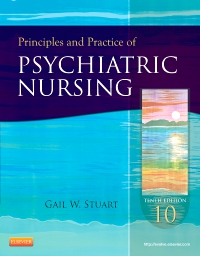

Principles and Practice of Psychiatric Nursing - Elsevier eBook on VitalSource, 10th Edition
Elsevier eBook on VitalSource
Now $68.59
Using the latest clinical research and diagnoses, Principles and Practice of Psychiatric Nursing, 10th Edition provides a holistic, biopsychosocial approach to psychiatric nursing care. It follows the popular Stuart stress-adaptation framework and includes comprehensive coverage to simplify important nursing and medical concepts, promote quality and safety in care, and address psychobiology and psychopharmacology topics integral to today’s psychiatry. New to this edition is a chapter on psychiatric care of military personnel, plus the latest on health care reform, prescription abuse, and obesity issues. Written by psychiatric nursing expert Gail W. Stuart, this market-leading text makes it easy to apply classroom theory to clinical practice.
-
- The Military and Their Families chapter addresses the issues and concerns surrounding the mental health needs of active, veteran, and National Guard personnel
- Updated coverage includes the latest on health care reform, prevention and mental health promotion, recovery and self determination, prescription abuse, and obesity issues related to mental health care
- Case studies in clinical chapters include scenarios related to chapter content and provide opportunities to develop clinical reasoning skills
- Summary of Evidence boxes help you understand the latest clinical research and apply it to practice
- Clinical Reasoning boxes provide opportunities to make a decision based on a particular clinical situation.
- Quality & Safety boxes discuss QSEN competencies or other quality and safety issues
- Icons and references identify additional resources on the Evolve companion website and in the Pageburst digital version of the text
-
- An easy-to-follow writing style makes it easy to understand both simple and complex topics
- A well-rounded, collaborative approach provides coverage of all major psychiatric disorders from nursing and medical perspectives
- The Stuart Stress Adaptation Model of health and wellness provides a consistent nursing-oriented framework, with clear explanations of biological, psychological, sociocultural, environmental, and legal-ethical components
- An evidence-based practice approach bridges the gap between clinical research and everyday practice
- Learning from a Clinical Case boxes begin disorders chapters with thought-provoking questions and end chapters with answers and feedback
- Summarizing the Evidence boxes in the disorders chapters examine the research and findings that support psychiatric nursing care
- A family focus and discussions of outpatient care reflect current trends in psychiatric nursing
- A Patient Speaks and A Family Speaks boxes present short vignettes with the patient’s and family’s perspectives of the caregiving process
- Competent Caring: A Clinical Exemplar of a Psychiatric Nurse boxes feature the experiences and personal insights of practicing psychiatric nurses
- Medical and Nursing Diagnoses boxes and Detailed Diagnoses tables emphasize the interdisciplinary approach to patient care by presenting NANDA diagnoses relevant to specific disorders and describing the essential features of the related DSM-IV-TR diagnoses
- Nursing Treatment Plan Summary tables present care plans including patient goals with nursing interventions and rationales
- Patient Education Plan and Family Education Plan tables include key information that you need to share with the patient and his or her family to facilitate shorter hospital stays and more outpatient care
- Therapeutic Dialogue boxes offer examples of nurse-patient interactions
- Clinical examples include selected nursing diagnoses
- Focus Points provide a comprehensive, point-by-point review of the important information in each chapter
-
Unit One: Principles of Psychiatric Nursing Care
1. Roles and Functions of Psychiatric-Mental Health Nurses: Competent Caring
2. Therapeutic Nurse-Patient Relationship
3. The Stuart Stress Adaptation Model of Psychiatric Nursing Care
4. Evidence-Based Psychiatric Nursing Practice
5. Biological Context of Psychiatric Nursing Care
6. Psychological Context of Psychiatric Nursing Care
7. Social, Cultural, and Spiritual Context of Psychiatric Nursing Care
8. Legal and Ethical Context of Psychiatric Nursing Care
9. Policy and Advocacy in Mental Health Care
10. Families as Resources, Caregivers, and Collaborators
11. Implementing the Nursing Process: Standards of Practice and Professional Performance
Unit Two: Continuum of Care
12. Prevention and Mental Health Promotion
13. Crisis and Disaster Intervention
14. Recovery Support
Unit Three: Applying Principles in Nursing Practice
15. Anxiety Responses and Anxiety Disorders
16. Psychophysiological Responses and Somatoform and Sleep Disorders
17. Self-Concept Responses and Dissociative Disorders
18. Emotional Responses and Mood Disorders
19. Self-Protective Responses and Suicidal Behavior
20. Neurobiological Responses and Schizophrenia and Psychotic Disorders
21. Social Responses and Personality Disorders
22. Cognitive Responses and Organic Mental Disorders
23. Chemically Mediated Responses and Substance-Related Disorders
24. Eating Regulation Responses and Eating Disorders
25. Sexual Responses and Sexual Disorders
Unit Four: Treatment Modalities
26. Psychopharmacology
27. Behavior Change and Cognitive Interventions
28. Preventing and Managing Aggressive Behavior
29. Somatic Therapies
30. Complementary and Alternative Therapies
31. Therapeutic Groups
32. Family Interventions
Unit Five: Treatment Settings
33. Hospital-Based Psychiatric Nursing Care
34. Community-Based Psychiatric Nursing Care
Unit Six: Special Populations in Psychiatry
35. Child Psychiatric Nursing
36. Adolescent Psychiatric Nursing
37. Geropsychiatric Nursing
38. Care of Survivors of Abuse and Violence
39. NEW! The Military and Their Families
40. Psychological Care of Patients with a Life-Threatening Illness
Appendixes
A: NANDA-Approved Nursing Diagnoses
B: Diagnostic Criteria for Mental Disorders (DSM-IV-TR) -
-
Ways of Reading
- The appearance of the text and page layout can be modified according to the capabilities of the reading system (font family and font size, spaces between paragraphs, sentences, words, and letters, as well as color of background and text)
- This e-publication is accessible to the full extent that the file format and types of content allow, on a specific reading device, by default, without necessarily including any additions such as textual descriptions of images or enhanced navigation
- No information about nonvisual reading is available
-
Conformance
- For detailed accessibility information, see Elsevier's website at https://www.elsevier.com/about/accessibility
- For queries regarding accessibility information, contact [email protected]
- The publication was certified on 07-04-2026
-
Navigation
- Table of contents to all chapters of the text via links
-
Rich Content
- No information is available
-
Hazards
- No information is available
-
Product Content
- No information is available
-
Legal Considerations
- No information is available
-
Additional Accessibility Information
- For readers with color vision deficiency, use of color (e.g., in diagrams, graphics and charts, in prompts, or on buttons inviting a response) is not the sole means of graphical distinction or of conveying information
- E-publication includes basic navigation (usually less detailed than TOC-based navigation)
- Where links, controls or buttons are included in the content, the purpose or functionality of each link, control or button is apparent from the associated text alone - or where it is unclear, separate link, control or button descriptions are provided
- All (or substantially all) textual matter is arranged in a single logical reading order (including text that is visually presented as separate from the main text flow, e.g., in boxouts, captions, tables, footnotes, endnotes, citations, etc.). Non-textual content is also linked from within this logical reading order. (Purely decorative non-text content can be ignored).
- The language of the text has been specified (e.g., via the HTML or XML lang attribute) to optimise text-to-speech (and other alternative renderings), both at the whole document level and, where appropriate, for individual words, phrases or passages in a different language.
-
Ways of Reading

 as described in our