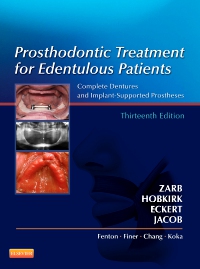

Prosthodontic Treatment for Edentulous Patients - Elsevier eBook on VitalSource, 13th Edition
Elsevier eBook on VitalSource
Now $114.29
Covering the functional and esthetic needs of edentulous patients, Prosthodontic Treatment for Edentulous Patients: Complete Dentures and Implant-Supported Prostheses, 13th Edition helps you provide complete dentures, with and without dental implant support. It addresses both the behavioral and clinical aspects of diagnosis and treatment and covers treatment modalities including osseointegration, overdentures, implant-supported fixed prosthesis, and the current and future directions of implant prosthodontics. New to this edition are full-color photographs and coverage of immediately loaded complete dental prostheses. From lead editor and respected educator George Zarb, Prosthodontic Treatment for Edentulous Patients provides an atlas of clinical procedures and emphasizes the importance of evidence-based treatment.
-
- NEW! Over 800 full-color photos and illustrations highlight key clinical and esthetic details
- NEW Immediately Loaded Complete Dental Prostheses chapter describes the rationale for the popular approach to immediately loading full arch implant supported/retained prostheses, allowing both enhanced functional outcomes and an accelerated time frame for completion of treatment
- NEW The Impact of Socioeconomic, Cultural and Technological Changes and the Notion of Standards of Care and Alternative Protocols chapter addresses the "appropriatech" concept of providing cost-effective, appropriate care and describes techniques that make complete dentures accessible to those who do not have access to alternative care, including discussions of alternative protocols such as Complete Dentures in Four Clinical Sessions (CD4)
- Completely revised Materials Used in the Management of Edentulous Patients chapter includes expanded information on the properties, behaviors, and limitations of dental materials used in the rehabilitation of the edentulous patient, including impression materials (such as zinc oxide-eugenol impression paste, hydrocolloids, agar, and silicones), polymeric denture base materials (including rapid-cure type resins, biocompatibility of acrylic-based resins, residual monomer content, and radio-opacity of denture bases), denture cleansers (microwave radiation), and denture adhesives (such as adjunctive retention, indications/contraindications, application, and adverse reactions)
-
- Short, easy-to-read chapters cover the essentials of care for both short- and long-term patients, stressing the importance of evidence-based treatment
- Expanded coverage of implant prosthodontics addresses the clinical protocols for implant-retained and implant-supported prosthodontic management
- Specific chapters address the three surfaces of the complete denture: (1) an impression or intaglio surface, (2) a polished surface, and (3) an occlusal surface, the integration of which is crucial to creating a stable, functional, and esthetic result
- Chapter on health and nutrition examines a number of systemic conditions (vesciculoerosive conditions, systemic lupus erythematosus, burning mouth syndrome, salivary dysfunction, Sjögren's syndrome, hyper/hyposalivation, diabetes) that affect the oral cavity and specifically influence the prognosis for wearing complete dentures or for accepting osseointegrated prostheses
- Chapter on the time-dependent changes which occur in the oral cavity focuses on both time-related direct (ulcer/cheek biting, irritation hyperplasia, denture stomatitis, flabby ridge and pendulous maxillary tuberosities, hyperkeratosis and oral cancer, residual ridge reduction) and indirect (atrophy of masticatory muscles, nutritional status and masticatory function, control of sequelae) changes in the oral environment, and provides strategies to minimize the risk of such changes
- Chapter on the techniques used to prolong the life of complete dentures focuses on the two techniques used to extend the life of dentures: relining and rebasing, also touching on denture duplication
- Well-respected editors and contributors are the leaders in their field, lending credibility and experience to each topic
-
Part 1: The Patient
1. The Edentulous State
2. Systemic Health Aspects and Nutritional Considerations for Edentulous Patients
3. The Aging Edentulous Patient
4. Sequelae Caused by Wearing Complete Dentures
Part 2: Treatment Options
5. History Taking, Treatment Planning and Improving Denture-Bearing Areas for Edentulous Patients
6. Additional Treatment Planning Options for both Edentulous and Potentially Edentulous Patients
Part Three: The Materials Used
7. Materials Used in the Management of Edentulous Patients
Part 4: Clinical Protocols for Diverse Treatment Scenarios
8. Maxillary and Mandibular Analougue/Substitutes for the Denture-Bearing Area
9. The Dentures' Polished Surfaces, Recording Jaw Relations, and Their Transfer to an Articulator
10. The Occlusal Surfaces: The Selection and Arrangement of Prosthetic Teeth
11. The Try-in Appointment
12. Prosthesis Insertion and Follow-up Appointments
13. Modified Protocols for Immediate Dentures, Overdentures, and Single Dentures
14. Prolonging the Useful Life of Complete Dentures: Relines, Repairs and Duplications
15. Speech Considerations with Complete Dentures
Part 5: Clinical Protocols Specific to Implant-Retained and Implanted Supported Prosthodontic Management
16. The Science of Osseointegration
17. Implant Overdentures
18. Fixed Full Arch Implant-Supported Prostheses for the Edentulous Patient
19. Maxillofacial Prosthodontics for the Edentulous Patient
20. Managing Problems and Complications
21. Immediately Loaded Complete Dental Prostheses
22. Current and Possible Future Directions in Implant Prosthdontics
Part 6: Additional Considerations in the Management of Edentulous Patients
23. The Impact of Socioeconomic, Cultural and Technological Changes and the Notion of Standards of Care and Alternative Protocols -
-
Ways of Reading
- The appearance of the text and page layout can be modified according to the capabilities of the reading system (font family and font size, spaces between paragraphs, sentences, words, and letters, as well as color of background and text)
- This e-publication is accessible to the full extent that the file format and types of content allow, on a specific reading device, by default, without necessarily including any additions such as textual descriptions of images or enhanced navigation
- All content can be read as read aloud speech or dynamic braille
- Has alternative text descriptions for images
-
Conformance
- The publication contains a conformance statement that it meets the EPUB Accessibility 1.1, WCAG 2.1, Level AA standard. Please see https://bornaccessible.benetech.org/certified-publishers/ for further details of our compatibility testing.
- The certifier's credential is https://bornaccessible.benetech.org/certified-publishers/
- For detailed accessibility information, see Elsevier's website at https://www.elsevier.com/about/accessibility
- For queries regarding accessibility information, contact [email protected]
- The publication was certified on 07-04-2026
-
Navigation
- Table of contents to all chapters of the text via links
- Index with links to referenced entries
- Elements such as headings, tables, etc. for structured navigation
- Page list to go to pages from the print source version
-
Rich Content
- Information-rich images are described by extended descriptions
-
Hazards
- The publication contains no hazards
-
Product Content
- Content includes any type of illustrations.
- The primary content is text.
- Content includes a significant number of actionable (clickable) web links to external content, downloadable resources, supplementary material, etc.
- Content includes a significant number of actionable (clickable) cross-references, hyperlinked notes and annotations, or with other actionable links between largely textual elements (e.g., quiz/test questions, 'choose your own ending', etc.).
- Content includes figures, diagrams, charts and/or graphs, including other 'mechanical' (i.e. non-photographic) illustrations.
- Content includes a significant number of web links (printed URLs, QR codes etc.).
- Content includes text within images, including text-as-text embedded in diagrams, charts, or within images containing speech balloons, thought bubbles, captions, etc.
-
Legal Considerations
- No information is available
-
Additional Accessibility Information
- Content is enhanced with ARIA roles to optimize organization and facilitate navigation
- Page breaks included from the original print source
- For readers with color vision deficiency, use of color (e.g., in diagrams, graphics and charts, in prompts, or on buttons inviting a response) is not the sole means of graphical distinction or of conveying information
- The body text is presented with a contrast ratio of at least 4.5:1 (or 3:1 for large/heading text)
- Ultra-high contrast between text and background
- E-publication includes basic navigation (usually less detailed than TOC-based navigation)
- Where links, controls or buttons are included in the content, the purpose or functionality of each link, control or button is apparent from the associated text alone - or where it is unclear, separate link, control or button descriptions are provided
- All (or substantially all) textual matter is arranged in a single logical reading order (including text that is visually presented as separate from the main text flow, e.g., in boxouts, captions, tables, footnotes, endnotes, citations, etc.). Non-textual content is also linked from within this logical reading order. (Purely decorative non-text content can be ignored).
- Where interactive content is included in the product, controls are provided (e.g., for speed, pause and resume, reset) and labelled to make their use clear.
- The language of the text has been specified (e.g., via the HTML or XML lang attribute) to optimise text-to-speech (and other alternative renderings), both at the whole document level and, where appropriate, for individual words, phrases or passages in a different language.
-
Ways of Reading


 as described in our