ISBN:
9780323096690
Copyright:
2015
Publication Date:
08-26-2014
Page Count:
640
Imprint:
Mosby
List Price:
$66.99

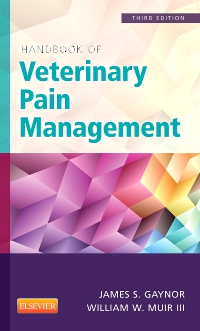
Handbook of Veterinary Pain Management - Elsevier eBook on VitalSource, 3rd Edition
by James S. Gaynor, DVM, MS, DACVA, DAAPM and William W. Muir, DVM, MSc, PhD, DACVA, DACVECC
Elsevier eBook on VitalSource
ISBN:
9780323096690
Copyright:
2015
Publication Date:
08-26-2014
Page Count:
640
Imprint:
Mosby
List Price:
$66.99
Was
$66.99
Now $60.29
Or $0.00 with a valid access code
Trust the Handbook of Veterinary Pain Management, 3rd Edition to help you meet the increasing need for effective pain management in the animals you treat. This user-friendly guide contains the most up-to-date and clinically relevant information on analgesic drugs and managing pain in dogs, cats, birds, reptiles, ferrets, and rabbits. It specifically covers the areas of pain assessment, pharmaceutical and non-pharmaceutical treatment options, guidelines for managing acute and chronic pain, and unique aspects of pain management. This edition also incorporates expanded information on cats, exotics, the latest drugs, and more to keep you on top of today’s best practices in veterinary pain management.
-
- NEW! Eight new chapters include the latest information on:
- the human-animal bond
- local and regional techniques
- preventive and multimodal analgesia
- energy modalities
- acupuncture
- physical examination with emphasis on isolating and locating pain
- therapeutic goals
- pain in laboratory animals
- NEW! Completely updated drug information, with new agents, doseforms, and routes provides the most current pain management therapies for use in the clinical setting.
- NEW! Expanded sections on the cat and exotics address the growing popularity of these pets by providing additional species-specific information.
-
- User-friendly format helps you quickly and easily find essential pain management information.
- Helpful boxes and tables provide at-a-glance access to pharmacologic protocols and clinical applications, including dosages, indications, contraindications, and side effects.
- Complementary and alternative treatment strategies are included throughout to assist you in using the latest non-pharmacological pain interventions.
- Case studies clearly illustrate the practical applications of key concepts in the clinical setting and help you sharpen your pain assessment and management skills.
-
-
 Handbook of Veterinary Pain ManagementPaperback
-
-
1. The Human-Animal Bond and Pain
2. Nociception and Pain Mechanisms
3. Pain: Physiologic Consequences and Stress
4. Pain Nomenclature
5. Pain Behaviors and Pain Assessment Scales
6. Quality of Life Assessment
7. Drug Classes and Drugs Used for Pain Therapy: An Overview
8. NSAIDs
9. Opioids
10. Alpha-2s
11. Local Anesthetics
12. Local and Regional Anesthetic Techniques
13. Corticosteroids
14. Other “Drugs and Injectable Modalities
15. Drug Delivery Methods
16. Preventative and “Multimodal Analgesia; “Masking and Pitfalls: Theory and Consequences
17. Energy Modalities: Therapeutic Laser and Pulsed Electromagnetic Field Therapy
18. Acupuncture
19. Physical Rehabilitation and Exercise
20. Physical Examination with Emphasis on Isolating and Detecting Pain
21. Therapeutic Goals
22. Acute Pain Cases
23. Chronic Pain Cases
24. Cat Specific Considerations
25. Rabbit and Small Mammal Specific Considerations
26. Bird Specific Considerations
27. Reptile Specific Considerations
28. Regulations in Pain and Distress in Laboratory Animals -
-
Ways of Reading
- The appearance of the text and page layout can be modified according to the capabilities of the reading system (font family and font size, spaces between paragraphs, sentences, words, and letters, as well as color of background and text)
- This e-publication is accessible to the full extent that the file format and types of content allow, on a specific reading device, by default, without necessarily including any additions such as textual descriptions of images or enhanced navigation
- No information about nonvisual reading is available
-
Conformance
- No information is available
-
Navigation
- Table of contents to all chapters of the text via links
- Page list to go to pages from the print source version
-
Rich Content
- No information is available
-
Hazards
- No information is available
-
Product Content
- No information is available
-
Legal Considerations
- No information is available
-
Additional Accessibility Information
- Page breaks included from the original print source
- For readers with color vision deficiency, use of color (e.g., in diagrams, graphics and charts, in prompts, or on buttons inviting a response) is not the sole means of graphical distinction or of conveying information
- E-publication includes basic navigation (usually less detailed than TOC-based navigation)
- Where links, controls or buttons are included in the content, the purpose or functionality of each link, control or button is apparent from the associated text alone - or where it is unclear, separate link, control or button descriptions are provided
- All (or substantially all) textual matter is arranged in a single logical reading order (including text that is visually presented as separate from the main text flow, e.g., in boxouts, captions, tables, footnotes, endnotes, citations, etc.). Non-textual content is also linked from within this logical reading order. (Purely decorative non-text content can be ignored).
- The language of the text has been specified (e.g., via the HTML or XML lang attribute) to optimise text-to-speech (and other alternative renderings), both at the whole document level and, where appropriate, for individual words, phrases or passages in a different language.
-
Ways of Reading
Was
$66.99
Now $60.29
Or $0.00 with a valid access code

 as described in our