ISBN:
9780323167598
Copyright:
2009
Publication Date:
01-31-2008
Page Count:
608
Imprint:
Mosby
List Price:
$93.99

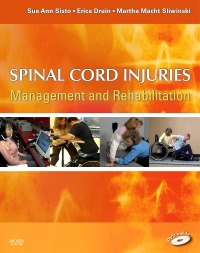
Spinal Cord Injuries - Elsevier eBook on VitalSource, 1st Edition
by Sue Ann Sisto, PT, MA, PhD, Erica Druin, MPT and Martha Macht Sliwinski, PT, MA, PhD
Elsevier eBook on VitalSource
ISBN:
9780323167598
Copyright:
2009
Publication Date:
01-31-2008
Page Count:
608
Imprint:
Mosby
List Price:
$93.99
Most review copies are eBooks – how fast!
A review copy request is most likely to be fulfilled as an eBook on VitalSource rather than a print product, unless no eBook is available. eBooks become available in as little as a few hours. Print products will take between 7 and 10 days to arrive. To request a print copy, please contact us through the Evolve Support Center for further assistance or contact your Elsevier Sales Rep.
-
- Case Studies with clinical application thinking exercises help you apply knowledge from the book to real life situations.
- Thoroughly referenced, evidence-based content provides the best evidence for treatment based on the most current research.
- Tables and boxes throughout each chapter organize and summarize important information for quick reference.
- Clinical Note boxes provide at-a-glance access to helpful tips.
- Over 500 clinical photos, line drawings, radiographs, and more bring important concepts to life.
- Highly respected experts in spinal cord injury rehabilitation, editors Sue Ann Sisto, Erica Druin, and Martha Sliwinski, provide authoritative guidance on the foundations and principles of practice for spinal cord injury.
- Companion DVD includes video clips of the techniques described throughout the book that demonstrate how to apply key concepts to practice.
-
Introduction: Profiles in Courage and Hope
1. Understanding Spinal Cord Injury and Advances in Recovery
2. Medical Management and Complications of Spinal Cord Injury
3. Nursing Care and Education for Patients with Spinal Cord Injury
4. Respiratory Treatment and Equipment
5. Psychological Adjustments to Spinal Cord Injury
6. Evaluation
7. Intervention Principles and Position Changes
8. Transfer Techniques
9. Activities of Daily Living
10. Management of the Upper Limb in Individuals with Tetraplegia
11. Seating and Positioning
12. Assessment and Match for Effective Assistive Technology
13. Using Assistive Technology
14. Accessible Home Modification and Durable Medical Equipment
15. Wheelchair Skills
16. Ambulation
17. Functional Electrical Stimulation
18. Exercise and Fitness with Spinal Cord Injury
19. Sports and Recreation for People with Spinal Cord Injury
20. Wheel Chair Transportation and Safety
21. Transportation and Community Access
22. Functional and Psychosocial Aspects of Aging with SCI
23. Quality of Life After Spinal Cord Injury -
-
Ways of Reading
- The appearance of the text and page layout can be modified according to the capabilities of the reading system (font family and font size, spaces between paragraphs, sentences, words, and letters, as well as color of background and text)
- This e-publication is accessible to the full extent that the file format and types of content allow, on a specific reading device, by default, without necessarily including any additions such as textual descriptions of images or enhanced navigation
- All content can be read as read aloud speech or dynamic braille
-
Conformance
- For detailed accessibility information, see Elsevier's website at https://www.elsevier.com/about/accessibility
- For queries regarding accessibility information, contact [email protected]
- The publication was certified on 07-04-2026
-
Navigation
- Table of contents to all chapters of the text via links
- Page list to go to pages from the print source version
-
Rich Content
- No information is available
-
Hazards
- No information is available
-
Product Content
- No information is available
-
Legal Considerations
- Elsevier is committed to making our eBooks accessible and complying with applicable laws. Given our vast library of titles, there are some cases where making an eBook fully accessible presents unique challenges, and including full features could transform its nature to no longer serve its primary purpose or result in a disproportionate burden for the publisher. As a result this eBook may have limited accessibility. See more at https://www.elsevier.com/en-gb/about/accessibility.
- Please refer to our disproportionate burden or fundamental modification statements.
-
Additional Accessibility Information
- Page breaks included from the original print source
- E-publication includes basic navigation (usually less detailed than TOC-based navigation)
- All (or substantially all) textual matter is arranged in a single logical reading order (including text that is visually presented as separate from the main text flow, e.g., in boxouts, captions, tables, footnotes, endnotes, citations, etc.). Non-textual content is also linked from within this logical reading order. (Purely decorative non-text content can be ignored).
- The language of the text has been specified (e.g., via the HTML or XML lang attribute) to optimise text-to-speech (and other alternative renderings), both at the whole document level and, where appropriate, for individual words, phrases or passages in a different language.
-
Ways of Reading
Most review copies are eBooks – how fast!
A review copy request is most likely to be fulfilled as an eBook on VitalSource rather than a print product, unless no eBook is available. eBooks become available in as little as a few hours. Print products will take between 7 and 10 days to arrive. To request a print copy, please contact us through the Evolve Support Center for further assistance or contact your Elsevier Sales Rep.

 as described in our