ISBN:
9780323167611
Copyright:
2006
Publication Date:
08-26-2005
Page Count:
592
Imprint:
Mosby
List Price:
$146.99

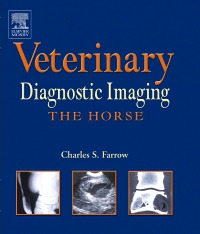
Veterinary Diagnostic Imaging - The Horse - Elsevier eBook on VitalSource, 1st Edition
by Charles S. Farrow, DVM
Elsevier eBook on VitalSource
ISBN:
9780323167611
Copyright:
2006
Publication Date:
08-26-2005
Page Count:
592
Imprint:
Mosby
List Price:
$146.99
Was
$146.99
Now $132.29
Or $0.00 with a valid access code
Focusing on the horse, this practical text is the second in a series of three to focus on veterinary diagnostic imaging and the new technologies available to help diagnose and pinpoint disease. Like Veterinary Diagnostic Imaging: The Dog and Cat, Veterinary Diagnostic Imaging: The Horse is organized by region with specific structures addressed within each region. Coverage includes background information, normal anatomy, and positioning for specific structures, followed by imaging findings and specific problems such as trauma/fracture, infection and neoplasm. The main focus of this book is radiology, with supplementary information on ultrasound, CT, and MRI.
-
- Includes Radiographic Diagnostic Indicators (RDIs), a versatile set of potential radiographic observations that, when used in combination, can often lead to a radiographic diagnosis.
- Features normal radiographs pictured near abnormal images for comparison.
- Provides telescopic images that provide both orientation and close-up views to help readers identify key points of the radiograph.
- Offers diagnosis at a glance with concise one or two word diagnoses in bold within each legend for quick reference.
- Features Emphasis Zones that electronically enhance regions of interest in more complex images.
-
I. Principles of Diagnostic Imaging
II. The Throat
III. The Neck
IV. The Thorax
V. The Abdomen
VI. The Spine
VII. The Pelvis
VIII. The Limbs
VIX. Soft Tissue -
-
Ways of Reading
- The appearance of the text and page layout can be modified according to the capabilities of the reading system (font family and font size, spaces between paragraphs, sentences, words, and letters, as well as color of background and text)
- This e-publication is accessible to the full extent that the file format and types of content allow, on a specific reading device, by default, without necessarily including any additions such as textual descriptions of images or enhanced navigation
- All content can be read as read aloud speech or dynamic braille
-
Conformance
- For detailed accessibility information, see Elsevier's website at https://www.elsevier.com/about/accessibility
- For queries regarding accessibility information, contact [email protected]
- The publication was certified on 07-04-2026
-
Navigation
- Table of contents to all chapters of the text via links
- Page list to go to pages from the print source version
-
Rich Content
- No information is available
-
Hazards
- No information is available
-
Product Content
- No information is available
-
Legal Considerations
- Elsevier is committed to making our eBooks accessible and complying with applicable laws. Given our vast library of titles, there are some cases where making an eBook fully accessible presents unique challenges, and including full features could transform its nature to no longer serve its primary purpose or result in a disproportionate burden for the publisher. As a result this eBook may have limited accessibility. See more at https://www.elsevier.com/en-gb/about/accessibility.
- Please refer to our disproportionate burden or fundamental modification statements.
-
Additional Accessibility Information
- Page breaks included from the original print source
- E-publication includes basic navigation (usually less detailed than TOC-based navigation)
- All (or substantially all) textual matter is arranged in a single logical reading order (including text that is visually presented as separate from the main text flow, e.g., in boxouts, captions, tables, footnotes, endnotes, citations, etc.). Non-textual content is also linked from within this logical reading order. (Purely decorative non-text content can be ignored).
- The language of the text has been specified (e.g., via the HTML or XML lang attribute) to optimise text-to-speech (and other alternative renderings), both at the whole document level and, where appropriate, for individual words, phrases or passages in a different language.
-
Ways of Reading
Was
$146.99
Now $132.29
Or $0.00 with a valid access code

 as described in our