ISBN:
9780323167680
Copyright:
2009
Publication Date:
05-28-2008
Page Count:
448
Imprint:
Mosby
List Price:
$116.99

Veterinary Diagnostic Imaging - Elsevier eBook on VitalSource, 1st Edition
by Charles S. Farrow, DVM
Elsevier eBook on VitalSource
ISBN:
9780323167680
Copyright:
2009
Publication Date:
05-28-2008
Page Count:
448
Imprint:
Mosby
List Price:
$116.99
Was
$116.99
Now $111.14
Or $0.00 with a valid access code
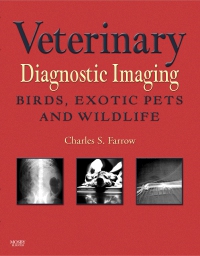
With a focus on birds, reptiles, and mammals, Veterinary Diagnostic Imaging: Avian and Exotic Pets discusses veterinary diagnostic imaging and new technologies for multiple modalities to help you accurately diagnose and pinpoint common injuries and disease. Divided into three sections — Birds, Mammals, and Reptiles — each section includes valuable information on positioning for specific structures, imaging findings, and more for each species with a wealth of photographs to provide real-life examples.
-
- Atlas-sized radiographs allow you to easily visualize the injury or indication of disease.
- Comparison radiographs display a normal image with an abnormal image to highlight differences and help you identify abnormalities in practice.
- “Telescopic images provide close-up views of larger radiographs to help you identify salient points visible in the radiograph.
- Content tailored to each species highlights the common injuries and diseases for each avian and exotic species.
- Discussions of multiple modalities including ultrasound, MRI, and CT provide all the information you need for diagnostic imaging in one resource.
-
Section I: Birds
1. Avian Radiography and Radiographic Diagnosis
2. Wild Birds
3. Cage Birds
4. The Wing: Particulars of Flight
5. The Wing: Normal Gross Anatomy
6. The Wing: Radiography and Normal Radiographic Anatomy
7. The Wing: Normal Computed Tomographic Anatomy
8. The Wing: An Overview of Wing Injuries
9. The Wing: Fracture Types and Tendencies
10. The Wing: Fracture Healing and Non-Healing
11. The Wing: Soft Tissue Injuries
12. The Wing: Dislocation, Fracture-Dislocation, Traumatic Amputation and Avulsion
13. The Wing: Gunshots
14. The Wing: Infections
15. The Wing: Post-Traumatic Osteoarthritis
16. Spine, Pelvis and Hips
17. The Leg
18. The Head
19. The Throat and Neck
20. The Torso
Section II: The Mammals
21. Guinea Pigs
22. Hamsters
23. Rats
24. Chinchillas, Dagus and Gophers
25. Hedgehogs
26. Rabbits
27. Ferrets
28. Skunks, Squirrels, Raccoons and Armadillos
29. Monkeys and Other Non-Human Primates
30. Acreage Pets: Alpacas, Llamas, Miniature Horses, Miniature Goats and Pot-Bellied Pigs
31. Performance and Demonstration Pets: Bear and Bison
Section III: The Reptiles
32. Snakes
33. Lizards
34. Turtles
35. Caiman -
-
Ways of Reading
- The appearance of the text and page layout can be modified according to the capabilities of the reading system (font family and font size, spaces between paragraphs, sentences, words, and letters, as well as color of background and text)
- This e-publication is accessible to the full extent that the file format and types of content allow, on a specific reading device, by default, without necessarily including any additions such as textual descriptions of images or enhanced navigation
- All content can be read as read aloud speech or dynamic braille
-
Conformance
- For detailed accessibility information, see Elsevier's website at https://www.elsevier.com/about/accessibility
- For queries regarding accessibility information, contact [email protected]
- The publication was certified on 07-04-2026
-
Navigation
- Table of contents to all chapters of the text via links
- Page list to go to pages from the print source version
-
Rich Content
- No information is available
-
Hazards
- No information is available
-
Product Content
- No information is available
-
Legal Considerations
- Elsevier is committed to making our eBooks accessible and complying with applicable laws. Given our vast library of titles, there are some cases where making an eBook fully accessible presents unique challenges, and including full features could transform its nature to no longer serve its primary purpose or result in a disproportionate burden for the publisher. As a result this eBook may have limited accessibility. See more at https://www.elsevier.com/en-gb/about/accessibility.
- Please refer to our disproportionate burden or fundamental modification statements.
-
Additional Accessibility Information
- Page breaks included from the original print source
- E-publication includes basic navigation (usually less detailed than TOC-based navigation)
- All (or substantially all) textual matter is arranged in a single logical reading order (including text that is visually presented as separate from the main text flow, e.g., in boxouts, captions, tables, footnotes, endnotes, citations, etc.). Non-textual content is also linked from within this logical reading order. (Purely decorative non-text content can be ignored).
- The language of the text has been specified (e.g., via the HTML or XML lang attribute) to optimise text-to-speech (and other alternative renderings), both at the whole document level and, where appropriate, for individual words, phrases or passages in a different language.
-
Ways of Reading
Was
$116.99
Now $111.14
Or $0.00 with a valid access code

 as described in our