
Chair Massage - Elsevier eBook on VitalSource, 1st Edition
Elsevier eBook on VitalSource
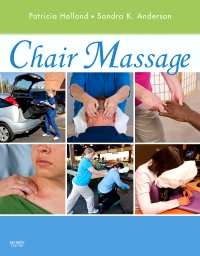
Expand your practice and attract new clients with chair massage! A practical, visual guide to this rapidly growing field, Chair Massage helps students develop a basic routine and adapt to different clients and situations. Expert authors Patricia M. Holland, MC, LMT, and Sandra K. Anderson, BA, LMT, NCTMB, provide coverage of massage techniques, chair adjustment, body mechanics, and applying pressure, plus specific routines for the lower back, shoulders, neck/head, and arm/hand regions -- with full-color photographs clearly demonstrating each technique. A chapter on the business aspects of seated massage helps your students market and manage their practices successfully.
-
- Full-color photographs and drawings clearly depict each technique.
- An Essentials of Practice chapter helps your students translate their knowledge into revenue by addressing crucial topics such as determining target markets, job-related conditions, marketing methods, introductory letters, setting fees, drawing up contracts, and getting paid, and includes practical advice from practitioners who offer chair massage.
- Unique! Coverage of low back techniques includes specific techniques for treating low back pain, its causes, when to perform massage, and when it is contraindicated.
- Unique! A chapter on additional techniques and adaptations covers body regions such as the iliotibial band, gastrocnemius, pectorals, anterior neck muscles, and serratus anterior, plus situations such as clients in wheelchairs.
- Unique! A segment on closing the session describes positive ways to finalize a chair massage session, including use of percussion as a finishing technique, closing stretches, a post-treatment discussion, and helping the client off the chair.
- A Communications and Ethics chapter addresses important topics such as the ethical presentation of self, boundaries, communicating with clients about feedback, pre- and post-treatment interviews, and intake forms.
- A review of anatomy and kinesiology covers the specific information that your students need to know in order make treatment decisions and perform routines.
- Coverage of traditional Chinese medicine points and channels gives your students more techniques to use during chair massage practice.
- Sample dialogues provide examples of effective communication with clients during their sessions.
-
-
 Chair MassagePaperback
-
-
Reviewers
Preface
1. What is Chair Massage?
2. Essentials of Practice
3. Basic Sequence
4. Enhancing Treatment Sessions
5. Additional Techniques and Adaptations
6. Essentials of Business
7. Communication and Ethics
Appendix A: Traditional Chinese Medicine Channel Review
Appendix B: Anatomy and Kinesiology Review
Answers to Study Questions
References
Resources
Index
-
-
Ways of Reading
- The appearance of the text and page layout can be modified according to the capabilities of the reading system (font family and font size, spaces between paragraphs, sentences, words, and letters, as well as color of background and text)
- This e-publication is accessible to the full extent that the file format and types of content allow, on a specific reading device, by default, without necessarily including any additions such as textual descriptions of images or enhanced navigation
- All content can be read as read aloud speech or dynamic braille
-
Conformance
- For detailed accessibility information, see Elsevier's website at https://www.elsevier.com/about/accessibility
- For queries regarding accessibility information, contact [email protected]
- The publication was certified on 07-04-2026
-
Navigation
- Table of contents to all chapters of the text via links
- Page list to go to pages from the print source version
-
Rich Content
- No information is available
-
Hazards
- No information is available
-
Product Content
- No information is available
-
Legal Considerations
- Elsevier is committed to making our eBooks accessible and complying with applicable laws. Given our vast library of titles, there are some cases where making an eBook fully accessible presents unique challenges, and including full features could transform its nature to no longer serve its primary purpose or result in a disproportionate burden for the publisher. As a result this eBook may have limited accessibility. See more at https://www.elsevier.com/en-gb/about/accessibility.
- Please refer to our disproportionate burden or fundamental modification statements.
-
Additional Accessibility Information
- Page breaks included from the original print source
- E-publication includes basic navigation (usually less detailed than TOC-based navigation)
- All (or substantially all) textual matter is arranged in a single logical reading order (including text that is visually presented as separate from the main text flow, e.g., in boxouts, captions, tables, footnotes, endnotes, citations, etc.). Non-textual content is also linked from within this logical reading order. (Purely decorative non-text content can be ignored).
- The language of the text has been specified (e.g., via the HTML or XML lang attribute) to optimise text-to-speech (and other alternative renderings), both at the whole document level and, where appropriate, for individual words, phrases or passages in a different language.
-
Ways of Reading

 as described in our