ISBN:
9780323167772
Copyright:
2006
Publication Date:
12-20-2005
Page Count:
668
Imprint:
Mosby
List Price:
$78.99

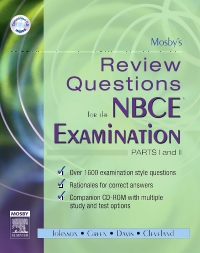
Mosby's Review Questions for the NBCE Examination: Parts I and II - Elsevier eBook on VitalSource, 1st Edition
by Mosby
Elsevier eBook on VitalSource
ISBN:
9780323167772
Copyright:
2006
Publication Date:
12-20-2005
Page Count:
668
Imprint:
Mosby
List Price:
$78.99
Most review copies are eBooks – how fast!
A review copy request is most likely to be fulfilled as an eBook on VitalSource rather than a print product, unless no eBook is available. eBooks become available in as little as a few hours. Print products will take between 7 and 10 days to arrive. To request a print copy, please contact us through the Evolve Support Center for further assistance or contact your Elsevier Sales Rep.
-
- Approximately 1,000 multiple-choice questions with explanatory answers are organized and formatted according to the national boards.
- Updated references in each section refer readers to supplemental resources, making it easier to investigate specific topics.
- CD-ROM with automatically scored quizzes enables students to practice and see their scores at the end of each test.
- Illustrations visually reinforce difficult topics and aid understanding.
- Tables, boxes, and other quick reference tools summarize the content at a glance.
- Approximately 500 additional questions are provided on CD-ROM with answers, and rationales.
-
Section I: General Anatomy
1. Topographical Anatomy
2. Osteology of the Appendicular Skeleton
3. Arthrology and Syndesmology of the Appendicular Skeleton
4. Myology of the Appendicular Skeleton
5. Cardiovascular and Lymphatic Systems
6. Digestive System
7. Respiratory System
8. Urogenital System
9. Endocrine System
Section II: Spinal Anatomy
10. Osetology of the Axial Skeleton
11. Myology of the Axial Skeleton
12. Arthrology and Syndesmology of the Axial Skeleton
13. Anatomy of the Central Nervous System and Related Structures
14. Anatomy of the Peripheral and Autonomic Nervous Systems
15. Organs of Special Senses
Section III: Physiology
16. Neurophysiology
17. Muscle Physiology
18. Cardiovascular Physiology
19. Respiratory Physiology
20. Body Fluids and Renal Physiology
21. Gastrointestinal Physiology
22. Reproductive Physiology
23. Endocrine Physiology
24. Exercise and Stress Physiology
Section IV: Chemistry
25. Carbohydrates
26. Lipids
27. Proteins, Amino Acids and Peptides
28. Enzymes
29. Hormones
30. Nucleotides and Nucleic Acids
31. Vitamins and Minerals
32. Biochemical Energetics
Section V: Pathology
33. Fundamentals of Pathology
34. Genetic and Congenital Disorders
35. Disorders of the Immune System
36. Environmental and Nutritional Diseases
37. Disorders of the Musculoskeletal System
38. Disorders of the Nervous System
39. Diseases of the Organ Systems
Section VI: Microbiology and Public Health
40. Principles of Microbiology
41. Communicable and Infectious Diseases
42. Epidemiology and Disease Management
43. Environmental Health
44. Immunology
Section VII: General Diagnosis
45. Case History
46. Inspection
47. Vital Signs
48. Head and Neck Examination
49. Thorax Examination
50. Abdominal Examination
51. Rectal and Urogenital Examination
52. Clinical Diagnosis
53. Laboratory Interpretation
Section VIII: Neuromuscoskeletal Diagnosis
54. Case History
55. Posture and Gait Assessment
56. Orthopedic Examination
57. Neuorlogic Examination
58. Clinical Diagnosis
Section IX: Diagnostic Imaging
59. X-Ray Technology
60. Radiographic Positioning and Normal Anatomy
61. X-Ray Diagnosis
62. Methods of Interpretation
63. Specialized Imaging Procedures
Section X: Principles of Chiropractic
64. Evolution of Chiropractic Principles
65. Concepts of Subluxation and Spinal Lesions
66. Basic Science Concepts in Chiropractic
67. Applied Chiropractic Principles
Section XI: Chiropractic Practice
68. Spinal Analysis and Evaluation
69. Chiropractic Adjustive Technique
70. Case Management and Patient Education
Section XII: Associated Clinical Sciences
71. Gynecology and Obstetrics
72. Geriatrics
73. Psychology
74. Dermatology
75. Sexually Transmitted Diseases
76. Toxicology
77. Pediatrics
78. Emergency Procedures
79. Jurisprudence, Ethics, and Basic Economics -
-
Ways of Reading
- The appearance of the text and page layout can be modified according to the capabilities of the reading system (font family and font size, spaces between paragraphs, sentences, words, and letters, as well as color of background and text)
- This e-publication is accessible to the full extent that the file format and types of content allow, on a specific reading device, by default, without necessarily including any additions such as textual descriptions of images or enhanced navigation
- All content can be read as read aloud speech or dynamic braille
-
Conformance
- For detailed accessibility information, see Elsevier's website at https://www.elsevier.com/about/accessibility
- For queries regarding accessibility information, contact [email protected]
- The publication was certified on 07-04-2026
-
Navigation
- Table of contents to all chapters of the text via links
- Page list to go to pages from the print source version
-
Rich Content
- No information is available
-
Hazards
- No information is available
-
Product Content
- No information is available
-
Legal Considerations
- Elsevier is committed to making our eBooks accessible and complying with applicable laws. Given our vast library of titles, there are some cases where making an eBook fully accessible presents unique challenges, and including full features could transform its nature to no longer serve its primary purpose or result in a disproportionate burden for the publisher. As a result this eBook may have limited accessibility. See more at https://www.elsevier.com/en-gb/about/accessibility.
- Please refer to our disproportionate burden or fundamental modification statements.
-
Additional Accessibility Information
- Page breaks included from the original print source
- E-publication includes basic navigation (usually less detailed than TOC-based navigation)
- All (or substantially all) textual matter is arranged in a single logical reading order (including text that is visually presented as separate from the main text flow, e.g., in boxouts, captions, tables, footnotes, endnotes, citations, etc.). Non-textual content is also linked from within this logical reading order. (Purely decorative non-text content can be ignored).
- The language of the text has been specified (e.g., via the HTML or XML lang attribute) to optimise text-to-speech (and other alternative renderings), both at the whole document level and, where appropriate, for individual words, phrases or passages in a different language.
-
Ways of Reading
Most review copies are eBooks – how fast!
A review copy request is most likely to be fulfilled as an eBook on VitalSource rather than a print product, unless no eBook is available. eBooks become available in as little as a few hours. Print products will take between 7 and 10 days to arrive. To request a print copy, please contact us through the Evolve Support Center for further assistance or contact your Elsevier Sales Rep.

 as described in our