ISBN:
9780323167802
Copyright:
2006
Publication Date:
09-23-2005
Page Count:
360
Imprint:
Mosby
List Price:
$58.99

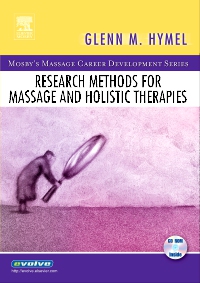
Research Methods for Massage and Holistic Therapies - Elsevier eBook on VitalSource, 1st Edition
by Glenn Hymel, EdD, LMT
Elsevier eBook on VitalSource
ISBN:
9780323167802
Copyright:
2006
Publication Date:
09-23-2005
Page Count:
360
Imprint:
Mosby
List Price:
$58.99
Most review copies are eBooks – how fast!
A review copy request is most likely to be fulfilled as an eBook on VitalSource rather than a print product, unless no eBook is available. eBooks become available in as little as a few hours. Print products will take between 7 and 10 days to arrive. To request a print copy, please contact us through the Evolve Support Center for further assistance or contact your Elsevier Sales Rep.
-
- Accommodates the March 2003 mandate from the Commission on Massage Therapy Accreditation (COMTA) that massage therapy schools incorporate into their curricula provisions to ensure a research literate profession.
- Examples and techniques for interpreting research guide practitioners and students to be knowledgeable readers of massage therapy research, allowing application to practice.
- Relies heavily on concept maps, flowcharts, tables, and illustrations and excerpts of published studies to augment the book's narrative development of topics by providing pictorial displays and summaries of the material.
- Literature-based and hypothetical research examples/illustrations from several manual therapy professions employing therapeutic massage make the material pertinent to real-life settings
- An introductory section at the beginning of each chapter reviews the material covered in the previous chapter and how it relates to the new material.
- Chapter coverage spans the quantitative, qualitative, and integrative research categories and affiliated research strategies and methods are considered in detail.
- Review/summary tables give an overview of the narrative development of topics.
- Boxes provide the essential features of a given topic.
- Relies on multiple examples of possible research scenarios and illustrative excerpts from the published research literature.
- Content is cross-referenced for use with the Massage Therapy Foundation's Massage Therapy Research Curriculum Kit to provide both instructors and students in the 6-, 15-, and 24-hour options/levels an extensively-developed resource in one place.
- Each chapter includes recommended web sites and software application packages for further information.
-
Part I – A Conceptual Framework for Understanding the Research Process
1. Why Research and Why Now?
2. Deductive Approach To Viewing the Research Process
3. An Overview of the True Experimental/Randomized Controlled Trial Research Method
4. A More Focused View of the True Experimental/Randomized Controlled Trial (RCT) Research Method: Concepts, Principles, & Procedures
Part II – The Quantitative Research Category
5. The Difference-Oriented Research Strategy
6. The Association-Oriented Research Strategy
7. The Descriptive-Oriented Research Strategy
Part III – Qualitative & Integrative Research Categories: Options Beyond the Quantitative
8. The Qualitative Research Category & Its Contextual/Interpretive Research Strategy
9. The Integrative Research Category & Its Synthesis-Oriented Research Strategy
Part IV – Advancing the Massage Therapy Research Agenda
10. Advancing Massage Therapy Research Competencies: Recent Contexts & Projected Directions
Appendices: Essential "Tools" for the Research Process
A. Electronic Literature Searching: Sources & Strategies
B. Ethical Principles Governing Research in the Biomedical & Behavioral Sciences
C. Research Report Format & Stylistic Requirements
D. Measurement & Statistics as Research Tools
Glossary
Index -
-
Ways of Reading
- The appearance of the text and page layout can be modified according to the capabilities of the reading system (font family and font size, spaces between paragraphs, sentences, words, and letters, as well as color of background and text)
- This e-publication is accessible to the full extent that the file format and types of content allow, on a specific reading device, by default, without necessarily including any additions such as textual descriptions of images or enhanced navigation
- All content can be read as read aloud speech or dynamic braille
-
Conformance
- For detailed accessibility information, see Elsevier's website at https://www.elsevier.com/about/accessibility
- For queries regarding accessibility information, contact [email protected]
- The publication was certified on 07-04-2026
-
Navigation
- Table of contents to all chapters of the text via links
- Page list to go to pages from the print source version
-
Rich Content
- No information is available
-
Hazards
- No information is available
-
Product Content
- No information is available
-
Legal Considerations
- Elsevier is committed to making our eBooks accessible and complying with applicable laws. Given our vast library of titles, there are some cases where making an eBook fully accessible presents unique challenges, and including full features could transform its nature to no longer serve its primary purpose or result in a disproportionate burden for the publisher. As a result this eBook may have limited accessibility. See more at https://www.elsevier.com/en-gb/about/accessibility.
- Please refer to our disproportionate burden or fundamental modification statements.
-
Additional Accessibility Information
- Page breaks included from the original print source
- E-publication includes basic navigation (usually less detailed than TOC-based navigation)
- All (or substantially all) textual matter is arranged in a single logical reading order (including text that is visually presented as separate from the main text flow, e.g., in boxouts, captions, tables, footnotes, endnotes, citations, etc.). Non-textual content is also linked from within this logical reading order. (Purely decorative non-text content can be ignored).
- The language of the text has been specified (e.g., via the HTML or XML lang attribute) to optimise text-to-speech (and other alternative renderings), both at the whole document level and, where appropriate, for individual words, phrases or passages in a different language.
-
Ways of Reading

Most review copies are eBooks – how fast!
A review copy request is most likely to be fulfilled as an eBook on VitalSource rather than a print product, unless no eBook is available. eBooks become available in as little as a few hours. Print products will take between 7 and 10 days to arrive. To request a print copy, please contact us through the Evolve Support Center for further assistance or contact your Elsevier Sales Rep.

 as described in our