ISBN:
9780323167819
Copyright:
2007
Publication Date:
07-31-2006
Page Count:
648
Imprint:
Mosby
List Price:
$178.99

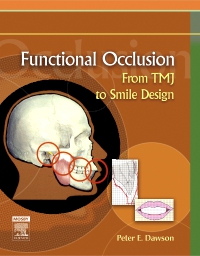
Functional Occlusion - Elsevier eBook on VitalSource, 1st Edition
by Peter E. Dawson, DDS
Elsevier eBook on VitalSource
ISBN:
9780323167819
Copyright:
2007
Publication Date:
07-31-2006
Page Count:
648
Imprint:
Mosby
List Price:
$178.99
Most review copies are eBooks – how fast!
A review copy request is most likely to be fulfilled as an eBook on VitalSource rather than a print product, unless no eBook is available. eBooks become available in as little as a few hours. Print products will take between 7 and 10 days to arrive. To request a print copy, please contact us through the Evolve Support Center for further assistance or contact your Elsevier Sales Rep.
-
OUTSTANDING FEATURES
- Special atlas sections break down complex information accompanied by descriptive diagrams and photographs to further explain sources of occlusal disorders and related pain.
- Hundreds of full-color photographs and illustrations show problems and procedures.
- Procedure boxes offer step-by-step explanations of specific procedures.
- Important Considerations boxes in the Treatment chapters outline treatment plans and describe what is to be accomplished.
- Programmed treatment planning, a specific process that guides a clinician through every step for solving even the most complex restorative or esthetic challenge.
- The role of TMJs and occlusion in "everyday" dentistry.
- The role of occlusion in orofacial pain and TMD, and in anterior esthetics.
- Simplified occlusal equilibration and how to explain this process to patients.
- The functional matrix concept for exceptional, foolproof smile design.
- The five options for occlusal correction and how to apply them to practice.
- Use and abuse of occlusal sprints.
- Coordinating occlusal treatment with specialists for a fully interdisciplinary approach.
- Specific criteria for success and how to test for each.
-
-
 Functional OcclusionHardcover
-
-
1. The Concept of Complete Dentistry
2. Perspectives on Occlusion and “Everyday Dentistry
3. Occlusal Disease
4. The Determinants of Occlusion
5. The Temporomandibular Joint
6. The Masticatory Musculature
7. Centric Relation
8. Adapted Centric Posture
9. Determining Centric Relation
10. Load Testing for Verification of Centric Relation
11. Recording centric relation
12. Classification of Occlusions
13. Vertical Dimension
14. The Neutral Zone
15. The Envelope of Function
16. Functional Smile Design
17. Anterior Guidance and Its Relationship to Smile Design
18. Restoring Lower Anterior Teeth
19. Long Centric
20. The Plane of Occlusion
21. Posterior Occlusion
22. Simplifying Instrumentation for Occlusal Analysis and Treatment
23. Differential Diagnosis of Temporomandibular Disorders
24. Occluso-Muscle Disorders
25. Intracapsular Disorders of the TMJ
26. Classification of Intracapsular Disorders
27. Imaging the TMJs
28. Bruxism
29. Requirements for Occlusal Stability
30. Solving Occlusal Problems through Programmed Treatment Planning
31. The Diagnostic Wax-Up
32. Occlusal Splints
33. Occlusal Equilibration
34. Neuromuscular Dentistry: Bioelectronic instrumentation
35. Solving Occlusal Wear Problems
36. Solving Deep Overbite Problems
37. Solving Anterior Overjet Problems
38. Solving Anterior Open Bite Problems
39. Treating End-to-End Occlusions
40. Treating Splayed or Separated Anterior Teeth
41. Treating the Cross Bite Patient
42. Treating Crowded, Irregular or Interlocking Anterior Teeth
43. Solving Severe Arch Malrelationship Problems
44. Using Cephalometrics for Occlusal Analysis
45. Post Operative Care of Occlusal Therapy Patients
46. The Technological Future of Occlusal Restoration
47. Criteria for Success of Occlusal Treatment -
-
Ways of Reading
- The appearance of the text and page layout can be modified according to the capabilities of the reading system (font family and font size, spaces between paragraphs, sentences, words, and letters, as well as color of background and text)
- This e-publication is accessible to the full extent that the file format and types of content allow, on a specific reading device, by default, without necessarily including any additions such as textual descriptions of images or enhanced navigation
- All content can be read as read aloud speech or dynamic braille
-
Conformance
- For detailed accessibility information, see Elsevier's website at https://www.elsevier.com/about/accessibility
- For queries regarding accessibility information, contact [email protected]
- The publication was certified on 07-04-2026
-
Navigation
- Table of contents to all chapters of the text via links
- Page list to go to pages from the print source version
-
Rich Content
- No information is available
-
Hazards
- No information is available
-
Product Content
- No information is available
-
Legal Considerations
- Elsevier is committed to making our eBooks accessible and complying with applicable laws. Given our vast library of titles, there are some cases where making an eBook fully accessible presents unique challenges, and including full features could transform its nature to no longer serve its primary purpose or result in a disproportionate burden for the publisher. As a result this eBook may have limited accessibility. See more at https://www.elsevier.com/en-gb/about/accessibility.
- Please refer to our disproportionate burden or fundamental modification statements.
-
Additional Accessibility Information
- Page breaks included from the original print source
- E-publication includes basic navigation (usually less detailed than TOC-based navigation)
- All (or substantially all) textual matter is arranged in a single logical reading order (including text that is visually presented as separate from the main text flow, e.g., in boxouts, captions, tables, footnotes, endnotes, citations, etc.). Non-textual content is also linked from within this logical reading order. (Purely decorative non-text content can be ignored).
- The language of the text has been specified (e.g., via the HTML or XML lang attribute) to optimise text-to-speech (and other alternative renderings), both at the whole document level and, where appropriate, for individual words, phrases or passages in a different language.
-
Ways of Reading
Most review copies are eBooks – how fast!
A review copy request is most likely to be fulfilled as an eBook on VitalSource rather than a print product, unless no eBook is available. eBooks become available in as little as a few hours. Print products will take between 7 and 10 days to arrive. To request a print copy, please contact us through the Evolve Support Center for further assistance or contact your Elsevier Sales Rep.

 as described in our