ISBN:
9780323167857
Copyright:
2008
Publication Date:
10-26-2007
Page Count:
312
Imprint:
Mosby
List Price:
$68.99

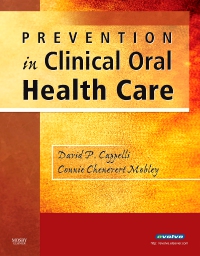
Prevention in Clinical Oral Health Care - Elsevier eBook on VitalSource, 1st Edition
by David P. Cappelli, DMD, MPH, PhD and Connie Chenevert Mobley, PhD, RD
Elsevier eBook on VitalSource
ISBN:
9780323167857
Copyright:
2008
Publication Date:
10-26-2007
Page Count:
312
Imprint:
Mosby
List Price:
$68.99
Most review copies are eBooks – how fast!
A review copy request is most likely to be fulfilled as an eBook on VitalSource rather than a print product, unless no eBook is available. eBooks become available in as little as a few hours. Print products will take between 7 and 10 days to arrive. To request a print copy, please contact us through the Evolve Support Center for further assistance or contact your Elsevier Sales Rep.
A valuable tool for all health care professionals, your students can use this resource to integrate oral health prevention as a component of their overall preventive message to the patient. This book focuses on oral health promotion and the impact of systemic disease in the development of oral disease, as well as how to introduce, apply, and communicate prevention to a patient with a defined risk profile.
-
- Discusses risk-based approaches to prevent problems such as caries, periodontal disease, and oral cancer.
- Topics are written at a level that can be understood by both practicing dental health team members and by dental hygiene and dental students so strategies can be applied to better understand the patient's risk for oral disease and how to prevent future disease.
- Identifies the barriers, oral health care needs, and preventive strategies for special populations such as children, the elderly, and the physically or mentally disabled.
- Explores the development of a culturally sensitive dental practice and strategies to make the dental environment more welcoming to individuals with different cultural backgrounds.
- Discusses how to gather patient information, the synthesis of the patient's data, and the application of the information collected in order to evaluate the patient's risk for disease.
-
-
 Prevention in Clinical Oral Health CarePaperback
-
-
PART ONE: EPIDEMIOLOGY AND PREVENTION THEORY
1. Epidemiology/Biology of Dental Caries
2. Epidemiology/Biology of Periodontal Diseases
3. Epidemiology/Biology of Oral Cancer
PART TWO: RISK-BASED PREVENTION
4. Dental Caries and Associated Risk Factors
5. Periodontal Disease and Associated Risk Factors
6. Oral Cancer and Associated Risk Factors
7. Synergism between Pharmacology and Oral Health
PART THREE: ASSESSMENT STRATEGIES TO TAILOR YOUR PATIENT CARE PLAN
8. Nutritional Risk Assessment
9. Laboratory Testing
10. Integrating Risk and Health Promotion Counseling
11. Enhancing Patient Adherence to Preventive Programs
12. The Fearful and Phobic Patient
13. Cultural Competence and Risk Assessment
PART FOUR: PREVENTION AND PRACTICE
14. Disease Prevention/Health Promotion
15. Prevention Strategies for Dental Caries
16. Prevention Strategies for Periodontal Diseases
17. Prevention Strategies for Oral Cancer
18. Prevention Strategies for Oral Components of Systemic Conditions
19. Prevention Strategies for Special Populations
20. Integrating Preventive Strategies into Clinical Practice -
-
Ways of Reading
- The appearance of the text and page layout can be modified according to the capabilities of the reading system (font family and font size, spaces between paragraphs, sentences, words, and letters, as well as color of background and text)
- This e-publication is accessible to the full extent that the file format and types of content allow, on a specific reading device, by default, without necessarily including any additions such as textual descriptions of images or enhanced navigation
- All content can be read as read aloud speech or dynamic braille
-
Conformance
- For detailed accessibility information, see Elsevier's website at https://www.elsevier.com/about/accessibility
- For queries regarding accessibility information, contact [email protected]
- The publication was certified on 10-07-2025
-
Navigation
- Table of contents to all chapters of the text via links
- Page list to go to pages from the print source version
-
Rich Content
- No information is available
-
Hazards
- No information is available
-
Product Content
- No information is available
-
Legal Considerations
- Elsevier is committed to making our eBooks accessible and complying with applicable laws. Given our vast library of titles, there are some cases where making an eBook fully accessible presents unique challenges, and including full features could transform its nature to no longer serve its primary purpose or result in a disproportionate burden for the publisher. As a result this eBook may have limited accessibility. See more at https://www.elsevier.com/en-gb/about/accessibility.
- Please refer to our disproportionate burden or fundamental modification statements.
-
Additional Accessibility Information
- Page breaks included from the original print source
- E-publication includes basic navigation (usually less detailed than TOC-based navigation)
- All (or substantially all) textual matter is arranged in a single logical reading order (including text that is visually presented as separate from the main text flow, e.g., in boxouts, captions, tables, footnotes, endnotes, citations, etc.). Non-textual content is also linked from within this logical reading order. (Purely decorative non-text content can be ignored).
- The language of the text has been specified (e.g., via the HTML or XML lang attribute) to optimise text-to-speech (and other alternative renderings), both at the whole document level and, where appropriate, for individual words, phrases or passages in a different language.
-
Ways of Reading
Most review copies are eBooks – how fast!
A review copy request is most likely to be fulfilled as an eBook on VitalSource rather than a print product, unless no eBook is available. eBooks become available in as little as a few hours. Print products will take between 7 and 10 days to arrive. To request a print copy, please contact us through the Evolve Support Center for further assistance or contact your Elsevier Sales Rep.

 as described in our