ISBN:
9780323167871
Copyright:
2007
Publication Date:
05-16-2006
Page Count:
576
Imprint:
Mosby
List Price:
$53.99

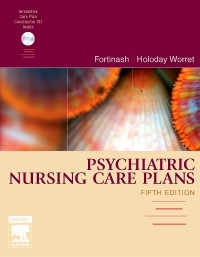
Psychiatric Nursing Care Plans - Elsevier eBook on VitalSource, 5th Edition
by Katherine M. Fortinash, MSN, APRN, BC, PMHCNS and Patricia A. Holoday Worret, MSN, APRN, BC, PMHCNS
Elsevier eBook on VitalSource
ISBN:
9780323167871
Copyright:
2007
Publication Date:
05-16-2006
Page Count:
576
Imprint:
Mosby
List Price:
$53.99
Most review copies are eBooks – how fast!
A review copy request is most likely to be fulfilled as an eBook on VitalSource rather than a print product, unless no eBook is available. eBooks become available in as little as a few hours. Print products will take between 7 and 10 days to arrive. To request a print copy, please contact us through the Evolve Support Center for further assistance or contact your Elsevier Sales Rep.
-
- New care plans, many that focus on the family, join completely updated and revised care plans to make this text the most comprehensive psychiatric nursing care planning text available.
- Dynamic internal design emphasizes the care plans as the focus of the text; tabbed pages noting the relevant disorder and a complete list of care plans with page number references make finding a specific care plan easier than ever before.
- Appropriate Nursing Interventions Classification (NIC) and Nursing Outcomes Classification (NOC) labels are presented with each care plan in order that students become familiar with these emerging classifications and practicing nurses can easily identify them for use in their care setting if applicable.
- A comprehensive pharmacotherapy appendix includes the most recent psychotropic drug information and appropriate related client care.
- Online Resources for the nurse, client, and family conclude each chapter.
-
- The first chapter, The Nursing Process, effectively describes the central principles of psychiatric nursing practice in detailing the ANA's six-step nursing process along with additional information on therapeutic nurse-client communication skills, client history and assessment tools, NIC and NOC, and more.
- The six-step nursing process format is maintained throughout to emphasize a practice-oriented, problem-solving approach to psychiatric care.
- Major psychiatric disorders are reviewed consistently and completely with sections including Etiology, Epidemiology, Assessment and Diagnostic Criteria, Interventions, and Prognosis and Discharge Criteria. With this basis of knowledge, relevant care plans are offered in the second section of each chapter.
- Care plans based on DSM-IV-TR medical and NANDA nursing diagnoses are logically and consistently organized with Assessment Data, Outcome Criteria, Planning and Implementation, and Evaluation sections.
- Assessment Data sections include detailed related factors (etiology) and defining characteristics or risk factors as appropriate for the specific diagnosis.
- Outcome Criteria sections give the reader clear indications of the desired end state.
- Planning and Implementation sections list specific, relevant, and practical nursing interventions with rationales in a clear, comprehensible two-column format. UNIQUE! Therapeutic and non-therapeutic dialogue examples are presented throughout to promote more effective client communication.
- Evaluation sections state the role of outcome evaluation as a critical and ongoing step in the nursing process.
- Client and Family Teaching boxes include Nurse Needs to Know and Teach Client and Family sections covering all aspects of post-treatment instructions for clients and caregivers.
- DSM-IV-TR boxes list all related DSM-IV-TR diagnoses for quick reference.
- Helpful appendices contain information and strategies that are timely and useful in the care of clients with mental and emotional disorders including such topics as psychiatric and psychosocial therapies, grief and loss, spirituality, and many more.
-
1. The Nursing Process
2. Anxiety and Related Disorders New Care Plan!
3. Mood Disorders 2 New Care Plans!
4. Schizophrenia and Other Psychotic Disorders
2 New Care Plans!
5. Adjustment Disorders New Care Plan!
6. Personality Disorders New Care Plan!
7. Disorders of Infancy, Childhood, and Adolescence 2 New Care Plans!
8. Cognitive Disorders: Delirium, Dementia, and Amnestic
9. Substance-Related Disorders
10. Eating Disorders New Care Plan!
11. Sexual and Gender Identity Disorders New Care Plan!
Appendixes
A. Suicide Assessment and Intervention Guidelines
B. Crisis and Crisis Intervention
C. Client Rights
D. Guidelines for Seclusion and Restraint Based on JCAHO Standard
E. Grief and Loss: Caregivers, Clients, and Families
F. Spirituality as a Dimension of the Person New Care Plan!
G. Psychiatric and Psychosocial Therapies
H. Psychopharmacology
I. Comparison of Developmental Theories
J. Defense Mechanisms and Strategies
K. Standards of Care for Psychiatric – Mental Health Nursing Practice
L. DSM-IV-TR Classification
Glossary
References -
-
Ways of Reading
- The appearance of the text and page layout can be modified according to the capabilities of the reading system (font family and font size, spaces between paragraphs, sentences, words, and letters, as well as color of background and text)
- This e-publication is accessible to the full extent that the file format and types of content allow, on a specific reading device, by default, without necessarily including any additions such as textual descriptions of images or enhanced navigation
- All content can be read as read aloud speech or dynamic braille
-
Conformance
- For detailed accessibility information, see Elsevier's website at https://www.elsevier.com/about/accessibility
- For queries regarding accessibility information, contact [email protected]
- The publication was certified on 07-04-2026
-
Navigation
- Table of contents to all chapters of the text via links
- Page list to go to pages from the print source version
-
Rich Content
- No information is available
-
Hazards
- No information is available
-
Product Content
- No information is available
-
Legal Considerations
- Elsevier is committed to making our eBooks accessible and complying with applicable laws. Given our vast library of titles, there are some cases where making an eBook fully accessible presents unique challenges, and including full features could transform its nature to no longer serve its primary purpose or result in a disproportionate burden for the publisher. As a result this eBook may have limited accessibility. See more at https://www.elsevier.com/en-gb/about/accessibility.
- Please refer to our disproportionate burden or fundamental modification statements.
-
Additional Accessibility Information
- Page breaks included from the original print source
- E-publication includes basic navigation (usually less detailed than TOC-based navigation)
- All (or substantially all) textual matter is arranged in a single logical reading order (including text that is visually presented as separate from the main text flow, e.g., in boxouts, captions, tables, footnotes, endnotes, citations, etc.). Non-textual content is also linked from within this logical reading order. (Purely decorative non-text content can be ignored).
- The language of the text has been specified (e.g., via the HTML or XML lang attribute) to optimise text-to-speech (and other alternative renderings), both at the whole document level and, where appropriate, for individual words, phrases or passages in a different language.
-
Ways of Reading
Most review copies are eBooks – how fast!
A review copy request is most likely to be fulfilled as an eBook on VitalSource rather than a print product, unless no eBook is available. eBooks become available in as little as a few hours. Print products will take between 7 and 10 days to arrive. To request a print copy, please contact us through the Evolve Support Center for further assistance or contact your Elsevier Sales Rep.

 as described in our