ISBN:
9780323168007
Copyright:
2010
Publication Date:
12-02-2009
Page Count:
544
Imprint:
Mosby
List Price:
$243.99

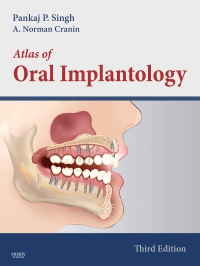
Atlas of Oral Implantology - Elsevier eBook on VitalSource, 3rd Edition
by Pankaj Singh, DDS, Diplomate ICOI, Diplomate ABOI, Fellow AAID and A. Norman Cranin, DDS, D. Eng, FAAID, FADSA, FICD, FAAHD, FADM, FACD, FBSE
Elsevier eBook on VitalSource
ISBN:
9780323168007
Copyright:
2010
Publication Date:
12-02-2009
Page Count:
544
Imprint:
Mosby
List Price:
$243.99
Was
$243.99
Now $231.79
Or $0.00 with a valid access code
Use this expert guide to enhance your skills in implant surgery! With more than 1,500 illustrations, Atlas of Oral Implantology, 3rd Edition covers key topics including diagnosis and planning, basic implant surgery, advanced implant surgery, implant prosthodontics, and implant management. You will learn how to select patients who are best suited for dental implants, evaluate host sites, select the proper type of implant for each patient, and place dental implants step-by-step. You’ll also learn to observe patients, diagnose incipient problems, institute remedial techniques for problems, and perform a wide variety of restorative modalities.
-
- Updates coverage with current technology, the latest surgical techniques, and today’s implant designs.
- Emphasizes hot topics such as implant esthetics, immediate loading implants, and site development of both hard and soft tissue augmentation.
-
- Explains techniques with easy-to-follow instructions.
- Demonstrates how to manage and maintain patients during the postoperative period.
- Includes long-term follow-up cases accurately showing “real life examples.
- Includes extensive appendices with information ranging from antibiotic prophylactic regimens to CAD-CAM computed tomography.
-
1. Introduction to the Atlas of Oral Implantology
2. Implant Types and Their Uses
3. Evaluation and Selection of the Implant Patient
4. How to Choose the Proper Implant
5. Prosthetic Options That Influence Implant Selections
6. Preparations for Implant Surgery
7. Soft Tissue Management and Grafting
8. Hard Tissue Surgery and Bone Grafting
9. Root Form Implant Surgery: Generic
10. Root Form Implant Surgery: Proprietary I
11. Root Form Implant Surgery: Proprietary II
12. Blade and Plate-Form Implant Surgery
13. Ramus Frame and Ramus Blade Implant Surgery
14. Mandibular Subperiosteal Implant Surgery
15. Maxillary Pterygohamular Subperiosteal Implant Surgery
16. Intramucosal Insert and Endodontic Stablilizers
17. Zygomatic Implant Surgery and Prosthodontics
18. All-on-4
19. Crête Mince, Mini-implant, Transitional, Temporary Anchorage Devices (TAD’s) and other Implant Surgical and Prosthodontic Procedures
20. Preliminary Prosthodontics: Fabricating a Template
21. Provisional Prostheses
22. Root Form Implant Prosthodontics: Abutments
23. Root Form Implant Prosthodontics: Single Tooth Implant Restorations
24 Implant Prosthodontics: Fixed and Fixed-Detachable Prosthesis Design and Fabrication
25. Implant Prosthodontics: Hybrid Bridge Fixed-Detachable Prosthesis Design and Fabrication
26. Implant Prosthodontics: Overdentures and Their Mesostructure Bars
27. Principles of Occlusion in Implantology
28. Diagnosis and Treatment of Complications
29. Maintenance and Hygiene
Glossary
Appendices
A. Past Medical and Dental History
B. Laboratory Values
C. CAD-CAM Computed Tomography
D. Stereolithographic Reproduction of Anatomic Structures Using C-T Scan or CBVT Scan
E. Treatment of Metals
F. Implant Surgery Consent Form
G. Postoperative Guidelines for the Surgeon
H. Postoperative Instructions for the Patient
I. Recommended Diet Following Implant Surgery
J. Implant Patient Follow-up Form
K. Equipment & Materials - Manufacturers and Suppliers
L. Distributors of Musculoskeletal Tissue
M. Antibiotic Prophylactic Regimens
N. Surgical Guide Generic and NobelGuide -
-
Ways of Reading
- The appearance of the text and page layout can be modified according to the capabilities of the reading system (font family and font size, spaces between paragraphs, sentences, words, and letters, as well as color of background and text)
- This e-publication is accessible to the full extent that the file format and types of content allow, on a specific reading device, by default, without necessarily including any additions such as textual descriptions of images or enhanced navigation
- All content can be read as read aloud speech or dynamic braille
-
Conformance
- For detailed accessibility information, see Elsevier's website at https://www.elsevier.com/about/accessibility
- For queries regarding accessibility information, contact [email protected]
- The publication was certified on 07-04-2026
-
Navigation
- Table of contents to all chapters of the text via links
- Page list to go to pages from the print source version
-
Rich Content
- No information is available
-
Hazards
- No information is available
-
Product Content
- No information is available
-
Legal Considerations
- Elsevier is committed to making our eBooks accessible and complying with applicable laws. Given our vast library of titles, there are some cases where making an eBook fully accessible presents unique challenges, and including full features could transform its nature to no longer serve its primary purpose or result in a disproportionate burden for the publisher. As a result this eBook may have limited accessibility. See more at https://www.elsevier.com/en-gb/about/accessibility.
- Please refer to our disproportionate burden or fundamental modification statements.
-
Additional Accessibility Information
- Page breaks included from the original print source
- E-publication includes basic navigation (usually less detailed than TOC-based navigation)
- All (or substantially all) textual matter is arranged in a single logical reading order (including text that is visually presented as separate from the main text flow, e.g., in boxouts, captions, tables, footnotes, endnotes, citations, etc.). Non-textual content is also linked from within this logical reading order. (Purely decorative non-text content can be ignored).
- The language of the text has been specified (e.g., via the HTML or XML lang attribute) to optimise text-to-speech (and other alternative renderings), both at the whole document level and, where appropriate, for individual words, phrases or passages in a different language.
-
Ways of Reading
Was
$243.99
Now $231.79
Or $0.00 with a valid access code

 as described in our