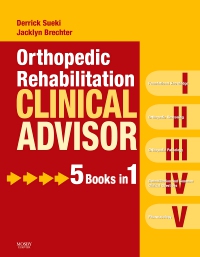

Orthopedic Rehabilitation Clinical Advisor - Elsevier eBook on VitalSource, 1st Edition
Elsevier eBook on VitalSource
Now $83.59
Access the information you need to confidently diagnose and treat musculoskeletal disorders at a glance! With a "5-books-in-1" approach, this essential clinical reference provides up-to-date diagnostic and therapeutic information on over 200 orthopedic conditions in a bulleted, quick-reference format ideal for both students and practitioners. Content is written entirely by orthopedic physical therapists and is logically organized to promote accurate, efficient differential diagnosis and intervention.
-
- '5-books-in-1' format combines essential content on foundational knowledge, clinical reasoning, orthopedic pathologies, common clinical questions, and pharmacology all in one place for fast, efficient reference.
- UNIQUE: Expert insight and decision-making strategies for the rehabilitation of musculoskeletal pathologies help you apply sound clinical reasoning to determine the needs of patients with musculoskeletal disorders.
- UNIQUE: Succinct, bulleted text organizes information consistently for easy access.
- Clinician-oriented profiles cover 200 orthopedic pathologies with considerations specific to your needs in orthopedic rehabilitation practice.
- 51 drug class monographs detail indications, dosages, contraindications and physical therapy implications to help you better understand drug interactions and more effectively manage patients.
-
SECTION I: Foundational Knowledge
1. Tissue Injury and Healing
2. Pain Mechanisms
3. Radiology
4. Biomechanics
SECTION II: Orthopedic Reasoning
1. Clinical Reasoning and Decision Making in Orthopedic Rehabilitation
2. Upper Cervical Spine
3. Cervical Spine
4. Thoracic Spine
5. Lumbar Spine
6. Sacroiliac Joint
7. Temporomandibular and Craniofacial Dysfunction
8. Shoulder
9. Elbow
10. Wrist and Hand 11. Hip and Thigh
12. Knee
13. Foot and Ankle
14. Pelvic Pain
15. Nerve
16. Chronic Pain
17. Red Flags and Non Musculoskeletal Pain
SECTION III: Orthopedic Pathology
1. Upper Cervical Spine
2. Cervical Spine
3. Thoracic Spine
4. Lumbar Spine
5. Sacroiliac Joint
6. Craniofascial and Temporomandibular Joint
7. Shoulder
8. Elbow
9. Hand and Wrist
10. Hip and Thigh
11. Knee
12. Ankle and Shin
13. Foot
14. Pediatric
15. Pelvic Pain and Women's Health
16. Nerve
17. Chronic Pain
SECTION IV: Rehabilitation and Common Clinical Questions
1. Cervical Spine
2. Thoracic Spine
3. Lumbar Spine
4. Temporomandibular Joint
5. Upper Extremity
6. Lower Extremity
7. Nerve Rehabilitation
SECTION V: Pharmacology
-
-
Ways of Reading
- The appearance of the text and page layout can be modified according to the capabilities of the reading system (font family and font size, spaces between paragraphs, sentences, words, and letters, as well as color of background and text)
- This e-publication is accessible to the full extent that the file format and types of content allow, on a specific reading device, by default, without necessarily including any additions such as textual descriptions of images or enhanced navigation
- All content can be read as read aloud speech or dynamic braille
-
Conformance
- For detailed accessibility information, see Elsevier's website at https://www.elsevier.com/about/accessibility
- For queries regarding accessibility information, contact [email protected]
- The publication was certified on 07-04-2026
-
Navigation
- Table of contents to all chapters of the text via links
- Page list to go to pages from the print source version
-
Rich Content
- No information is available
-
Hazards
- No information is available
-
Product Content
- No information is available
-
Legal Considerations
- Elsevier is committed to making our eBooks accessible and complying with applicable laws. Given our vast library of titles, there are some cases where making an eBook fully accessible presents unique challenges, and including full features could transform its nature to no longer serve its primary purpose or result in a disproportionate burden for the publisher. As a result this eBook may have limited accessibility. See more at https://www.elsevier.com/en-gb/about/accessibility.
- Please refer to our disproportionate burden or fundamental modification statements.
-
Additional Accessibility Information
- Page breaks included from the original print source
- E-publication includes basic navigation (usually less detailed than TOC-based navigation)
- All (or substantially all) textual matter is arranged in a single logical reading order (including text that is visually presented as separate from the main text flow, e.g., in boxouts, captions, tables, footnotes, endnotes, citations, etc.). Non-textual content is also linked from within this logical reading order. (Purely decorative non-text content can be ignored).
- The language of the text has been specified (e.g., via the HTML or XML lang attribute) to optimise text-to-speech (and other alternative renderings), both at the whole document level and, where appropriate, for individual words, phrases or passages in a different language.
-
Ways of Reading


 as described in our