ISBN:
9780323168427
Copyright:
2009
Publication Date:
10-06-2008
Page Count:
400
Imprint:
Mosby
List Price:
$53.99

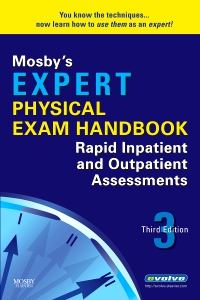
Mosby's Expert Physical Exam Handbook - Elsevier eBook on VitalSource, 3rd Edition
by Mosby
Elsevier eBook on VitalSource
ISBN:
9780323168427
Copyright:
2009
Publication Date:
10-06-2008
Page Count:
400
Imprint:
Mosby
List Price:
$53.99
Was
$53.99
Now $51.29
Or $0.00 with a valid access code
With the most up-to-date information on assessment techniques, normal and abnormal findings, and the assessment of patients with specific diseases and disorders, Mosby’s Expert Physical Exam Handbook: Rapid Inpatient and Outpatient Assessments, 3rd Edition is an essential resource for the medical-surgical setting. Detailed instructions and tips help you effectively apply your physical examination skills. From basic examination techniques to step-by-step guides for examining each body region and system, this handbook has everything you need to perform quick and thorough physical examinations.
-
- UNIQUE! Expert Exam Checklists available in the book and on the companion Evolve website provide handy reminders for assessing each body region.
- Thoroughly updated content reflects the latest research findings and evidence-based practice for techniques, normal and abnormal findings, and more.
- More illustrations and photographs than ever before clearly show normal anatomy, as well as normal and abnormal assessment findings.
- Dual-function table of contents, with body systems cross-referencing in addition to a body regions organization, helps you quickly find the information you need.
- Spanish/English assessment terms enable you to accurately communicate with Spanish-speaking patients.
-
- NEW! Nora AI - an AI-powered learning assistant exclusive to Elsevier ebooks on VitalSource's Bookshelf® platform - offers built-in AI learning support that provides personalized answers based on content from the Elsevier ebook
- UNIQUE! Action Stats identify immediate actions for critical situations and explain what to do for a patient with a potentially life-threatening condition.UNIQUE! Disorder Close-Ups enable you to identify abnormalities and determine when further analysis or treatment is needed
- Normal Findings summarize characteristic findings and acceptable variations based on age, sex, and condition of the patient
- UNIQUE! Interpreting Abnormal Findings helps you analyze irregular findings and determine their causes
- A chapter on documentation highlights key information to record during the initial assessment, with guidelines for documenting findings for over 20 selected conditions
- Examination Tips save you time with practical advice on how to examine patients more efficiently
- Lifespan Considerations provide guidelines for assessing patients of all ages to help you individualize exams
- Cultural Considerations include valuable information on variations in findings and transcultural considerations for the increasingly multicultural population
- Anatomy Reviews with detailed anatomical illustrations refresh your knowledge of anatomy for more accurate physical examinations
- A chapter covering health history, equipment, examination techniques, and procedures provides a solid foundation for learning to conduct more effective exams
- UNIQUE! The easy-to-follow, step-by-step format covers all aspects of physical examination – inspection, palpation, percussion, and auscultation – promoting an efficient and logical approach to physical exams
- Interview questions and guidelines help you hone your interviewing skills to focus your physical assessments
- How-to tips on individualizing the physical exam for patients with handicaps, pain, and serious illnesses enable you to effectively and accurately assess patients with special situations
-
1. Health History and Physical Examination Review
2. Examining Patients with Special Needs
3. First Encounters: A General Survey of the Patient
4. Examining the Head and Neck
5. Examining the Eyes and Ears
6. Examining the Chest and Back
7. Examining the Upper Extremities
8. Examining the Abdominal Region
9. Examining the Lower Extremities
10. Putting It All Together
11. Documenting Your Findings Accurately -
-
Ways of Reading
- No information about appearance modifiability is available
- All content can be read as read aloud speech or dynamic braille
- Has alternative text descriptions for images
-
Conformance
- The publication contains a conformance statement that it meets the EPUB Accessibility 1.1, WCAG 2.1, Level AA standard. Please see https://bornaccessible.benetech.org/certified-publishers/ for further details of our compatibility testing.
- The certifier's credential is https://bornaccessible.benetech.org/certified-publishers/
- The publication was certified on 06-02-2026
-
Navigation
- Index with links to referenced entries
- Elements such as headings, tables, etc. for structured navigation
- Page list to go to pages from the print source version
-
Rich Content
- Math formulas in accessible format (MathML)
- Information-rich images are described by extended descriptions
-
Hazards
- The publication contains no hazards
-
Product Content
- The primary content is text.
- Content includes a significant number of actionable (clickable) web links to external content, downloadable resources, supplementary material, etc.
- Content includes a significant number of actionable (clickable) cross-references, hyperlinked notes and annotations, or with other actionable links between largely textual elements (e.g., quiz/test questions, 'choose your own ending', etc.).
- Content includes photographs, whether in a plate section / insert or not.
- Content includes figures, diagrams, charts and/or graphs, including other 'mechanical' (i.e. non-photographic) illustrations.
- Content includes images displayed in a specific order for the purpose of graphic storytelling or giving information (e.g. graphic novels, comics and manga). May include text integrated into the image (as speech and thought bubbles, textual 'sound' effects, captions etc.).
- Content includes text within images, including text-as-text embedded in diagrams, charts, or within images containing speech balloons, thought bubbles, captions, etc.
- At least some text - including text within other images - is 'text as an image' (i.e., a picture of text).
-
Legal Considerations
- No information is available
-
Additional Accessibility Information
- Content is enhanced with ARIA roles to optimize organization and facilitate navigation
- Page breaks included from the original print source
- The body text is presented with a contrast ratio of at least 4.5:1 (or 3:1 for large/heading text)
- Ultra-high contrast between text and background
- Content provides explanations for unusual words, abbreviations, acronyms, idioms, jargon in an accessible form, such as glossaries, scripted pop-ups.
- Where interactive content is included in the product, controls are provided (e.g., for speed, pause and resume, reset) and labelled to make their use clear.
-
Ways of Reading
Was
$53.99
Now $51.29
Or $0.00 with a valid access code

 as described in our