ISBN:
9780323168458
Copyright:
2009
Publication Date:
11-25-2008
Page Count:
216
Imprint:
Mosby
List Price:
$25.99

Mosby's PDQ for Massage Therapists - Elsevier eBook on VitalSource, 2nd Edition
by Mosby and Sandy Fritz, MS, BCTMB, CMBE
Elsevier eBook on VitalSource
ISBN:
9780323168458
Copyright:
2009
Publication Date:
11-25-2008
Page Count:
216
Imprint:
Mosby
List Price:
$25.99
Was
$25.99
Now $18.19
Or $0.00 with a valid access code
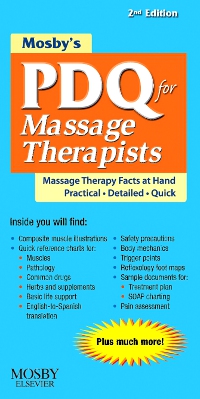
Ideal for both massage students and practicing therapists, this pocket-sized reference provides key information in a handy, easy-to-use format! Bullet lists, tables, and numerous full-color line drawings and photos make this reference ideal for use on the go. This second edition is thoroughly updated and includes new muscle illustrations and new sections on how nutrition and common medications affect massage-treatment planning, helping you provide even more effective treatment for your clients.
-
- Muscle illustrations and an updated muscle chart provide quick reminders of muscle locations and actions to assist in assessment and treatment planning.
- The latest nutritional information, with a chart of vitamins and minerals, helps you keep track of patients’ nutritional intake.
- An updated section on body mechanics with numerous color photos demonstrates correct positioning and posture to perform various strokes and techniques for more effective practice.
- Updated content on pharmacology and medication helps you provide safe and effective massage with information on the most commonly used medications and their effects on pain sensation.
-
- A quick-reference format provides all of the key information you need with fast-access illustrations, charts, and tables.
- The pocket-sized format and spiral binding allow the book to lay flat so you can quickly reference the pages you need while leaving your hands free to work.
- User-friendly, full-color design includes vibrant illustrations, as well as highlights and clarifies important facts to help you easily find what you need.
-
Anatomy
1. Systems and Organs
2. Functions of ANS
3. Joint Movements
4. ROM
5. Muscles
Safety and Precautions
6. Standard Precautions
7. Endangerment Sites
Massage Application
8. Licensing, Certification, Scope of Practice
9. Benefits of Therapeutic Massage
10. Body Mechanics
11. Draping Suggestions
12. Outcome Massage Sequence
13. Quality of Touch
14. Adapting During Massage Based on Safety and Outcomes
15. Hydrotherapy
16. Lymphatic Drain and Blood Circulation
17. Common Trigger Points
18. Connective Tissue
19. Chakra, Color, Music Therapy
20. Meridians
21. Reflexology
22. Stages of Soft Tissue Healing
23. Development of Treatment Plan
24. Abdominal Massage
Documentation
25. Taking a Health History
26. Treatment Plan Form
27. SOAP Notes
28. Common Abbreviations
29. Common Word Roots
30. Common Prefixes
31. Common Suffixes
Assessment, Pain, and Pathology
32. Palpation Assessment
33. Posture Assessment
34. Muscle Testing Assessment
35. Joint vs Soft Tissue Assessment
36. Referred Pain
37. Pain Assessment Factors
38. Pain Rating Scales
39. Assessment Scale for Pitting Edema to Determine Appropriateness for Lymphatic Drain
40. Characteristics of Headaches
41. Diseases and Indications/Contraindications for Massage
42. Disorders Related to Chronic Inflammation
43. Skin Pathologies
44. Common Stress Responses
45. Common Drugs by Class
46. Common Herbal Supplements
47. Functions and Sources of Vitamins
48. Functions and Sources of Selected Minerals
Tools
49. Basic Life Support
50. Heart Attack Warning Signs
51. English-Spanish Translation Guide
52. Sign Language Chart
53. Research Vocabulary
54. Glossary -
-
Ways of Reading
- The appearance of the text and page layout can be modified according to the capabilities of the reading system (font family and font size, spaces between paragraphs, sentences, words, and letters, as well as color of background and text)
- This e-publication is accessible to the full extent that the file format and types of content allow, on a specific reading device, by default, without necessarily including any additions such as textual descriptions of images or enhanced navigation
- All content can be read as read aloud speech or dynamic braille
-
Conformance
- For detailed accessibility information, see Elsevier's website at https://www.elsevier.com/about/accessibility
- For queries regarding accessibility information, contact [email protected]
- The publication was certified on 07-04-2026
-
Navigation
- Table of contents to all chapters of the text via links
- Page list to go to pages from the print source version
-
Rich Content
- No information is available
-
Hazards
- No information is available
-
Product Content
- No information is available
-
Legal Considerations
- Elsevier is committed to making our eBooks accessible and complying with applicable laws. Given our vast library of titles, there are some cases where making an eBook fully accessible presents unique challenges, and including full features could transform its nature to no longer serve its primary purpose or result in a disproportionate burden for the publisher. As a result this eBook may have limited accessibility. See more at https://www.elsevier.com/en-gb/about/accessibility.
- Please refer to our disproportionate burden or fundamental modification statements.
-
Additional Accessibility Information
- Page breaks included from the original print source
- E-publication includes basic navigation (usually less detailed than TOC-based navigation)
- All (or substantially all) textual matter is arranged in a single logical reading order (including text that is visually presented as separate from the main text flow, e.g., in boxouts, captions, tables, footnotes, endnotes, citations, etc.). Non-textual content is also linked from within this logical reading order. (Purely decorative non-text content can be ignored).
- The language of the text has been specified (e.g., via the HTML or XML lang attribute) to optimise text-to-speech (and other alternative renderings), both at the whole document level and, where appropriate, for individual words, phrases or passages in a different language.
-
Ways of Reading
Was
$25.99
Now $18.19
Or $0.00 with a valid access code

 as described in our