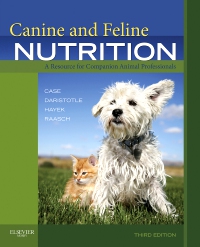

Canine and Feline Nutrition - Elsevier eBook on VitalSource, 3rd Edition
Elsevier eBook on VitalSource
Now $61.59
How well can you answer pet owners' questions about proper diet and feeding? Canine and Feline Nutrition, 3rd Edition describes the role of nutrition and its effects upon health and wellness and the dietary management of various disorders of dogs and cats. By using the book's cutting-edge research and clinical nutrition information, you'll be able to make recommendations of appropriate pet food and proper feeding guidelines. Pet nutrition experts Linda P. Case, MS, Leighann Daristotle, DVM, PhD, Michael G. Hayek, PhD, and Melody Foess Raasch, DVM, provide complete, head-to-tail coverage and a broad scope of knowledge, so you can help dog and cat owners make sound nutrition and feeding choices to promote their pets' health to prolong their lives.
-
- New clinical information covers a wide range of emerging nutrition topics including the role of the omega-3 and omega-6 fatty acid families in pet health and disease management
- Coverage of pet food safety and pet food ingredients includes both commercially and home-prepared foods and provides answers to pet owners’ questions on these topics
- Completely updated content reflects the latest findings in clinical nutrition research
- Information regarding functional ingredients and dietary supplementation provides a scientifically based rationale for recommending or advising against dietary supplements
- Guidelines for understanding pet food formulations and health claims differentiate between "market-speak" and actual clinical benefits for patients, with practice advice for evaluating and selecting appropriate foods
-
- Tables and boxes provide quick reference to the most important clinical information
- Key points summarize essential information at a glance
- A useful Nutritional Myths and Feeding Practices chapter dispels and corrects common food myths
-
-
 Canine and Feline NutritionPaperback
-
-
Section 1: Basics of Nutrition
1. Energy and Water
2. Carbohydrates
3. Fats
4. Protein and Amino Acids
5. Vitamins
6. Minerals
7. Digestion and Absorption
Section 2: Nutrient Requirements of Dogs and Cats
8. Nutritional Idiosyncrasies of the Cat
9. Energy Balance
10. Carbohydrate Metabolism
11. Fat Requirements
12. Protein Requirements
13. Vitamin and Mineral Requirements
Section 3: Pet Foods
14. History and Regulation of Pet Foods
15. Pet Food Labels
16. Nutrient Content of Pet Foods
17. Types of Pet Foods
18. Evaluation of Pet Foods
Section 4: Feeding Management Throughout the Life Cycle
19. Feeding Regimens for Dogs and Cats
20. Pregnancy and Lactation
21. Nutritional Care of Neonatal Puppies and Kittens
22. Growth
23. Adult Maintenance
24. Performance
25. Geriatrics
26. Nutritional Myths and Feeding Practices
Section 5: Nutritionally Responsive Disorders
27. Inherited Disorders of Nutrient Metabolism
28. Development and Treatment of Obesity
29. Diabetes Mellitus
30. Dietary Management of Urolithiasis in Cats and Dogs
31. Nutritionally-Responsive Dermatoses
32. Chronic Renal Failure
33. Feline Hepatic Lipidosis
34. Dental Health and Diet
35. Nutritional Management of Gastrointestinal Disease
36. Nutritional Care of Cancer Patients
37. Nutrition and Mobility NEW!
38. Nutrition and the Heart NEW!
Appendix 1: Estimated Metabolizable Energy Requirements for Dogs
Appendix 2: Estimated Metabolizable Energy Requirements of Adult Cats
Appendix 3: Standard Weights for American Kennel Club (AKC) Dog Breeds (lbs)
Glossary -
-
Ways of Reading
- The appearance of the text and page layout can be modified according to the capabilities of the reading system (font family and font size, spaces between paragraphs, sentences, words, and letters, as well as color of background and text)
- This e-publication is accessible to the full extent that the file format and types of content allow, on a specific reading device, by default, without necessarily including any additions such as textual descriptions of images or enhanced navigation
- All content can be read as read aloud speech or dynamic braille
-
Conformance
- For detailed accessibility information, see Elsevier's website at https://www.elsevier.com/about/accessibility
- For queries regarding accessibility information, contact [email protected]
- The publication was certified on 07-04-2026
-
Navigation
- Table of contents to all chapters of the text via links
- Page list to go to pages from the print source version
-
Rich Content
- No information is available
-
Hazards
- No information is available
-
Product Content
- No information is available
-
Legal Considerations
- Elsevier is committed to making our eBooks accessible and complying with applicable laws. Given our vast library of titles, there are some cases where making an eBook fully accessible presents unique challenges, and including full features could transform its nature to no longer serve its primary purpose or result in a disproportionate burden for the publisher. As a result this eBook may have limited accessibility. See more at https://www.elsevier.com/en-gb/about/accessibility.
- Please refer to our disproportionate burden or fundamental modification statements.
-
Additional Accessibility Information
- Page breaks included from the original print source
- E-publication includes basic navigation (usually less detailed than TOC-based navigation)
- All (or substantially all) textual matter is arranged in a single logical reading order (including text that is visually presented as separate from the main text flow, e.g., in boxouts, captions, tables, footnotes, endnotes, citations, etc.). Non-textual content is also linked from within this logical reading order. (Purely decorative non-text content can be ignored).
- The language of the text has been specified (e.g., via the HTML or XML lang attribute) to optimise text-to-speech (and other alternative renderings), both at the whole document level and, where appropriate, for individual words, phrases or passages in a different language.
-
Ways of Reading

 as described in our