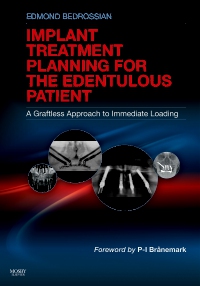

Implant Treatment Planning for the Edentulous Patient - Elsevier eBook on VitalSource, 1st Edition
Elsevier eBook on VitalSource
-
- Over 1,000 full-color illustrations depict implant techniques and products.
- Coverage of the Graftless Approach includes two concepts: 1) the anterior tilted implant, and 2) the zygoma implant, each eliminating the need for grafts and producing an implant site less prone to infection and with a quicker healing time.
- A Computer Guided Surgery chapter covers the latest software developed for treatment planning, creating the surgical template, laboratory procedures, and fabrication of the prosthetics.
- Case presentations on immediate loading tilted implants and zygoma implants appear at the end of the book, each a beginning-to-end study from Dr. Bedrossian’s own archives.
- Coverage of broader issues related to the edentulous patient includes a discussion of special needs, demographics, and the systemic pretreatment of these patients including bone composites and overall esthetic and functional goals.
-
1. Demographics of the edentulous patients
2. Osseointegration: rational for 2-stage vs. 1-stage protocols
3. Immediate loading
- 2-stage procedures
- Distance Osteogenesis
- Contact Osteogenesis
- Enhanced surfaces, Fluid retention index
- ISQ and immediate loading
4. Treatment limitation in treating the edentulous maxilla
- Literature review for treatment of the edentulous maxilla
- Lip support, VDO, phonetics, oral hygiene
- Surgical limitation for implant placement (posterior maxilla)
- Grafting approach: Surgical reconstruction of composite defects
- Prosthetic reconstruction of composite defect
5. Systematic pretreatment evaluation of the edentulous maxilla
- Composite defects
- Types of implant supported prosthesis
- Transition line
- Zones of the maxilla
6. Graftless approach for the treatment of the edentulous maxilla
a) Anterior tilted implant concept
7. Graftless approach for the treatment of the edentulous maxilla
a) Zygoma implant concept
8. Systematic pretreatment evaluation of the edentulous mandible
- All-on-4 concept
9. Conversion technique for immediate loading of the edentulous patient
10. Computer guided surgery (CGS)
- Treatment planning
- Guided templates
- Immediate loading
d) CGS: Maxillary tilted implants
e) CGS : Mandibular tilted implants
f) CGS : Zygoma concept
11. Case presentations: Alternatives for the final framework designs
- Hybrid vs. Profile prosthesis
- Titanium framework for the final profile prosthesis
c) Cal bar for the final profile prosthesis
12. Case presentations: Immediate loading tilted implants
- Tilted concept maxilla profile prosthesis
- Tilted concept mandible: profile prosthesis
- Tilted concept: PFM prosthesis
13. Case presentations: Immediate loading zygoma implant
- The zygoma protocol
- Combination of failing teeth and implants
- Guided zygoma
14. Case presentations: Advanced procedures
- Complete anodontia
- Ectodermal dysplasia
- Management of the patient with alveolar cleft
- Immediate replacement of existing failing implants
- Failing implant supported maxillary overdenture
15. Case presentations: Management of complications
- Failed zygomatic implant
- Failed tilted implant
16. Case presentations: The quad-zygoma concept
-
-
Ways of Reading
- The appearance of the text and page layout can be modified according to the capabilities of the reading system (font family and font size, spaces between paragraphs, sentences, words, and letters, as well as color of background and text)
- This e-publication is accessible to the full extent that the file format and types of content allow, on a specific reading device, by default, without necessarily including any additions such as textual descriptions of images or enhanced navigation
- All content can be read as read aloud speech or dynamic braille
-
Conformance
- For detailed accessibility information, see Elsevier's website at https://www.elsevier.com/about/accessibility
- For queries regarding accessibility information, contact [email protected]
- The publication was certified on 07-04-2026
-
Navigation
- Table of contents to all chapters of the text via links
- Page list to go to pages from the print source version
-
Rich Content
- No information is available
-
Hazards
- No information is available
-
Product Content
- No information is available
-
Legal Considerations
- Elsevier is committed to making our eBooks accessible and complying with applicable laws. Given our vast library of titles, there are some cases where making an eBook fully accessible presents unique challenges, and including full features could transform its nature to no longer serve its primary purpose or result in a disproportionate burden for the publisher. As a result this eBook may have limited accessibility. See more at https://www.elsevier.com/en-gb/about/accessibility.
- Please refer to our disproportionate burden or fundamental modification statements.
-
Additional Accessibility Information
- Page breaks included from the original print source
- E-publication includes basic navigation (usually less detailed than TOC-based navigation)
- All (or substantially all) textual matter is arranged in a single logical reading order (including text that is visually presented as separate from the main text flow, e.g., in boxouts, captions, tables, footnotes, endnotes, citations, etc.). Non-textual content is also linked from within this logical reading order. (Purely decorative non-text content can be ignored).
- The language of the text has been specified (e.g., via the HTML or XML lang attribute) to optimise text-to-speech (and other alternative renderings), both at the whole document level and, where appropriate, for individual words, phrases or passages in a different language.
-
Ways of Reading


 as described in our