ISBN:
9780323170253
Copyright:
2011
Publication Date:
10-15-2010
Page Count:
328
Imprint:
Mosby
List Price:
$119.99

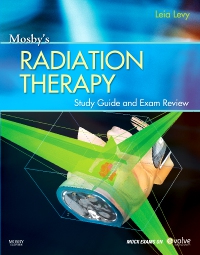
Mosby's Radiation Therapy Study Guide and Exam Review - Elsevier eBook on VitalSource, 1st Edition
by Leia Levy, Ed.D., R.T.(T).
Elsevier eBook on VitalSource
ISBN:
9780323170253
Copyright:
2011
Publication Date:
10-15-2010
Page Count:
328
Imprint:
Mosby
List Price:
$119.99
Reinforce student understanding of radiation therapy and help them prepare for the Registry exam! Mosby's Radiation Therapy Study Guide and Exam Review is both a study companion for Washington and Leaver's Principles and Practice of Radiation Therapy and a superior review for the ARRT Radiation Therapy Certification Exam. An easy-to-read format presents information in concise bullets and tables. Over 1,000 review questions are included in the book, with an additional 1,000 questions available online on the companion Evolve website.
New Edition Expected Availability: 09-02-2025

Mosby's Radiation Therapy Study Guide and Exam Review - Elsevier E-Book on VitalSource
Elsevier eBook on VitalSource
ISBN: 9780443245367
-
- Over 2,000 multiple-choice questions in Registry format are provided in the text and online, allowing students to both study and simulate the actual exam experience
- Focus questions and key information in tables make it easy for students to find and remember information for the exam
- Review exercises reinforce learning with a variety of question formats to fit different learning styles
- Online mock exams add over 1,000 questions to those included in the book
- Questions are organized by ARRT content categories and are available in study mode with immediate feedback after each question, or in exam mode, which simulates the test-taking experience in a timed environment with ARRT exam-style questions
-
1. Developing Good Study Habits in the Health Professions
2. An Overview of Cancer and Management Modalities
3. Radiation Therapy Physics
4. Radiation Biology
5. Radiation Protection and Safety
6. Radiation Therapy Treatment Delivery Equipment and Quality Assurance
7. Radiation Therapy Treatment Planning
8. Oncology Patient Care
9. Clinical Applications in Radiation Therapy -
-
Ways of Reading
- The appearance of the text and page layout can be modified according to the capabilities of the reading system (font family and font size, spaces between paragraphs, sentences, words, and letters, as well as color of background and text)
- This e-publication is accessible to the full extent that the file format and types of content allow, on a specific reading device, by default, without necessarily including any additions such as textual descriptions of images or enhanced navigation
- All content can be read as read aloud speech or dynamic braille
-
Conformance
- For detailed accessibility information, see Elsevier's website at https://www.elsevier.com/about/accessibility
- For queries regarding accessibility information, contact [email protected]
- The publication was certified on 07-04-2026
-
Navigation
- Table of contents to all chapters of the text via links
- Page list to go to pages from the print source version
-
Rich Content
- No information is available
-
Hazards
- No information is available
-
Product Content
- No information is available
-
Legal Considerations
- Elsevier is committed to making our eBooks accessible and complying with applicable laws. Given our vast library of titles, there are some cases where making an eBook fully accessible presents unique challenges, and including full features could transform its nature to no longer serve its primary purpose or result in a disproportionate burden for the publisher. As a result this eBook may have limited accessibility. See more at https://www.elsevier.com/en-gb/about/accessibility.
- Please refer to our disproportionate burden or fundamental modification statements.
-
Additional Accessibility Information
- Page breaks included from the original print source
- E-publication includes basic navigation (usually less detailed than TOC-based navigation)
- All (or substantially all) textual matter is arranged in a single logical reading order (including text that is visually presented as separate from the main text flow, e.g., in boxouts, captions, tables, footnotes, endnotes, citations, etc.). Non-textual content is also linked from within this logical reading order. (Purely decorative non-text content can be ignored).
- The language of the text has been specified (e.g., via the HTML or XML lang attribute) to optimise text-to-speech (and other alternative renderings), both at the whole document level and, where appropriate, for individual words, phrases or passages in a different language.
-
Ways of Reading


 as described in our