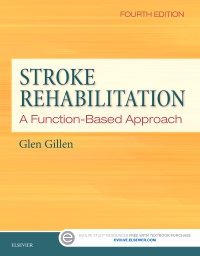

Stroke Rehabilitation - Elsevier eBook on VitalSource, 4th Edition
Elsevier eBook on VitalSource
Now $94.49
Learn to confidently manage the growing number of stroke rehabilitation clients with Gillen’s Stroke Rehabilitation: A Function-Based Approach, 4th Edition. Using a holistic and multidisciplinary approach, this text remains the only comprehensive, evidence-based stroke rehabilitation resource for occupational therapists. The new edition has been extensively updated with the latest information, along with more evidence-based research added to every chapter. As with previous editions, this comprehensive reference uses an application-based method that integrates background medical information, samples of functionally based evaluations, and current treatment techniques and intervention strategies.
New Edition Expected Availability: 10-01-2020

Stroke Rehabilitation Elsevier eBook on VitalSource
-
- Three new chapters broaden your understanding of stroke intervention in the areas of Using Technology to Improve Limb Function, Managing Speech and Language Deficits after Stroke, and Parenting after Stroke.
- Learning activities and interactive references on a companion Evolve Resources website help you review textbook content and locate additional information.
-
- Evidence-based clinical trials and outcome studies clearly outline the basis for stroke interventions.
- UNIQUE! Survivor's Perspectives help readers understand the stroke rehabilitation process from the client'' point-of-view.
- UNIQUE! Case studies challenge readers to apply rehabilitation concepts to realistic scenarios.
- UNIQUE! A multidisciplinary approach highlights discipline-specific distinctions in stroke rehabilitation among occupation and physical therapists, physicians, and speech-language pathologists.
- Review questions in each chapter help readers assess their understanding of rehabilitation concepts.
- Key terms and chapter objectives at the beginning of each chapter help readers study more efficiently.
-
Part I: Foundations of Stroke Rehabilitation
1. Pathophysiology, Medical Management and Acute Rehabilitation of Stroke Survivors
2. Improving Participation and Quality of Life through Occupation
3. Task-Oriented Approach to Stroke Rehabilitation
4. Activity-Based Intervention in Stroke Rehabilitation
5. Client Centeredness: A Survivor's PerspectivePart 2: Maximizing Participation in Everyday Activities
6. Enhancing Performance of Activities of Daily Living
7. Activities of Daily Living Adaptations: Managing the Environment with One-Handed Techniques
8. Functional Mobility
9. Gait Awareness
10. Return to Work
11. Driving and Community Mobility as an Instrumental Activity of Daily Living
12. Parenting after Stroke
13. Sexual Function and Intimacy
14. Leisure Participation after Stroke
15. Caregivers and CaregivingPart 3: Maximizing Outcomes for Specific Problem Areas Following Stroke
16. Psychological Aspects of Stroke Rehabilitation
17. Approaches to Motor Control Dysfunction: An Evidence-Based Review
18. Trunk Control: Supporting Functional Independence
19. Overview of Balance Impairments: Functional Implications
20. Vestibular Rehabilitation and Stroke
21. Upper Extremity Function and Management
22. Rehabilitation Technologies to Promote Upper Limb Recovery after Stroke
23. Edema Control
24. Splinting Applications
25. Managing Visual and Visuospatial Impairments to Optimize Function
26. Impact of Neurobehavioral Deficits on Activities of Daily Living
27. Treatment of Cognitive-Perceptual Deficits: A Function-Based Approach
28. Seating and Wheeled Mobility Prescription
29. Managing Speech and Language Deficits after Stroke
30. Dysphagia Management
31. Home Evaluation and ModificationsElectronic Chapters
32. How Therapists Think: Exploring Therapists’ Reasoning When Working with Patients Who Have Cognitive and Perceptual Problems Following Stroke
33. A Survivor’s Perspective II: Stroke -
-
Ways of Reading
- The appearance of the text and page layout can be modified according to the capabilities of the reading system (font family and font size, spaces between paragraphs, sentences, words, and letters, as well as color of background and text)
- This e-publication is accessible to the full extent that the file format and types of content allow, on a specific reading device, by default, without necessarily including any additions such as textual descriptions of images or enhanced navigation
- No information about nonvisual reading is available
-
Conformance
- The publication was certified on 27-05-2026
-
Navigation
- Table of contents to all chapters of the text via links
- Page list to go to pages from the print source version
-
Rich Content
- No information is available
-
Hazards
- No information is available
-
Product Content
- No information is available
-
Legal Considerations
- No information is available
-
Additional Accessibility Information
- Page breaks included from the original print source
- For readers with color vision deficiency, use of color (e.g., in diagrams, graphics and charts, in prompts, or on buttons inviting a response) is not the sole means of graphical distinction or of conveying information
- E-publication includes basic navigation (usually less detailed than TOC-based navigation)
- Where links, controls or buttons are included in the content, the purpose or functionality of each link, control or button is apparent from the associated text alone - or where it is unclear, separate link, control or button descriptions are provided
- All (or substantially all) textual matter is arranged in a single logical reading order (including text that is visually presented as separate from the main text flow, e.g., in boxouts, captions, tables, footnotes, endnotes, citations, etc.). Non-textual content is also linked from within this logical reading order. (Purely decorative non-text content can be ignored).
- The language of the text has been specified (e.g., via the HTML or XML lang attribute) to optimise text-to-speech (and other alternative renderings), both at the whole document level and, where appropriate, for individual words, phrases or passages in a different language.
-
Ways of Reading

 as described in our