ISBN:
9780323188043
Copyright:
2016
Publication Date:
05-21-2015
Page Count:
472
Imprint:
Saunders
List Price:
$151.99

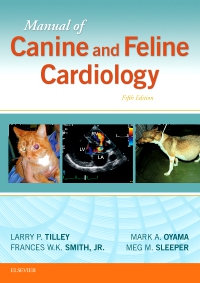
Manual of Canine and Feline Cardiology - Elsevier eBook on VitalSource, 5th Edition
by Francis W. K. Smith, DVM, DACVIM (Internal Medicine & Cardiology), Larry P. Tilley, DVM, DACVIM(Internal Medicine), Mark Oyama, DVM, DACVIM(Cardiology) and Meg M. Sleeper, VMD, DACVIM(Cardiology)
Elsevier eBook on VitalSource
ISBN:
9780323188043
Copyright:
2016
Publication Date:
05-21-2015
Page Count:
472
Imprint:
Saunders
List Price:
$151.99
Was
$151.99
Now $106.39
Or $0.00 with a valid access code
The most effective, practical approach to the recognition and management of cardiovascular and cardiopulmonary medicine, Manual of Canine and Feline Cardiology, 5th Edition walks readers through the challenges and conditions encountered in everyday practice. This completely revised and updated edition includes vital information on diagnostic modalities and techniques, therapeutic options, surgical procedures, and pharmaceutical management of the dog and cat cardiac patient. A new chapter on genetic and biomarker testing and a new chapter on nutrition surrounding cardiovascular disease ensure practitioners are well-equipped to handle every aspect of cardiac care in small animals.
New Edition Expected Availability: 01-09-2025

Manual of Canine and Feline Cardiology - Elsevier eBook on VitalSource
Elsevier eBook on VitalSource
ISBN: 9780323936620
-
- NEW! Genetic and Biomarker Testing of Cardiovascular Diseases chapter covers genetic testing for mutations associated with specific cardiac diseases and testing for circulating substances indicative of heart disease or injury
- NEW! Nutrition and Cardiovascular Disease chapter focuses on the significant role nutrition can play in preventing or treating cardiac disease
- NEW! Significantly revised Echocardiography chapter features the latest information on indications and the role of the electrocardiogram in clinical practice
- NEW! All new doppler echocardiogram images in the Feline Cardiomyopathy chapter show the primary cardiomyopathies, including: severe hypertrophic cardiomyopathy, severe hypertrophic obstructive cardiomyopathy, severe dilated cardiomyopathy, severe endomyocardial fibrosis and restrictive cardiomyopathy, severe unclassified cardiomyopathy, and severe arrhythmogenic right ventricular cardiomyopathy
- NEW! Section on hybrid cardiac procedures in the Cardiac Surgery chapter include image-guided catheter-based interventions with direct transcardiac (transatrial, transventricular, transapical) surgical approaches to the heart
-
- The latest coverage on common cardiovascular disorders and practical treatment methods addresses topics, such as: cardiac failure, cardiac arrhythmias, conduction disturbances, cardiopulmonary arrest, and more
- Easy-to-follow organization separates content into three sections that build on each other — Section 1: Diagnosis of Heart Disease; Section 2: Cardiovascular Disease; Section 3: Treatment of Cardiovascular Disease
- Extensive art program contains vivid illustrations, clinical photographs, and color Doppler images
- Drug formulary appendix features a list of commonly used cardiopulmonary drugs, along with formulations, indications, and dosages (for both dogs and cats)
- Streamlined text, bullet points, and helpful boxes help to highlight the most important clinical content
- Highlighted key points spotlight key information, diagnosis considerations, clinical tips and more
-
-
 Manual of Canine and Feline CardiologyHardcover
-
-
Section 1: Diagnosis of Heart Disease
1. The History of Physical Examination
2. Radiology of the Heart
3. Electrocardiography
4. Echocardiography and Doppler Ultrasound
5. Special Diagnostic Techniques for Evaluation of Cardiac Disease
6. Laboratory Diagnosis of Cardiac Disease NEW!
Section 2: Cardiovascular Diseases
7. Acquired Valvular Disease
8. Canine Cardiomyopathy
9. Feline Cardiomyopathy
10. Cor Pulmonale & Pulmonary Thromboembolism
11. Canine and Feline Heartworm Disease
12. Cardiac Tumors and Pericardial Disease
13. Congenital Heart Disease
14. Cardiovascular Disorders in Systemic Diseases
15. Systemic Hypertension
Section 3: Treatment of Cardiovascular Disease
16. Pathophysiology and Therapy of Heart Failure
17. Treatment of Cardiac Arrhythmias and Conduction Disturbances
18. Cardiopulmonary Arrest and Resuscitation
19. Emergency Management and Critical Care
20. Anesthesia of the Cardiac Patient
21. Cardiac Surgery
22. Pacemaker Therapy
23. Nutrition and Cardiac Disease NEW!
Appendices
1. Canine Breed Predilections for Heart Disease
2. Available Canine and Feline Genetic Tests for Breed-Specific Cardiac Disease NEW!
3. Breed-Specific Cardiac Conditions for Dogs and Cats NEW!
4. Genetic Testing Centers NEW!
5. Common Cardiovascular Drugs
6. New Guidelines for CPR NEW!
7. Echocardiographic Normals by Body Weight & Breed
8. Chief Classification System of Canine Congestive Heart Failure -
-
Ways of Reading
- The appearance of the text and page layout can be modified according to the capabilities of the reading system (font family and font size, spaces between paragraphs, sentences, words, and letters, as well as color of background and text)
- This e-publication is accessible to the full extent that the file format and types of content allow, on a specific reading device, by default, without necessarily including any additions such as textual descriptions of images or enhanced navigation
- No information about nonvisual reading is available
-
Conformance
- No information is available
-
Navigation
- Table of contents to all chapters of the text via links
- Page list to go to pages from the print source version
-
Rich Content
- No information is available
-
Hazards
- No information is available
-
Product Content
- No information is available
-
Legal Considerations
- No information is available
-
Additional Accessibility Information
- Page breaks included from the original print source
- For readers with color vision deficiency, use of color (e.g., in diagrams, graphics and charts, in prompts, or on buttons inviting a response) is not the sole means of graphical distinction or of conveying information
- E-publication includes basic navigation (usually less detailed than TOC-based navigation)
- Where links, controls or buttons are included in the content, the purpose or functionality of each link, control or button is apparent from the associated text alone - or where it is unclear, separate link, control or button descriptions are provided
- All (or substantially all) textual matter is arranged in a single logical reading order (including text that is visually presented as separate from the main text flow, e.g., in boxouts, captions, tables, footnotes, endnotes, citations, etc.). Non-textual content is also linked from within this logical reading order. (Purely decorative non-text content can be ignored).
- The language of the text has been specified (e.g., via the HTML or XML lang attribute) to optimise text-to-speech (and other alternative renderings), both at the whole document level and, where appropriate, for individual words, phrases or passages in a different language.
-
Ways of Reading
Was
$151.99
Now $106.39
Or $0.00 with a valid access code

 as described in our