ISBN:
9780323227803
Copyright:
2015
Publication Date:
07-06-2015
Page Count:
512
Imprint:
Saunders
List Price:
$74.99

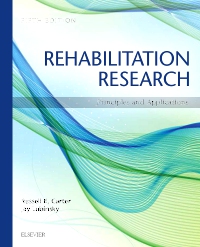
Rehabilitation Research - Elsevier eBook on Vitalsource, 5th Edition
by Russell Carter, EdD, PT and Jay Lubinsky, PhD, CCC-A/SLP
Elsevier eBook on VitalSource
ISBN:
9780323227803
Copyright:
2015
Publication Date:
07-06-2015
Page Count:
512
Imprint:
Saunders
List Price:
$74.99
Was
$74.99
Now $67.49
Or $0.00 with a valid access code
Find out how to use evidence to improve your practice! Thoroughly covering the full range of rehabilitation research with a clear, easy-to-understand approach, Rehabilitation Research: Principles and Applications, 5th Edition will help you analyze and apply research to practice. It examines traditional experimental designs as well as nonexperimental and emerging approaches, including qualitative research, single-subject designs, outcomes research, and survey research. Ideal for students and practitioners in physical therapy, occupational therapy, and communication sciences and disorders, this user-friendly resource emphasizes evidence-based practice and the development of true scientist-practitioners.
New Edition Expected Availability: 09-15-2021

Rehabilitation Research - Elsevier eBook on Vitalsource
Elsevier eBook on VitalSource
ISBN: 9780323680455
-
- NEW! Completely updated evidence-based content and references makes the information useful for both students and rehab practitioners.
- UPDATED! Expanded Single-Subject Designs chapter provides a more thorough explanation and examples of withdrawal, multiple baselines, alternating treatments, and interactions - designs that you can use in everyday clinical practice.
-
- Evidence-Based Practice chapter provides an overview of the important concepts of EBP and the WHO model of health and disease.
- Interdisciplinary author team consisting of a PT and an ASHA dually-certified SLP/AUD brings an interdisciplinary focus and a stronger emphasis on evidence-based practice.
- Discipline-specific examples are drawn from three major fields: physical therapy, occupational therapy, and communication sciences and disorders.
- Coverage of nonexperimental research includes chapters on clinical case studies and qualitative research, so you understand a wide range of research methods and when it is most appropriate to use each type.
- Finding Research Literature chapter includes step-by-step descriptions of literature searches within different rehabilitation professions.
-
Section 1: Research Fundamentals
1. Rehabilitation Research
2. Theory in Rehabilitation Research
3. Evidence-Based Practice
4. Finding Research Literature
5. Research Ethics
Section 2: Research Design
6. Research Paradigms
7. Variables
8. Research Validity
9. Selection and Assignment of Participants
Section 3: Experimental Designs
10. Group Designs
11. Single-Subject Designs
Section 4: Nonexperimental Research for Rehabilitation
12. Overview of Nonexperimental Research
13. Clinical Case Reports
Section 5: Research Beyond the Everyday
14. Qualitative Research
15. Epidemiology
16. Outcomes Research
17. Survey Research
Section 6: Measurement
18. Measurement Theory
19. Methodological Research
Section 7: Data Analysis
20. Statistical Reasoning
21. Statistical Analysis of Differences: The Basics
22. Statistical Analysis of Differences: Advanced
23. Statistical Analysis of Relationships: The Basics
24. Statistical Analysis of Relationships: Advanced
Section 8: Being a Consumer of Research
25. Evaluating Evidence One Article at a Time
26. Synthesizing Bodies of Evidence
Section 9: Implementing Research
27. Implementing a Research Project
28. Publishing and Presenting Research
Appendices -
-
Ways of Reading
- The appearance of the text and page layout can be modified according to the capabilities of the reading system (font family and font size, spaces between paragraphs, sentences, words, and letters, as well as color of background and text)
- This e-publication is accessible to the full extent that the file format and types of content allow, on a specific reading device, by default, without necessarily including any additions such as textual descriptions of images or enhanced navigation
- No information about nonvisual reading is available
-
Conformance
- The publication was certified on 27-05-2026
-
Navigation
- Table of contents to all chapters of the text via links
- Page list to go to pages from the print source version
-
Rich Content
- No information is available
-
Hazards
- No information is available
-
Product Content
- No information is available
-
Legal Considerations
- No information is available
-
Additional Accessibility Information
- Page breaks included from the original print source
- For readers with color vision deficiency, use of color (e.g., in diagrams, graphics and charts, in prompts, or on buttons inviting a response) is not the sole means of graphical distinction or of conveying information
- E-publication includes basic navigation (usually less detailed than TOC-based navigation)
- Where links, controls or buttons are included in the content, the purpose or functionality of each link, control or button is apparent from the associated text alone - or where it is unclear, separate link, control or button descriptions are provided
- All (or substantially all) textual matter is arranged in a single logical reading order (including text that is visually presented as separate from the main text flow, e.g., in boxouts, captions, tables, footnotes, endnotes, citations, etc.). Non-textual content is also linked from within this logical reading order. (Purely decorative non-text content can be ignored).
- The language of the text has been specified (e.g., via the HTML or XML lang attribute) to optimise text-to-speech (and other alternative renderings), both at the whole document level and, where appropriate, for individual words, phrases or passages in a different language.
-
Ways of Reading
Was
$74.99
Now $67.49
Or $0.00 with a valid access code

 as described in our