ISBN:
9780323228077
Copyright:
2015
Publication Date:
07-01-2014
Page Count:
488
Imprint:
Saunders
List Price:
$252.99

Color Atlas of Dental Implant Surgery - Elsevier eBook on VitalSource, 4th Edition
by Michael S. Block, DMD
Elsevier eBook on VitalSource
ISBN:
9780323228077
Copyright:
2015
Publication Date:
07-01-2014
Page Count:
488
Imprint:
Saunders
List Price:
$252.99
Most review copies are eBooks – how fast!
A review copy request is most likely to be fulfilled as an eBook on VitalSource rather than a print product, unless no eBook is available. eBooks become available in as little as a few hours. Print products will take between 7 and 10 days to arrive. To request a print copy, please contact us through the Evolve Support Center for further assistance or contact your Elsevier Sales Rep.
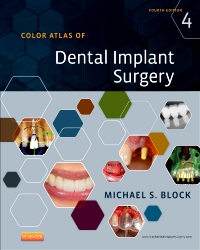
Written by leading expert Michael S. Block, DMD, Color Atlas of Dental Implant Surgery, 4th Edition provides clear, full-color clinical photos and practical instructions covering a wide range of implant challenges. This vivid atlas-style guide walks students through treatment planning, pre-surgical guidelines, detailed surgical techniques, and postoperative follow-up. This new fourth edition includes expansive content updates, realistic case studies, and a new companion website that houses over 60 video clips that clearly demonstrate the nuances and techniques of implant procedures that can’t be seen in still photos.
-
- NEW! Thoroughly revised and updated content reflects the latest information and advancements in dental implant surgery.
- NEW! 60+ video clips on a companion website clearly demonstrate the nuances and techniques of implant procedures that can’t be seen in still photos.
- NEW! Information on the placement of implants into single tooth sites with tooth removal looks at three clinical scenarios that can help you decide on the best timing of treatment.
- NEW! Coverage of the placement of implants immediately into mandibular molar sites addresses criteria for immediate placement, implant selection, and surgical technique.
- NEW! Exploration of grafting the thin maxilla, with an accompanying case study, looks at how to best handle patients who present with a thin, narrow alveolar bone, which does not allow implant placement.
- NEW! Section on the use of interpositional osteotomy to restore missing vertical bone in the esthetic zone discusses how to manage vertical bone deficiency in the esthetic zone by moving the vertical bone inferiorly using an interpositional osteotomy.
- NEW! Section on the crestal approach for sinus elevation addresses implant site preparation and surgical technique.
-
- NEW! Thoroughly revised and updated content reflects the latest information and advancements in dental implant surgery.
- NEW! Information on the placement of implants into single tooth sites with tooth removal looks at three clinical scenarios that can help students decide on the best timing of treatment.
- NEW! Coverage of the placement of implants immediately into mandibular molar sites addresses criteria for immediate placement, implant selection, and surgical technique.
- NEW! Exploration of grafting the thin maxilla, with an accompanying case study, looks at how to best handle patients who present with a thin, narrow alveolar bone, which does not allow implant placement.
- NEW! Section on the use of interpositional osteotomy to restore missing vertical bone in the esthetic zone discusses how to manage vertical bone deficiency in the esthetic zone by moving the vertical bone inferiorly using an interpositional osteotomy.
- NEW! Section on the crestal approach for sinus elevation addresses implant site preparation and surgical technique.
- NEW! 60+ video clips on a companion website clearly demonstrate the nuances and techniques of implant procedures that can’t be seen in still photos.
- Over 1,500 full-color photographs and drawings depict important concepts and techniques, and show treatment from beginning to end.
- Clear step-by-step procedures include indications, contraindications, and treatment results for each procedure.
- Case studies throughout the book explore realistic clinical scenarios, each with a variant.
- Chapters are organized by oral anatomy and surgical technique, with each chapter presenting a different area of the mouth or a specific surgical technique.
-
-
 Color Atlas of Dental Implant SurgeryHardcover
-
-
Part 1: Mandible
1. Surgery of the Anterior Mandible
2. Surgery of the Posterior Mandible
Part 2: Maxilla
3. Implants for the Maxillary Edentulous Patient
4. Surgery of the Partially Edentulous Maxilla
5. Zygomaticus Implants and Angled Implants for the Edentulous Maxilla
6. Maxillary Sinus Grafting
7. Techniques for Grafting and Implant Placement for the Extraction Site
8. Immediate Provisionalization of Implant Restorations
9. Esthetic Anterior Implant Restorations: Surgical Techniques for Optimal Results
10. Soft Tissue Manipulation around Implants in the Esthetic Zone -
-
Ways of Reading
- The appearance of the text and page layout can be modified according to the capabilities of the reading system (font family and font size, spaces between paragraphs, sentences, words, and letters, as well as color of background and text)
- This e-publication is accessible to the full extent that the file format and types of content allow, on a specific reading device, by default, without necessarily including any additions such as textual descriptions of images or enhanced navigation
- No information about nonvisual reading is available
-
Conformance
- No information is available
-
Navigation
- Table of contents to all chapters of the text via links
- Page list to go to pages from the print source version
-
Rich Content
- No information is available
-
Hazards
- No information is available
-
Product Content
- No information is available
-
Legal Considerations
- No information is available
-
Additional Accessibility Information
- Page breaks included from the original print source
- For readers with color vision deficiency, use of color (e.g., in diagrams, graphics and charts, in prompts, or on buttons inviting a response) is not the sole means of graphical distinction or of conveying information
- E-publication includes basic navigation (usually less detailed than TOC-based navigation)
- Where links, controls or buttons are included in the content, the purpose or functionality of each link, control or button is apparent from the associated text alone - or where it is unclear, separate link, control or button descriptions are provided
- All (or substantially all) textual matter is arranged in a single logical reading order (including text that is visually presented as separate from the main text flow, e.g., in boxouts, captions, tables, footnotes, endnotes, citations, etc.). Non-textual content is also linked from within this logical reading order. (Purely decorative non-text content can be ignored).
- The language of the text has been specified (e.g., via the HTML or XML lang attribute) to optimise text-to-speech (and other alternative renderings), both at the whole document level and, where appropriate, for individual words, phrases or passages in a different language.
-
Ways of Reading
Most review copies are eBooks – how fast!
A review copy request is most likely to be fulfilled as an eBook on VitalSource rather than a print product, unless no eBook is available. eBooks become available in as little as a few hours. Print products will take between 7 and 10 days to arrive. To request a print copy, please contact us through the Evolve Support Center for further assistance or contact your Elsevier Sales Rep.

 as described in our