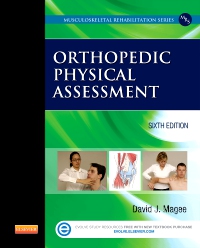

Orthopedic Physical Assessment - Elsevier eBook on VitalSource, 6th Edition
Elsevier eBook on VitalSource
Newly updated, this full-color text offers a rich array of features to help students develop their musculoskeletal assessment skills. Orthopedic Physical Assessment, 6th Edition provides students and clinicians with rationales for various aspects of assessment and covers every joint of the body, as well as specific topics including principles of assessment, gait, posture, the head and face, the amputee, primary care, and emergency sports assessment. Artwork and photos with detailed descriptions of assessments clearly demonstrate assessment methods, tests, and causes of pathology. The text also comes with an array of online learning and teaching tools, including video clips demonstrating assessment tests, test bank, PowerPoint slides, assessment forms, and more.
New Edition Expected Availability: 01-25-2021

Orthopedic Physical Assessment - Elsevier eBook on VitalSource
-
- NEW! Online resources include video clips, assessment forms, text references with links to MEDLINE® abstracts, and more.
- NEW! Video clips demonstrate selected movements and the performance of tests used in musculoskeletal assessment.
- NEW! Text references linked to MEDLINE abstracts provide easy access to abstracts of journal articles for further review.
- NEW! Forms from the text with printable patient assessment forms can be downloaded for ease of use.
- NEW! Updated information in all chapters includes new photos, line drawings, boxes, and tables.
- NEW! The use of icons to show the clinical utility of special tests supplemented by evidence - based reliability & validity tables for tests & techniques on the Evolve site.
-
- NEW! Online teaching and learning resources include video clips, test bank, PowerPoint® slides, assessment forms, text references with links to MEDLINE® abstracts and downloadable content.
- NEW! Video clips demonstrate examples of joint assessments based on specific pathology
- NEW! Test bank questions better prepare students for the musculoskeletal portion of the board examinations.
- NEW! PowerPoint lecture slides offer instructors a starting point when preparing for a lecture.
- NEW! Text references linked to MEDLINE abstracts provide easy access to abstracts of journal articles for further review.
- NEW! Forms from the text with printable patient assessment forms can be downloaded for ease of use.
- NEW! Updated information in all chapters includes new photos, line drawings, boxes, and tables.
- NEW! The use of icons to show the clinical utility of special tests supplemented by evidence - based reliability & validity tables for tests & techniques on the Evolve site
- Thorough, evidence-based review of orthopedic physical assessment provides the information and detail you need to understand and apply essential neuromuscular assessment methods.
- 2,400 illustrations include full-color clinical photographs and drawings as well as radiographs, depicting key concepts along with assessment techniques and special tests.
- The latest research and most current practices keep students up to date on accepted practices.
- Evidence-based reliability and validity tables for tests and techniques on the EVOLVE site provide information on the diagnostic strength of each test and helps students and clinicians in selecting proven assessment tests.
- A Summary (Précis) of Assessment at the end of each chapter serves as a quick review of assessment steps for the structure or joint being assessed.
- Quick-reference data includes hundreds of at-a-glance summary boxes, red-flag and yellow-flag boxes, differential diagnosis tables, muscle and nerve tables, and classification, normal values, and grading tables.
- Case studies use real-world scenarios to help students develop assessment and diagnostic skills.
- Combined with other books in the Musculoskeletal Rehabilitation series — Pathology and Intervention, Scientific Foundations and Principles of Practice, and Athletic and Sport Issues — this book provides students with the knowledge and background necessary to assess and treat musculoskeletal conditions.
-
1. Principles and Concepts of Assessment
2. Head and Face
3. Cervical Spine
4. Temporomandibular Joint
5. Shoulder
6. Elbow
7. Forearm, Wrist, and Hand
8. Thoracic (Dorsal) Spine
9. Lumbar Spine
10. Pelvis
11. Hip
12. Knee
13. Lower leg, foot and ankle
14. Assessment of Gait
15. Assessment of Posture
16. Assessment of the Amputee
17. Primary Care Assessment
18. Emergency Sports Assessment -
-
Ways of Reading
- The appearance of the text and page layout can be modified according to the capabilities of the reading system (font family and font size, spaces between paragraphs, sentences, words, and letters, as well as color of background and text)
- This e-publication is accessible to the full extent that the file format and types of content allow, on a specific reading device, by default, without necessarily including any additions such as textual descriptions of images or enhanced navigation
- No information about nonvisual reading is available
-
Conformance
- The publication was certified on 27-05-2026
-
Navigation
- Table of contents to all chapters of the text via links
- Page list to go to pages from the print source version
-
Rich Content
- No information is available
-
Hazards
- No information is available
-
Product Content
- No information is available
-
Legal Considerations
- No information is available
-
Additional Accessibility Information
- Page breaks included from the original print source
- For readers with color vision deficiency, use of color (e.g., in diagrams, graphics and charts, in prompts, or on buttons inviting a response) is not the sole means of graphical distinction or of conveying information
- E-publication includes basic navigation (usually less detailed than TOC-based navigation)
- Where links, controls or buttons are included in the content, the purpose or functionality of each link, control or button is apparent from the associated text alone - or where it is unclear, separate link, control or button descriptions are provided
- All (or substantially all) textual matter is arranged in a single logical reading order (including text that is visually presented as separate from the main text flow, e.g., in boxouts, captions, tables, footnotes, endnotes, citations, etc.). Non-textual content is also linked from within this logical reading order. (Purely decorative non-text content can be ignored).
- The language of the text has been specified (e.g., via the HTML or XML lang attribute) to optimise text-to-speech (and other alternative renderings), both at the whole document level and, where appropriate, for individual words, phrases or passages in a different language.
-
Ways of Reading

 as described in our