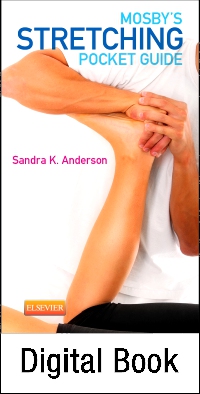

Mosby's Stretching Pocket Guide - Elsevier eBook on VitalSource, 1st Edition
Elsevier eBook on VitalSource
From basic static stretches to advanced techniques like the pin-and-stretch, Mosby’s Stretching Pocket Guide defines and explains stretching and flexibility in a way that is both applicable to manual therapy professionals and easily understood by manual therapy students. Presented in an atlas format with over 200 illustrations, this convenient reference has Spotlight boxes with salient points, and general assessment and stretching guidelines available in a clear, easy to understand format that is immediately applicable to manual therapy practice.
-
- Over 200 detailed line drawings and photos demonstrate basic and advanced stretching techniques.
- Atlas format helps students quickly and easily find the stretching technique and pertinent information they need.
- Coverage of basic information on stretching, flexibility, and range of motion equips students with just the right amount of background information to help them understand the body mechanics involved in stretching techniques.
- Spotlight boxes highlight key concepts so your students can check and reinforce facts at a glance.
- Glossary of stretching terms helps students understand the language of the body in terms of stretching.
- List of references helps students obtain more detailed information when necessary.
-
1. Stretching and Flexibility
• Stretching and flexibility are defined
• Principles behind stretching and flexibility
• Purpose and benefits of stretching
• Explanation of how stretches can be reasoned out instead of memorized
• Assessments to determine if stretching would be beneficial
• Identifying target muscles/tissues2. Basic Stretching Techniques
• Relationship between a line of tension and stretching
• Safe and effective stretching methods
• Direct tissue stretching
• Longitudinal and cross directional direct tissue stretching
• Difference between active and passive stretching
• Static stretching
• Dynamic stretching3. Advanced Stretching Techniques
• Pin and stretch
• Contract relax
• Contract relax agonist contract (CRAC)
• Combined stretching methods for increased effect4. Stretching for Self-Care
• Principles of Stretching for self-care
• StretchesGlossary
Index -
-
Ways of Reading
- The appearance of the text and page layout can be modified according to the capabilities of the reading system (font family and font size, spaces between paragraphs, sentences, words, and letters, as well as color of background and text)
- This e-publication is accessible to the full extent that the file format and types of content allow, on a specific reading device, by default, without necessarily including any additions such as textual descriptions of images or enhanced navigation
- No information about nonvisual reading is available
-
Conformance
- No information is available
-
Navigation
- Table of contents to all chapters of the text via links
- Page list to go to pages from the print source version
-
Rich Content
- No information is available
-
Hazards
- No information is available
-
Product Content
- No information is available
-
Legal Considerations
- No information is available
-
Additional Accessibility Information
- Page breaks included from the original print source
- For readers with color vision deficiency, use of color (e.g., in diagrams, graphics and charts, in prompts, or on buttons inviting a response) is not the sole means of graphical distinction or of conveying information
- E-publication includes basic navigation (usually less detailed than TOC-based navigation)
- Where links, controls or buttons are included in the content, the purpose or functionality of each link, control or button is apparent from the associated text alone - or where it is unclear, separate link, control or button descriptions are provided
- All (or substantially all) textual matter is arranged in a single logical reading order (including text that is visually presented as separate from the main text flow, e.g., in boxouts, captions, tables, footnotes, endnotes, citations, etc.). Non-textual content is also linked from within this logical reading order. (Purely decorative non-text content can be ignored).
- The language of the text has been specified (e.g., via the HTML or XML lang attribute) to optimise text-to-speech (and other alternative renderings), both at the whole document level and, where appropriate, for individual words, phrases or passages in a different language.
-
Ways of Reading

 as described in our