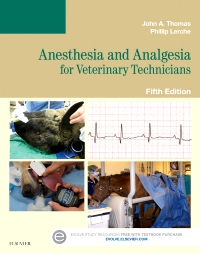

Anesthesia and Analgesia for Veterinary Technicians - Elsevier eBook on VitalSource, 5th Edition
Elsevier eBook on VitalSource
Now $65.69
Covering essential principles of anesthesia administration and pain management in small and large animals, Anesthesia and Analgesia for Veterinary Technicians, 5th Edition is completely updated with the latest drugs and techniques. This entry-level practical resource prepares you to properly administer anesthesia with the most up-to-date information on pre-anesthetic preparation of the patient, induction procedures, monitoring animals’ vital signs during the anesthetic period, and postoperative care. Dive into interesting discussions of actions and side effects of anesthetic agents; the physiology of respiration, heart rate, and blood pressure; emergency response; anesthetic equipment; and specialized techniques — and take a more integrated approach to learning techniques for anesthesia administration with the text’s expertly illustrated step-by-step procedures.
New Edition Expected Availability: 11-02-2023

Anesthesia and Analgesia for Veterinary Technicians and Nurses Elsevier eBook on VitalSource
-
- NEW! Updated drug information, equipment, and techniques keep you up-to-date on the latest advances in the field
- NEW! Content on camelid anesthesia prepares you to properly treat llamas and alpacas
-
- Comprehensive coverage of lab animals and large and small animals makes this an excellent resource for veterinary students and technicians
- Two large animal anesthesia chapters cover pain management and anesthetic techniques for equine, ruminant, camelid, and swine patients
- Procedures boxes offer clear step-by-step guidelines, with sequential, high-quality color photos, for performing common procedures during each phase of an anesthetic event
- Reference tables and boxes facilitate rapid access to information like fluid administration rates, properties of anesthetic drugs, oxygen flow rates, anesthetic protocols, and normal and abnormal monitoring parameters
- Vet Tech Threads help you grasp key content and include pedagogical aids, such as: introductions, suggested readings, boxed Technician Notes, learning objectives, chapter outlines, key terms, and a glossary
- Glossary at the end of the text provides you with accurate, concise definitions
- Evolve site provides you with additional interactive assets that reinforce what you learn in the text
-
1. Introduction to Anesthesia
2. Patient Preparation
3. Anesthetic Agents and Adjuncts
4. Anesthetic Equipment
5. Workplace Safety
6. Anesthetic Monitoring
7. Special Techniques
8. Analgesia
9. Canine and Feline Anesthesia
10. Equine Anesthesia
11. Anesthesia of Ruminants, Camelids, and Swine
12. Rodent and Rabbit Anesthesia
13. Anesthetic Problems and Emergencies -
-
Ways of Reading
- The appearance of the text and page layout can be modified according to the capabilities of the reading system (font family and font size, spaces between paragraphs, sentences, words, and letters, as well as color of background and text)
- This e-publication is accessible to the full extent that the file format and types of content allow, on a specific reading device, by default, without necessarily including any additions such as textual descriptions of images or enhanced navigation
- No information about nonvisual reading is available
-
Conformance
- No information is available
-
Navigation
- Table of contents to all chapters of the text via links
- Page list to go to pages from the print source version
-
Rich Content
- No information is available
-
Hazards
- No information is available
-
Product Content
- No information is available
-
Legal Considerations
- No information is available
-
Additional Accessibility Information
- Page breaks included from the original print source
- For readers with color vision deficiency, use of color (e.g., in diagrams, graphics and charts, in prompts, or on buttons inviting a response) is not the sole means of graphical distinction or of conveying information
- E-publication includes basic navigation (usually less detailed than TOC-based navigation)
- Where links, controls or buttons are included in the content, the purpose or functionality of each link, control or button is apparent from the associated text alone - or where it is unclear, separate link, control or button descriptions are provided
- All (or substantially all) textual matter is arranged in a single logical reading order (including text that is visually presented as separate from the main text flow, e.g., in boxouts, captions, tables, footnotes, endnotes, citations, etc.). Non-textual content is also linked from within this logical reading order. (Purely decorative non-text content can be ignored).
- The language of the text has been specified (e.g., via the HTML or XML lang attribute) to optimise text-to-speech (and other alternative renderings), both at the whole document level and, where appropriate, for individual words, phrases or passages in a different language.
-
Ways of Reading


 as described in our