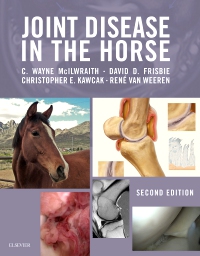

Joint Disease in the Horse - Elsevier eBook on VitalSource, 2nd Edition
Elsevier eBook on VitalSource
Now $175.49
Dr. McIlwraith’s Joint Disease in the Horse, 2nd Edition is the only book to give you a full account of equine joint disease, combining a thorough, up-to-date survey of scientific advances with a practical guide to both medical and surgical treatments. With contributions from nationally and internationally recognized pioneers in the field, this groundbreaking text offers an overview of joint structure and function and translates the latest information on basic joint pathobiology into practical application for the clinician. Step-by-step guidance on injection techniques and medications, along with a survey of practical arthroscopic surgery and developments, make it a truly indispensable reference for all equine veterinarians treating sports and racing horses.
-
- NEW! Full color throughout with new artwork and a range of new images including radiographs showing both the normal and the disease progression.
- NEW! Practical step-by-step approach demonstrates the authors’ preferred injections methods and shows underlying anatomic correlations.
- NEW and UPDATED! Restructured and substantially revised to emphasize treatment options, making it a practical, concise, and accessible reference and text.
- NEW! All-new chapters on drugs and new biological therapies, including stem cells, IRAP, and PRP and thoroughly updated coverage of HA and corticosteroids.
- NEW! Covers advanced imaging, giving you the latest information available.
- NEW! Expert advice from Dr. McIlwraith, three new co-editors, and new contributors — all distinguished specialists in the field of joint disease in the horse.
- Lameness and surgical clinicians describe how to approach the various, specific disease conditions.
- Equine specific radiologists provide their opinions on the best imaging techniques for defining the disease and making interpretations.
-
- UNIQUE! Unprecedented, state-of-the-art coverage of the pathology, pathogenesis, and clinical diagnosis of traumatic and degenerative joint disease, so you stay in the know.
- Section on general principles of joint pathobiology provides the background to evaluate and interpret the diagnostic and surgical aspects of disease.
- Explores treatments for traumatic arthritis and osteoarthritis and other joint entities, offering a broad range of options and up-to-date recommendations for problematic decisions.
- Addresses recent advances and results in arthroscopic surgery for the acute injury and results including fragment removal, fragment fixation, and synovectomy.
- Discussion of current research provides insight for difficult cases and calls out the directions in which future arthritis research is headed.
- More than 325 photographs and line drawings help engage and guide you through procedures and treatments.
-
-
 Joint Disease in the HorseHardcover
-
-
Section I: General Principles of Joint Pathobiology
1. General Anatomy and Physiology of Joints
2. Biomechanics
3. Traumatic Arthritis and Post-traumatic Osteoarthritis
4. Pathologic Manifestations of Joint Disease
5. Osteochondritis Dissecans
6. Subchondral Cystic Lesions
7. Infective (septic) Arthritis
8. Effect of Loading/Exercise on Articular TissuesSection II: General Principles of Diagnosis and Treatment
9. Principles of Diagnosis
10. Synovial fluid and serum biomarkersSection III: Principles of Therapy of Traumatic Arthritis and Osteoarthritis
11. Nonsteroidal Anti-inflammatory Drugs
12. Intraarticular Corticosteroids
13. Hyaluronan
14. Polysulfated Glycosaminoglycan (Adequan®)
15. Potential Use of Pentosan Polysulfate for the Treatment of Equine Joint Disease
16. Biological Therapies
17. Stem Cells
18. Rehabilitation
19. Use of oral joint supplements in equine joint diseaseSection IV: Specifics of Anatomy, Clinical Diagnosis, Imaging Diagnosis and Treatment by Region
20. Distal limb
21. Fetlock
22. Carpus
23. Elbow and Shoulder
24. Tarsus
25. Stifle
26. HipSection V: New Frontiers
27. Arthritis Research, Some Present and Future Direction in Joint Disease -
-
Ways of Reading
- The appearance of the text and page layout can be modified according to the capabilities of the reading system (font family and font size, spaces between paragraphs, sentences, words, and letters, as well as color of background and text)
- This e-publication is accessible to the full extent that the file format and types of content allow, on a specific reading device, by default, without necessarily including any additions such as textual descriptions of images or enhanced navigation
- No information about nonvisual reading is available
-
Conformance
- No information is available
-
Navigation
- Table of contents to all chapters of the text via links
- Page list to go to pages from the print source version
-
Rich Content
- No information is available
-
Hazards
- No information is available
-
Product Content
- No information is available
-
Legal Considerations
- No information is available
-
Additional Accessibility Information
- Page breaks included from the original print source
- For readers with color vision deficiency, use of color (e.g., in diagrams, graphics and charts, in prompts, or on buttons inviting a response) is not the sole means of graphical distinction or of conveying information
- E-publication includes basic navigation (usually less detailed than TOC-based navigation)
- Where links, controls or buttons are included in the content, the purpose or functionality of each link, control or button is apparent from the associated text alone - or where it is unclear, separate link, control or button descriptions are provided
- All (or substantially all) textual matter is arranged in a single logical reading order (including text that is visually presented as separate from the main text flow, e.g., in boxouts, captions, tables, footnotes, endnotes, citations, etc.). Non-textual content is also linked from within this logical reading order. (Purely decorative non-text content can be ignored).
- The language of the text has been specified (e.g., via the HTML or XML lang attribute) to optimise text-to-speech (and other alternative renderings), both at the whole document level and, where appropriate, for individual words, phrases or passages in a different language.
-
Ways of Reading

 as described in our