ISBN:
9780323327909
Copyright:
2015
Publication Date:
11-17-2014
Page Count:
112
Imprint:
Saunders
List Price:
$79.99

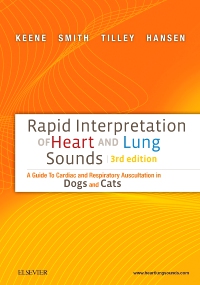
Rapid Interpretation of Heart and Lung Sounds - Elsevier eBook on VitalSource, 3rd Edition
by Bruce W. Keene, DVM, MSc, DACVIM, Francis W. K. Smith, DVM, DACVIM (Internal Medicine & Cardiology), Larry P. Tilley, DVM, DACVIM(Internal Medicine) and Bernie Hansen
Elsevier eBook on VitalSource
ISBN:
9780323327909
Copyright:
2015
Publication Date:
11-17-2014
Page Count:
112
Imprint:
Saunders
List Price:
$79.99
Was
$79.99
Now $75.99
Or $0.00 with a valid access code
Composed of a website and a companion book, this package demonstrates how to do accurate clinical evaluations of the heart and lungs in the examining room. The website offers step-by-step instructions on how to identify, interpret, and differentiate heart and lung sounds in dogs and cats. Made by using a heart sound simulator as well as recordings from patients, the website also covers heart murmurs and arrhythmias.The book expands on the website content and offers clear, concise illustrations of electrocardiograms (ECGs) and polarcardiograms (PCGs). It also includes pretests and post-tests to ensure thorough understanding of the material, as well as content on properties of sound, the stethoscope, and keys to successful auscultation.
-
Lung sounds added
Many more heart sounds
Section on murmurs and arrhythmia expended
Intros for each sound on the companion website have been expanded to provide more information -
- Heart sound simulator allows you to focus on the heart sounds without the distraction of respiratory sounds or artifacts of hair rubbing against the stethoscope.
- Wide variety of heart and lung sounds provides you with real-life cases that are as close to clinical practice as possible.
- Pretests may be taken prior to reviewing the book and website to measure how much you already know.
- Posttests help determine when the material has been mastered and direct the user to remediation in areas where additional study is needed.
- Inclusion of clinically-relevant conditions makes it easy for you to apply this information to day-to-day practice.
- Key points called out within the text alert you to potential problems, variations on techniques, and other treatment considerations.
-
Introduction
Suggestions for Program Use
Chapter 1: Heart Sounds
Chapter 2: Murmurs
Chapter 3: Arrhythmias
Chapter 4: Lung Sounds
Appendix -
-
Ways of Reading
- The appearance of the text and page layout can be modified according to the capabilities of the reading system (font family and font size, spaces between paragraphs, sentences, words, and letters, as well as color of background and text)
- This e-publication is accessible to the full extent that the file format and types of content allow, on a specific reading device, by default, without necessarily including any additions such as textual descriptions of images or enhanced navigation
- No information about nonvisual reading is available
-
Conformance
- No information is available
-
Navigation
- Table of contents to all chapters of the text via links
- Page list to go to pages from the print source version
-
Rich Content
- No information is available
-
Hazards
- No information is available
-
Product Content
- No information is available
-
Legal Considerations
- No information is available
-
Additional Accessibility Information
- Page breaks included from the original print source
- For readers with color vision deficiency, use of color (e.g., in diagrams, graphics and charts, in prompts, or on buttons inviting a response) is not the sole means of graphical distinction or of conveying information
- E-publication includes basic navigation (usually less detailed than TOC-based navigation)
- Where links, controls or buttons are included in the content, the purpose or functionality of each link, control or button is apparent from the associated text alone - or where it is unclear, separate link, control or button descriptions are provided
- All (or substantially all) textual matter is arranged in a single logical reading order (including text that is visually presented as separate from the main text flow, e.g., in boxouts, captions, tables, footnotes, endnotes, citations, etc.). Non-textual content is also linked from within this logical reading order. (Purely decorative non-text content can be ignored).
- The language of the text has been specified (e.g., via the HTML or XML lang attribute) to optimise text-to-speech (and other alternative renderings), both at the whole document level and, where appropriate, for individual words, phrases or passages in a different language.
-
Ways of Reading

Was
$79.99
Now $75.99
Or $0.00 with a valid access code

 as described in our