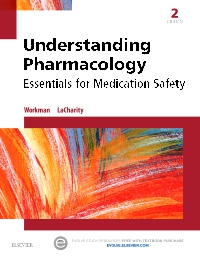

Understanding Pharmacology - Elsevier eBook on VitalSource, 2nd Edition
Elsevier eBook on VitalSource
Now $64.79
Pharmacology can be difficult. But with the right text, understanding drugs and how they work doesn’t have to be! Using easy-to-follow language and engaging learning tools — like Memory Joggers, Clinical Pitfalls, Do Not Confuse, and Drug Alerts — the second edition of Understanding Pharmacology: Essentials for Medication Safety helps readers really understand how drugs work. In addition to the popular critical thinking activities from the first edition, the second edition also includes more chapter review questions, updated content, and a new organization that centers on the different body systems. For students who have a limited background in the sciences and want complete preparation for licensure exams and clinical practice, there is no better choice than Understanding Pharmacology, 2nd Edition!
New Edition Expected Availability: 02-21-2023

Understanding Pharmacology - Elsevier eBook on VitalSource
-
- NEW! Body system organization helps readers better understand drugs that are specific to particular body systems
- NEW! More chapter review questions have been added to the text. All review questions are now organized into one of two categories: Test Yourself on the Basics and Test Yourself on Advanced Concepts
-
- Entire unit reviewing math, weights and measures, and dosage calculation minimizes readers’ anxiety and promotes medication safety
- Clever, easy-to-recognize margin icons help visual learners remember essential side effects of drugs
- Simplified heading structure replaces intimidating terminology (i.e. pharmacokinetics) with simplified language (How These Drugs Work) to increase understanding of concepts
- Drug Alert!, Do-Not-Confuse, and Clinical Pitfall boxes highlight important tips for safe medication administration
- Memory Jogger boxes help readers remember important drug information
- Get Ready for Practice sections at the end of each chapter include key points, chapter review questions, and critical thinking activities to reinforce learning
- 10th grade reading level uses straightforward, everyday language to really enhance readers’ understanding of pharmacology concepts
- Incorporation of adult learning theory features both a simple to complex organization of material along with answers to why readers need to learn something
-
-
 Study Guide for Understanding Pharmacology - Elsevier eBook on VitalSourceElsevier eBook on VitalSource
-
-
UNIT I: General Aspects of Pharmacology
1. Drug Regulation, Actions, and Responses
2. Safely Preparing and Giving Drugs
UNIT II: Mathematics for Pharmacology and Dosage Calculation
3. Mathematics Review and Introduction to Dosage Calculations
4. Medical Systems of Weights and Measures
5. Dosage Calculation of Intravenous solutions and Drugs
UNIT III: Pharmacology For Multisystem Application
6. Anti-Inflammatory Drugs
7. Drugs for Pain Control
8. Anti-Infectives: Antibacterial Drugs
9. Anti-Infectives: Antiviral Drugs
10. Anti-Infectives: Antitubercular and Antifungal Drugs
11. Immunizations
12. Anticancer Drugs
Unit IV: Drug Therapy for Endocrine Problems
13. Drug therapy for Diabetes
14. Drug Therapy for Thyroid and Adrenal Gland Problems
Unit V: Drug Therapy for Problems of the Circulatory and Cardiac Systems
15. Drug Therapy Affecting Urine Output
16. Drug Therapy for Hypertension
17. Drug Therapy for Heart Failure
18. Drug Therapy for Dysrhythmias
19. Drug Therapy for High Blood Lipids
20. Drug Therapy to Disrupt Clotting
Unit VI: Drug Therapy for Respiratory System Problems
21. Drug Therapy for Asthma, Chronic Obstructive Pulmonary Disease, and Pulmonary Fibrosis/Hypertension
Unit VII: Drug Therapy for Gastrointestinal System Problems
22. Drug Therapy for Gastrointestinal Dysfunction
23. Drug Therapy for Gastric Ulcers and Reflux
24. Drug Therapy with Nutritional Supplements
Unit VIII: Drug Therapy for Nervous System Problems
25. Drug Therapy for Seizures
26. Drug Therapy for Parkinson’s and Alzheimer’s Diseases
27. Drug Therapy for Psychiatric Problems
28. Drug Therapy for Insomnia
29. Drug Therapy for Eye Problems
Unit IX: Drug Therapy for Problems of the Musculoskeletal System
30. Drug Therapy for Osteoporosis and Muscle Relaxation
Unit X: Drug Therapy for Problems of the Reproductive System
31. Drug Therapy for Male Reproductive Problems
32. Drug Therapy for Female Reproductive Problems -
-
Ways of Reading
- The appearance of the text and page layout can be modified according to the capabilities of the reading system (font family and font size, spaces between paragraphs, sentences, words, and letters, as well as color of background and text)
- This e-publication is accessible to the full extent that the file format and types of content allow, on a specific reading device, by default, without necessarily including any additions such as textual descriptions of images or enhanced navigation
- No information about nonvisual reading is available
-
Conformance
- The publication was certified on 27-05-2026
-
Navigation
- Table of contents to all chapters of the text via links
- Page list to go to pages from the print source version
-
Rich Content
- No information is available
-
Hazards
- No information is available
-
Product Content
- No information is available
-
Legal Considerations
- No information is available
-
Additional Accessibility Information
- Page breaks included from the original print source
- For readers with color vision deficiency, use of color (e.g., in diagrams, graphics and charts, in prompts, or on buttons inviting a response) is not the sole means of graphical distinction or of conveying information
- E-publication includes basic navigation (usually less detailed than TOC-based navigation)
- Where links, controls or buttons are included in the content, the purpose or functionality of each link, control or button is apparent from the associated text alone - or where it is unclear, separate link, control or button descriptions are provided
- All (or substantially all) textual matter is arranged in a single logical reading order (including text that is visually presented as separate from the main text flow, e.g., in boxouts, captions, tables, footnotes, endnotes, citations, etc.). Non-textual content is also linked from within this logical reading order. (Purely decorative non-text content can be ignored).
- The language of the text has been specified (e.g., via the HTML or XML lang attribute) to optimise text-to-speech (and other alternative renderings), both at the whole document level and, where appropriate, for individual words, phrases or passages in a different language.
-
Ways of Reading

 as described in our