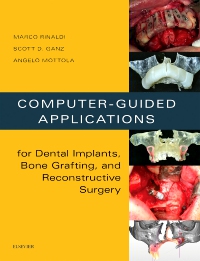

Computer-Guided Applications for Dental Implants, Bone Grafting, and Reconstructive Surgery (adapted translation) - Elsevier eBook on VitalSource, 1st Edition
Elsevier eBook on VitalSource
Now $189.69
Written by recognized dental implant surgery experts Marco Rinaldi, Scott Ganz, and Angelo Mottola, Computer-Guided Applications for Dental Implants, Bone Grafting, and Reconstructive Surgery is the first text to provide state-of-the-art information on procedures and techniques used in guided dental implant surgery and bone grafting. It begins with the basic principles of guided dental implants including anatomical obstacles, pathologies, and pharmacological management of patients, and then uses a templated, atlas format to discuss clinical case studies. With a companion website includes videos demonstrating surgical procedures, this text makes it easier for the entire surgical team to share in the diagnosis and treatment planning for patients receiving implants.
-
- Coverage of computer-guided surgery from treatment planning to recovery includes a combination of actual 3-D computed imagery and clinical photos to clearly demonstrate implant surgeries.
- Bone grafting protocols address 3-D evaluation of bone density and the use of bone grafts to augment bone volume prior to dental implant surgery.
- 40 case studies include pre- and post-operative considerations as well as the description of the surgical procedure, using high-quality clinical photos as well as CT and 3-D images to clearly illustrate every guided-implant challenge.
- Over 1,800 full-color images include pre-, intra-, and post-operative photographs, showing pathologies, procedures, and outcomes.
- Expert, authoritative authors provide guidance based upon extensive experience with current techniques as well as the latest technological advances in guided-implant surgery.
- A companion website includes 10 video clips that are linked to selected clinical cases in the text.
- Digital book formats supplement the print book, making this reference easy to access on iPads, tablets, e-readers, and smart phones.
-
Part I: Theory and Rationale
1. Anatomical Obstacles to Implant Placement
2. Bone Grafts
3. Computer-Assisted Implant Surgery
4. Maxillary Sinus: the Role of the Otolaryngologist
5. Pharmacological Management of Patients
Part II: Clinical Cases – Dr. Marco Rinaldi
Section A: Computer-Guided Applications for Dental Implants
CC1
Maxillary partially edentulism, guided implantology
CC2
Partial edentulism, guided implantology
CC3
Mandibular single edentulism, guided implantology
CC4
Maxillary partial edentulism flapless guided implantology
CC5
Lateral incisor agenesis with narrow space between incisor and canine, immediate loading
CC6
Mandibular edentulism, flapless guided implantology
CC7
Mandibular edentulism, tilted implants, guided implantology
CC8
Mandibular edentulism, guided implantology, tilted implants
CC9
Mandibular edentulism, guided implantology, tilted implants
CC10
Maxillary edentulism, guided implantology , tilted implants
CC11
Maxillary edentulism, guided implantology, tilted implants
CC12
Maxillary and mandibular edentulism, guided implantology, tilted implants
CC13
Maxillary and mandibular edentulism, guided implantology, tilted implants, immediate loading
CC14
Maxillary edentulism, guided implantology, tilted implants
CC15
Maxillary edentulism angled implants and digital cast
CC16 VIDEO
Extractions with simultaneous implants placement Reduction guide
CC17 VIDEO
Supernumerary impacted teeth
Section B: Computer-Guided Applications for Bone Grafting and Reconstructive Surgery
CC18 VIDEO
Maxillary and mandibular severe bone defects bone grafting
CC 19 VIDEO
Maxillary severe bone defects bone grafting
CC 20
Maxillary Edentulism, bone and sinus graft planned on STL model, guided implantology
CC21 VIDEO
Maxillary Edentulism, cystectomy and bone graft planned on STL model, guided implantology, immediate implant placements
CC22
Maxillary Edentulism, bone graft planned on STL model, guided implantology
CC23
Maxillary Edentulism, bone graft planned on STL model, guided implantology
CC24
Maxillary Edentulism, bone and sinus graft planned on STL model, guided implantology
CC25
Maxillary Edentulism, sinus and bone graft planned on STL model, tilted implants
CC26
Maxillary and mandibular edentulism, bone grafts, planned on STL model, guided implantology
CC27
Maxillary edentulism, sinus and bone graft planned on STL model, guided implantology
CC28 VIDEO
Posterior Mandibular Bone defects in thickness and height
CC29
Posterior Mandibular Bone defects in thickness and height
CC30
Bilateral agenesis of lateral incisors with bone defect in thickness harvesting bone from mandibular body and ascending ramus
CC31
Mandibular partially edentulism bone graft planned on STL model
CC32
Maxillary edentulism, sinus graft with heterologous bone block, performed on STL model
CC33 VIDEO
Bilateral sinus floor augmentation, harvesting bone from Posterior Superior Iliac Spine
CC34
Sinus floor augmentation in presence of sinus septa, harvesting bone from Posterior Superior Iliac Spine
CC35
Partially edentulism, bilateral sinus grafts planned on STL model
CC36
Sinus floor augmentation and implant placement
CC37 VIDEO
Sinus floor augmentation and implant placement
CC38
Sinus floor augmentation with stereolithographic sinus graft guide with implants placement 20B
CC39 VIDEO
Bilateral sinus augmentation
CC40 VIDEO
Zygomatic implant in a case of Hemimaxillectomy -
-
Ways of Reading
- The appearance of the text and page layout can be modified according to the capabilities of the reading system (font family and font size, spaces between paragraphs, sentences, words, and letters, as well as color of background and text)
- This e-publication is accessible to the full extent that the file format and types of content allow, on a specific reading device, by default, without necessarily including any additions such as textual descriptions of images or enhanced navigation
- No information about nonvisual reading is available
-
Conformance
- No information is available
-
Navigation
- Table of contents to all chapters of the text via links
- Page list to go to pages from the print source version
-
Rich Content
- No information is available
-
Hazards
- No information is available
-
Product Content
- No information is available
-
Legal Considerations
- No information is available
-
Additional Accessibility Information
- Page breaks included from the original print source
- For readers with color vision deficiency, use of color (e.g., in diagrams, graphics and charts, in prompts, or on buttons inviting a response) is not the sole means of graphical distinction or of conveying information
- E-publication includes basic navigation (usually less detailed than TOC-based navigation)
- Where links, controls or buttons are included in the content, the purpose or functionality of each link, control or button is apparent from the associated text alone - or where it is unclear, separate link, control or button descriptions are provided
- All (or substantially all) textual matter is arranged in a single logical reading order (including text that is visually presented as separate from the main text flow, e.g., in boxouts, captions, tables, footnotes, endnotes, citations, etc.). Non-textual content is also linked from within this logical reading order. (Purely decorative non-text content can be ignored).
- The language of the text has been specified (e.g., via the HTML or XML lang attribute) to optimise text-to-speech (and other alternative renderings), both at the whole document level and, where appropriate, for individual words, phrases or passages in a different language.
-
Ways of Reading


 as described in our