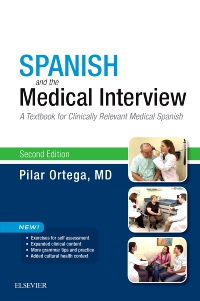

Spanish and the Medical Interview Elsevier eBook on VitalSource, 2nd Edition
Elsevier eBook on VitalSource
Now $30.59
Focusing on communication needs in real-world clinical situations, Dr. Pilar Ortega’s updated edition of this practical text helps you address today’s growing demand for Spanish-speaking physicians and healthcare workers. This pocket-sized resource provides basic Spanish skills, sample interview questions, relevant cultural information, and more, in addition to online videos of physician-patient interactions, interactive self-assessment tools, and clinical vignettes. You’ll find exactly what you need to develop better physician-patient communication skills, increase your cultural competence, and make better clinical decisions in your practice.
New Edition Expected Availability: 03-25-2027

Spanish and the Medical Interview Elsevier eBook on VitalSource
-
- Understand the nuts and bolts of better communication through Spanish grammar, vocabulary, pronunciation, sample interview questions, and helpful interview techniques
- Pocket size allows for quick reference in an easily accessible format
-
-
 Spanish and the Medical InterviewPaperback
-
-
1. Basics of Conversational Spanish
2. Setting the Stage for the Clinical Encounter
3. History of the Present Illness
4. Past Medical History and Review of Systems
5. Medications and Drug Effects
6. Family History
7. Social and Sexual History
8. Mental Health and Cognition
9. Preventive Health and Nutrition
10. Pediatrics
11. Physical Examination
12. Procedures and Informed Consent
13. Impression and Plan
14. Knowing your Limitations: When and How to Use a Medical Interpreter -
-
Ways of Reading
- The appearance of the text and page layout can be modified according to the capabilities of the reading system (font family and font size, spaces between paragraphs, sentences, words, and letters, as well as color of background and text)
- This e-publication is accessible to the full extent that the file format and types of content allow, on a specific reading device, by default, without necessarily including any additions such as textual descriptions of images or enhanced navigation
- No information about nonvisual reading is available
-
Conformance
- No information is available
-
Navigation
- Table of contents to all chapters of the text via links
- Page list to go to pages from the print source version
-
Rich Content
- No information is available
-
Hazards
- No information is available
-
Product Content
- No information is available
-
Legal Considerations
- No information is available
-
Additional Accessibility Information
- Page breaks included from the original print source
- For readers with color vision deficiency, use of color (e.g., in diagrams, graphics and charts, in prompts, or on buttons inviting a response) is not the sole means of graphical distinction or of conveying information
- E-publication includes basic navigation (usually less detailed than TOC-based navigation)
- Where links, controls or buttons are included in the content, the purpose or functionality of each link, control or button is apparent from the associated text alone - or where it is unclear, separate link, control or button descriptions are provided
- All (or substantially all) textual matter is arranged in a single logical reading order (including text that is visually presented as separate from the main text flow, e.g., in boxouts, captions, tables, footnotes, endnotes, citations, etc.). Non-textual content is also linked from within this logical reading order. (Purely decorative non-text content can be ignored).
- The language of the text has been specified (e.g., via the HTML or XML lang attribute) to optimise text-to-speech (and other alternative renderings), both at the whole document level and, where appropriate, for individual words, phrases or passages in a different language.
-
Ways of Reading

 as described in our