ISBN:
9780323378154
Copyright:
2017
Publication Date:
12-22-2016
Page Count:
217
Imprint:
Mosby
List Price:
$56.99

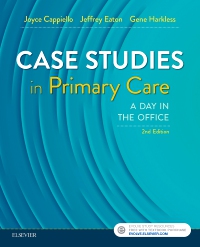
Case Studies in Primary Care - Elsevier eBook on VitalSource, 2nd Edition
by Joyce D. Cappiello, PhD, FNP, FAANP, Jeffrey A. Eaton, PhD, NP and Gene E. Harkless, DNSc, FNP-BC, CNL, FAANP
Elsevier eBook on VitalSource
ISBN:
9780323378154
Copyright:
2017
Publication Date:
12-22-2016
Page Count:
217
Imprint:
Mosby
List Price:
$56.99
Was
$56.99
Now $39.89
Real-world scenarios help you develop clinical reasoning skills for primary care! Case Studies in Primary Care: A Day in the Office, 2nd Edition includes 50 case studies on the most commonly encountered situations in primary care. Demonstrating the kinds of health problems that a Nurse Practitioner or Physician Assistant might see during a typical clinical day, case studies cover patients from various cultures and all ages. You’re asked to analyze data and think critically in reaching accurate diagnoses and planning effective treatment; you can then submit your responses online for grading and instant feedback.
-
- Six NEW cases are included (for a total of 50), with three focusing on older clients with more complex health challenges, one addressing unplanned pregnancy, and two addressing practice management issues.
- NEW! Emphasis on follow-up care addresses patients coming to the primary care setting from retail clinics, rehabilitation settings, or acute-care settings, and underscores the importance of interprofessional collaboration.
- NEW! Enhanced patient diversity includes cases for all age groups, and reflects a more contemporary appreciation of cultural diversity and gender/gender identity.
- NEW! Updates to all cases ensure that case studies and feedback are consistent with the latest research evidence, clinical practice guidelines, and national and international treatment standards.
- NEW! Online answer submission allows you to write Assessment and Plan answers in the printed book, then submit answers online for grading and feedback.
- NEW! Grading rubrics are provided on the companion Evolve website to help you develop your answers.
- NEW! Introduction explains how to get the most out of the book.
-
- Real-world scenarios offer the opportunity to analyze clinical situations likely to be encountered in today's primary care settings, providing practice in clinical reasoning skills.
- Day in the Office format presents cases hour by hour, in the way a typical clinical day might unfold.
- Emphasis on problem-based learning helps you to think critically and analyze clinical situations — such as ear infections, diarrhea, and coughing and fever — in order to provide appropriate primary care.
-
Day 1
7:45 am CASE #1 Organizing and managing your day NEW!
8:00 am CASE #2 Complete physical exam
8:30 am CASE #3 Incontinence NEW!
9:00 am CASE #4 Unintended pregnancy NEW!
9:15 am CASE #5 Dysuria
9:30 am CASE #6 Head congestion
9:45 am CASE #7 Rash
10:00 am CASE #8 Complete physical exam, headaches
10:45 am CASE# 9 Emergency contraception
11:00 am CASE #10 Well child check
11:30 am CASE #11 Travel
11:45 am CASE #12 Upper respiratory infection
Lunchtime Phone Call CASE #13 Negative PPD
1:00 pm CASE #14 Ear infection
1:15 pm CASE #15 Anemia
1:30 pm CASE #16 Cholesterol follow-up
1:45 pm CASE #17 Contraception
2:00 pm CASE #18 Ankle pain
2:15 pm CASE #19 Acne
2:45 pm CASE #20 Heartburn
3:15 pm CASE #21 Recurrent diarrhea
3:45 pm CASE #22 Head lice
4:00 pm CASE #23 Diabetes follow-up
4:30 pm CASE #24 Scrotal pain
After Office Hours
Add-on CASE #25 Review Pap results (patient not present)
Phone Call #1 at closing CASE #26 Rectal bleeding
Phone Call #2 at closing CASE #27 Worms
Day 2
8:00 am CASE #28 Sports physical exam
8:30 am CASE #29 Chronic atrial fibrillation, diabetes NEW!
9:00 am CASE #30 Low back pain
9:15 am CASE #31 Hypertension
9:45 am CASE #32 Left great toe pain
10:00 am CASE #33 Complete physical exam
10:45 am CASE #34 Diarrhea
11:00 am CASE #35 Annual GYN, depressed
11:30 am CASE #36 Annual GYN, intimate-partner violence
Review diagnostic report CASE #37 Mammogram report
1:00 pm CASE #38 Allergy shot
1:15 pm CASE #39 Cough, fever, chills
1:30 pm CASE #40 Prenatal check
1:45 pm CASE #41 Urinary incontinence
2:30 pm CASE #42 Eye redness
2:45 pm CASE #43 Scrotal pain
3:00 pm CASE #44 Vaginal discharge
3:15 pm CASE #45 Wrist pain
3:30 pm CASE #46 Confusion
4:00 pm CASE #47 Weight gain NEW!
4:30 pm CASE #48 Difficulty starting urinary stream
4:45 pm CASE #49 Cough
After Office Hours
6:00 pm CASE #50 Staff Meeting to review financials NEW! -
-
Ways of Reading
- The appearance of the text and page layout can be modified according to the capabilities of the reading system (font family and font size, spaces between paragraphs, sentences, words, and letters, as well as color of background and text)
- This e-publication is accessible to the full extent that the file format and types of content allow, on a specific reading device, by default, without necessarily including any additions such as textual descriptions of images or enhanced navigation
- No information about nonvisual reading is available
-
Conformance
- No information is available
-
Navigation
- Table of contents to all chapters of the text via links
- Page list to go to pages from the print source version
-
Rich Content
- No information is available
-
Hazards
- No information is available
-
Product Content
- No information is available
-
Legal Considerations
- No information is available
-
Additional Accessibility Information
- Page breaks included from the original print source
- For readers with color vision deficiency, use of color (e.g., in diagrams, graphics and charts, in prompts, or on buttons inviting a response) is not the sole means of graphical distinction or of conveying information
- E-publication includes basic navigation (usually less detailed than TOC-based navigation)
- Where links, controls or buttons are included in the content, the purpose or functionality of each link, control or button is apparent from the associated text alone - or where it is unclear, separate link, control or button descriptions are provided
- All (or substantially all) textual matter is arranged in a single logical reading order (including text that is visually presented as separate from the main text flow, e.g., in boxouts, captions, tables, footnotes, endnotes, citations, etc.). Non-textual content is also linked from within this logical reading order. (Purely decorative non-text content can be ignored).
- The language of the text has been specified (e.g., via the HTML or XML lang attribute) to optimise text-to-speech (and other alternative renderings), both at the whole document level and, where appropriate, for individual words, phrases or passages in a different language.
-
Ways of Reading

Was
$56.99

 as described in our