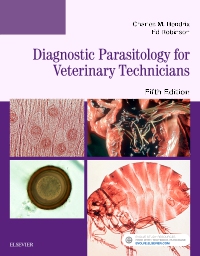

Diagnostic Parasitology for Veterinary Technicians - Elsevier eBook on VitalSource, 5th Edition
Elsevier eBook on VitalSource
Now $80.99
Recognize and treat the parasites seen in veterinary practice! Diagnostic Parasitology for Veterinary Technicians, 5th Edition features clear and concise discussions of the most commonly encountered internal and external parasites. Chapters are organized by parasite group — including nematodes, cestodes, trematodes, protozoans, arthropods, and leeches — and include a detailed description of the group, with special emphasis on morphology, life cycle, and important parasites. Then in each chapter, material is conveniently organized by host species: dogs, cats, horses, ruminants, swine, birds, lab animals, fish, and reptiles. Written by noted educators Charles Hendrix and Ed Robinson, this full-color, spiral-bound book provides the knowledge that veterinary technicians need to collect samples, perform lab procedures, and communicate with clients and other members of the veterinary team.
New Edition Expected Availability: 07-21-2022

Diagnostic Parasitology for Veterinary Technicians - Elsevier eBook on VitalSource
-
- NEW case studies provide more opportunities to apply what you have learned, and bring to life a subject that can be dry and difficult
- UPDATED information throughout provides the most up-to-date coverage of the parasites most often seen in veterinary practice
- NEW! End-of-chapter matching exercises and online activities make study and review easier
-
- Clear, concise coverage simplifies information on the most commonly encountered internal and external parasites, preparing you for credentialing exams and the veterinary clinic
- More than 470 full-color photos show exactly what ova, adult parasites, and parasitic diseases look like, so you can identify them more easily when viewing lab samples
- Step-by-step guidelines in the Laboratory Procedures chapter describe how to gather samples and how to perform the laboratory techniques used in identifying parasites
- Emphasis on the zoonotic potential of parasites helps you alert clients and other health care workers to the significance of zoonotic parasites and shows ways in which you can prevent transmission of a zoonotic parasite, condition, or syndrome from animals to humans
- Logical chapter organization follows the sequence of parasitology classes, beginning with a basic overview of external parasites, internal parasites, and nematodes, followed by chapters that go into detail of the parasites by host species. An appendix lists the parasites of each species and shows their location in the text, making information easy to find
- Heartworm section helps you recognize and treat heartworms with an in-depth discussion of the performance and interpretation of diagnostic tests for this major parasite
- Summary tables show how to categorize parasites, and include such categories as body systems affected, taxonomic grouping, host species, and location in host
- Table of parasites at the front of the book is arranged by host species and includes page numbers for cross-reference throughout the book
- Vet Tech Threads design makes learning easier with chapter outlines, chapter objectives, key terms, and Technician Notes in every chapter
- Chapter on terminology familiarizes you with the basic language and classification scheme of parasitology for more effective communication with clients and colleagues
- Flash cards on the Evolve companion website help you learn and memorize key facts about the major parasites, including audio pronunciations
- Workbook/textbook format provides immediate review tools through matching exercises and questions for thought and discussion at the end of each chapter
-
1. The Language of Veterinary Parasitology
2. Parasites That Infect and Infest Domestic Animals
3. Introduction to the Nematodes
4. Nematodes that Infect Domestic Animals
5. The Phylum Platyhelminthes, Class Cestoda
6. Tapeworms that Parasitize Domestic Animals and Humans
7. The Phylum Platyhlminthes, Class Trematoda
8. Trematodes (Flukes) of Animals and Humans
9. The Phylum Acanthocephala
10. The Protozoans
11. Common Protozoans That Infect Domestic Animals
12. Introduction to the Arthropods
13. Arthropods That Infect and Infest Domestic Animals
14. Introduction to the Phylum Arthropoda, Subphylum Pentastomida
15. The Phylum Annelida
16. Parasites of Public Health Importance in Veterinary Parasitology
17. Common Laboratory Procedures for Diagnosing Parasitism
18. Reference to Common Parasite Ova and Forms Seen in Veterinary Medicine -
-
Ways of Reading
- The appearance of the text and page layout can be modified according to the capabilities of the reading system (font family and font size, spaces between paragraphs, sentences, words, and letters, as well as color of background and text)
- This e-publication is accessible to the full extent that the file format and types of content allow, on a specific reading device, by default, without necessarily including any additions such as textual descriptions of images or enhanced navigation
- No information about nonvisual reading is available
-
Conformance
- The publication was certified on 27-05-2026
-
Navigation
- Table of contents to all chapters of the text via links
- Page list to go to pages from the print source version
-
Rich Content
- No information is available
-
Hazards
- No information is available
-
Product Content
- No information is available
-
Legal Considerations
- No information is available
-
Additional Accessibility Information
- Page breaks included from the original print source
- For readers with color vision deficiency, use of color (e.g., in diagrams, graphics and charts, in prompts, or on buttons inviting a response) is not the sole means of graphical distinction or of conveying information
- E-publication includes basic navigation (usually less detailed than TOC-based navigation)
- Where links, controls or buttons are included in the content, the purpose or functionality of each link, control or button is apparent from the associated text alone - or where it is unclear, separate link, control or button descriptions are provided
- All (or substantially all) textual matter is arranged in a single logical reading order (including text that is visually presented as separate from the main text flow, e.g., in boxouts, captions, tables, footnotes, endnotes, citations, etc.). Non-textual content is also linked from within this logical reading order. (Purely decorative non-text content can be ignored).
- The language of the text has been specified (e.g., via the HTML or XML lang attribute) to optimise text-to-speech (and other alternative renderings), both at the whole document level and, where appropriate, for individual words, phrases or passages in a different language.
-
Ways of Reading


 as described in our