ISBN:
9780323394888
Copyright:
2016
Publication Date:
11-11-2015
Page Count:
656
Imprint:
Saunders
List Price:
$89.99

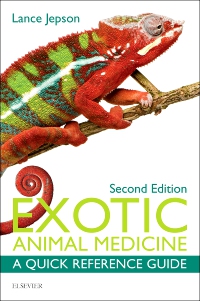
Exotic Animal Medicine - Elsevier eBook on VitalSource, 2nd Edition
by Lance Jepson, MA, VetMB, MRSB, MRCVS
Elsevier eBook on VitalSource
ISBN:
9780323394888
Copyright:
2016
Publication Date:
11-11-2015
Page Count:
656
Imprint:
Saunders
List Price:
$89.99
Was
$89.99
Now $80.99
Or $0.00 with a valid access code
Exotic pets are more popular than ever before, so make sure you are ready to care for everything from rats to songbirds with Exotic Animal Medicine: A Quick Reference Guide, 2nd Edition. Expanded with three all new chapters and updated content, this new edition provides the key points on differential diagnoses and diagnostics, along with background information on a wide variety of exotic pets, to veterinary practitioners who may or may not have experience treating them. Its practical quick-reference outline format makes it easy for you to see the conditions likely to be encountered within a species; develop a potential differential diagnosis list quickly; initiate an investigational plan; and view treatment regimens.
-
- NEW! All new chapters on marmosets and tamarins, hedgehogs, and sugar gliders provide up-to-date coverage of exotic species you may encounter in the clinic
- NEW! Thoroughly updated and expanded coverage of exotic species and the problems that may plague them helps you develop a potential differential diagnosis list quickly and seek appropriate care for exotic animals, such as: ferrets, rabbits, guinea pigs, chinchillas, pet rats, hamsters and other small rodents; parrots, budgerigars and related species, canaries, finches, toucans; lizards, snakes, tortoises and turtles, frogs, salamanders; pond fish, tropical freshwater fish and tropical marine fish
-
- Covers the most commonly encountered exotic species in one text, making it a succinct and practical clinician’s guide to diagnosing and treating a wide variety of exotic pets
- Expert advice on diagnostic approaches, clinical techniques, anesthetic protocols, and treatment regimens offers an invaluable source of useful clinically applicable material
- Organization of chapters by species and clinical signs enables you to access information easily and efficiently
- User-friendly outline format allows the guide to act as a quick reference in the clinical setting
-
-
 Exotic Animal MedicinePaperback
-
-
1. Ferrets
2. Rabbits
3. Guinea Pigs, Chinchillas and Degus
4. Small Rodents
5. Marmosets and Tamarins
6. Hedgehogs
7. Sugar Gliders
8. Parrots and Related Species
9. Songbirds and Softbills
10. Lizards
11. Snakes
12. Tortoises and Turtles
13. Amphibians
14. Goldfish and Koi
15. Tropical Freshwater Fish
16. Tropical Marine Fish -
-
Ways of Reading
- The appearance of the text and page layout can be modified according to the capabilities of the reading system (font family and font size, spaces between paragraphs, sentences, words, and letters, as well as color of background and text)
- This e-publication is accessible to the full extent that the file format and types of content allow, on a specific reading device, by default, without necessarily including any additions such as textual descriptions of images or enhanced navigation
- No information about nonvisual reading is available
-
Conformance
- No information is available
-
Navigation
- Table of contents to all chapters of the text via links
- Page list to go to pages from the print source version
-
Rich Content
- No information is available
-
Hazards
- No information is available
-
Product Content
- No information is available
-
Legal Considerations
- No information is available
-
Additional Accessibility Information
- Page breaks included from the original print source
- For readers with color vision deficiency, use of color (e.g., in diagrams, graphics and charts, in prompts, or on buttons inviting a response) is not the sole means of graphical distinction or of conveying information
- E-publication includes basic navigation (usually less detailed than TOC-based navigation)
- Where links, controls or buttons are included in the content, the purpose or functionality of each link, control or button is apparent from the associated text alone - or where it is unclear, separate link, control or button descriptions are provided
- All (or substantially all) textual matter is arranged in a single logical reading order (including text that is visually presented as separate from the main text flow, e.g., in boxouts, captions, tables, footnotes, endnotes, citations, etc.). Non-textual content is also linked from within this logical reading order. (Purely decorative non-text content can be ignored).
- The language of the text has been specified (e.g., via the HTML or XML lang attribute) to optimise text-to-speech (and other alternative renderings), both at the whole document level and, where appropriate, for individual words, phrases or passages in a different language.
-
Ways of Reading
Was
$89.99
Now $80.99
Or $0.00 with a valid access code

 as described in our