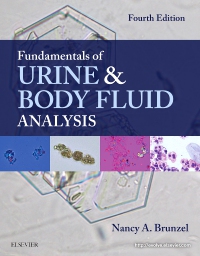

Fundamentals of Urine and Body Fluid Analysis - Elsevier eBook on VitalSource, 4th Edition
Elsevier eBook on VitalSource
Now $51.09
Learn to accurately analyze urine and body fluids with Fundamentals of Urine & Body Fluid Analysis, 4th Edition. Known for its clear writing style, logical organization, and vivid full-color illustrations, this renowned text covers the fundamental principles of urine and body fluids that are frequently encountered in the clinical laboratory. This includes the collection and analysis of urine, fecal specimens, vaginal secretions, and other body fluids such as cerebrospinal, synovial, seminal, amniotic, pleural, pericardial, and peritoneal fluids. In addition, author Nancy Brunzel also shares her own extensive knowledge and expertise in the field as she highlights key information and walks you through essential techniques and procedures — showing you how to correlate data with your knowledge of basic anatomy and physiology in order to understand pathologic processes. In all, this is the perfect book to help you master all aspects of urine and body fluid analysis.
New Edition Expected Availability: 06-14-2022

Fundamentals of Urine and Body Fluid Analysis - Elsevier eBook on VitalSource
-
- NEW! Fully updated content provides the latest information and procedures in fluid analysis.
- NEW! Updated illustrations and micrographs paint a vivid picture of text concepts to ensure you can properly identify fluid elements.
-
- UNIQUE! Analysis of Vaginal Secretions chapter covers vaginal wet preps — a fluid collected and evaluated frequently in physician offices.
- UNIQUE! Image gallery on urine sediment houses 100 urine sediment micrographs to help you accurately identify urine sediment elements.
- UNIQUE! Chapter on microscopy provides valuable information as you complete clinical work with microscopes.
- Full color, high quality images aid in accurately identifying urine and body fluids at a microscopic level.
- Glossary at the end of the book provides accurate definitions at your fingertips.
- Excellent pedagogy includes key terms, learning objectives, case studies, and study questions to help provide a framework and learning pathway.
-
1. Quality Assessment and Safety
2. Urine Specimen Types, Collection, and Preservation
3. The Kidney
4. Renal Function
5. Physical Examination of Urine
6. Chemical Examination of Urine
7. Microscopic Examination of Urine Sediment
Urine Sediment Image Gallery
8. Renal and Metabolic Disease
9. Cerebrospinal Fluid Analysis
10. Pleural, Pericardial, and Peritoneal Fluid Analysis
11. Synovial Fluid Analysis
12. Seminal Fluid Analysis
13. Analysis of Vaginal Secretions
14. Amniotic Fluid Analysis
15. Fecal Analysis
16. Automation of Urine and Body Fluid Analysis
17. Body Fluid Analysis: Manual Hemocytometer Counts and Differential Slide Preparation
18. MicroscopyAppendix A: Reagent Strip Color Charts
Appendix B: Comparison of Reagent Strip Principles, Sensitivity, and Specificity
Appendix C: Reference Intervals
Appendix D: Body Fluid Diluents and Pretreatment Solutions
Appendix E: Manual and Historic Methods of Interest
Answer Key
Glossary
Index -
-
Ways of Reading
- The appearance of the text and page layout can be modified according to the capabilities of the reading system (font family and font size, spaces between paragraphs, sentences, words, and letters, as well as color of background and text)
- This e-publication is accessible to the full extent that the file format and types of content allow, on a specific reading device, by default, without necessarily including any additions such as textual descriptions of images or enhanced navigation
- No information about nonvisual reading is available
-
Conformance
- The publication was certified on 27-05-2026
-
Navigation
- Table of contents to all chapters of the text via links
- Page list to go to pages from the print source version
-
Rich Content
- No information is available
-
Hazards
- No information is available
-
Product Content
- No information is available
-
Legal Considerations
- No information is available
-
Additional Accessibility Information
- Page breaks included from the original print source
- For readers with color vision deficiency, use of color (e.g., in diagrams, graphics and charts, in prompts, or on buttons inviting a response) is not the sole means of graphical distinction or of conveying information
- E-publication includes basic navigation (usually less detailed than TOC-based navigation)
- Where links, controls or buttons are included in the content, the purpose or functionality of each link, control or button is apparent from the associated text alone - or where it is unclear, separate link, control or button descriptions are provided
- All (or substantially all) textual matter is arranged in a single logical reading order (including text that is visually presented as separate from the main text flow, e.g., in boxouts, captions, tables, footnotes, endnotes, citations, etc.). Non-textual content is also linked from within this logical reading order. (Purely decorative non-text content can be ignored).
- The language of the text has been specified (e.g., via the HTML or XML lang attribute) to optimise text-to-speech (and other alternative renderings), both at the whole document level and, where appropriate, for individual words, phrases or passages in a different language.
-
Ways of Reading

 as described in our