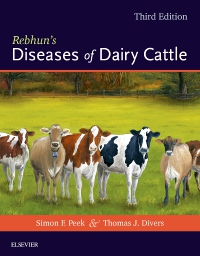

Rebhun's Diseases of Dairy Cattle – Elsevier eBook on VitalSource, 3rd Edition
Elsevier eBook on VitalSource
Now $123.89
Diagnose and treat bovine diseases in cattle with Rebhun’s Diseases of Dairy Cattle, 3rd Edition — your all-in-one guide to bovine disease management. Organized by body system for quick, convenient reference, this complete resource equips practitioners and students with the knowledge needed to confidently diagnose, treat, and prevent bovine disease. All chapters are updated from the previous edition to reflect the most up-to-date diagnostics and therapeutics, including revised drug usage considerations. An entirely new chapter for this third edition provides easy-to-read, but detailed information on diagnostic laboratory sample submission so that you will know what tests are available and the proper samples to submit. Another entirely new chapter focuses on diseases of the bull. More color photographs and illustrations are provided so that clinical signs and pathology of the diseases and diagnostic procedures commonly used in practice can be visualized. With expanded coverage of herd diseases, this new edition meets the growing need for management of both diseases of individual cows and medical problems affecting whole herds.
-
- NEW! All-new chapter covering diseases specific to or common in the dairy bull offers valuable new content that makes this the most comprehensive resource for veterinary students and practitioners.
- NEW! A companion website, hosted by Cornell University with more than 60 neurologic, ultrasound, and endoscopic case study videos, illustrates key concepts discussed throughout the book and brings to life a variety of techniques that are more easily visualized than described in print.
- UPDATED! Expanded coverage of herd health features diseases of individual cows, as well as problems affecting entire herds, that challenge today’s large animal veterinarians.
- NEW! Emphasis on herd health addresses the dairy industry's increased concern over population medicine.
- UPDATED! Revised drug usage recommendations and legal considerations present the most current information in these critical areas to help you prevent dangerous or costly errors.
-
- Practical overviews for procedures such as blood transfusion, abdominal paracentesis, and ECG give you reliable support for some of the most common procedures in bovine care.
- A logical and user-friendly body systems organization makes diagnosis easier and more effective by isolating system-specific diseases and conditions.
- Additional public health/safety considerations identify diseases that pose a substantial public threat and detail special measures for related care of dairy cattle.
- Addresses the latest treatment innovations, including: antibiotic residue testing, care of individual metabolic disease, troubleshooting, and much more.
- Expanded, up-to-date coverage of public health/food safety considerations for practitioners helps to prevent dangerous and costly errors.
- Current legal and practical considerations for extra label medications are outlined, and all recommendations for drug usage have been revised according to federal guideline changes, to help ensure that you are familiar with the latest evidence-based guidelines.
-
-
 Rebhun's Diseases of Dairy CattleHardcover
-
-
Part One: Examination and Assessment
1. The Clinical Examination
2. Therapeutics and Routine Procedures
Part Two: Diseases of Body Systems
3. Cardiovascular Diseases
4. Respiratory Diseases
5. Noninfectious Diseases of the Gastrointestinal Tract
6. Infectious Diseases of the Gastrointestinal Tract
7. Skin Diseases
8. Diseases of the Teats and Udder
9. Reproductive Diseases
10. Diseases Specific to or Common in the Dairy Bull
11. Urinary Tract Diseases
12. Musculoskeletal Diseases
13. Neurologic Diseases
14. Ocular Diseases
15. Metabolic Diseases
16. Miscellaneous Infectious Diseases
17. Miscellaneous Toxicities and Deficiencies -
-
Ways of Reading
- The appearance of the text and page layout can be modified according to the capabilities of the reading system (font family and font size, spaces between paragraphs, sentences, words, and letters, as well as color of background and text)
- This e-publication is accessible to the full extent that the file format and types of content allow, on a specific reading device, by default, without necessarily including any additions such as textual descriptions of images or enhanced navigation
- No information about nonvisual reading is available
-
Conformance
- No information is available
-
Navigation
- Table of contents to all chapters of the text via links
- Page list to go to pages from the print source version
-
Rich Content
- No information is available
-
Hazards
- No information is available
-
Product Content
- No information is available
-
Legal Considerations
- No information is available
-
Additional Accessibility Information
- Page breaks included from the original print source
- For readers with color vision deficiency, use of color (e.g., in diagrams, graphics and charts, in prompts, or on buttons inviting a response) is not the sole means of graphical distinction or of conveying information
- E-publication includes basic navigation (usually less detailed than TOC-based navigation)
- Where links, controls or buttons are included in the content, the purpose or functionality of each link, control or button is apparent from the associated text alone - or where it is unclear, separate link, control or button descriptions are provided
- All (or substantially all) textual matter is arranged in a single logical reading order (including text that is visually presented as separate from the main text flow, e.g., in boxouts, captions, tables, footnotes, endnotes, citations, etc.). Non-textual content is also linked from within this logical reading order. (Purely decorative non-text content can be ignored).
- The language of the text has been specified (e.g., via the HTML or XML lang attribute) to optimise text-to-speech (and other alternative renderings), both at the whole document level and, where appropriate, for individual words, phrases or passages in a different language.
-
Ways of Reading

 as described in our