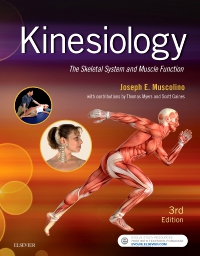

Kinesiology - Elsevier eBook on VitalSource, 3rd Edition
Elsevier eBook on VitalSource
Now $55.99
Learn how to apply kinesiology concepts and treat dysfunction with Muscolino’s Kinesiology: The Skeletal System and Muscle Function, 3rd Edition! With more than 1,200 full-color illustrations, this highly visual text offers a vividly illustrated look at the skeletal system and how muscles function as movers, antagonists, and stabilizers in the body. Part One covers the fundamentals of structure and motion, including essential terminology that is used in kinesiology. Part Two covers the skeletal system including the makeup of skeletal and fascial tissues. Part Three contains a detailed study of the joints of the body. And lastly, Part Four examines how muscles function. This new edition also boasts an all-new chapter on biomechanics, more than 100 online video clips, and an interactive muscle program. If you want a thorough understanding of muscle function and how to apply that knowledge on the job, then there’s no better guide than Muscolino!
New Edition Expected Availability: 12-08-2022

-
- NEW! A new chapter on biomechanics helps you understand how the body moves under normal circumstances and what may impair its movement in pathology
- NEW! Improved illustrations in The Skeletal Muscles of the Human Body offer a vivid muscle atlas within the text
- NEW! Expanded resources on Evolve companion site include a new collection of video clips and an interactive muscle program which help you identify the necessary skills for professional success
-
- NEW! Nora AI - an AI-powered learning assistant exclusive to Elsevier ebooks on VitalSource's Bookshelf® platform - offers built-in AI learning support that provides personalized answers based on content from the Elsevier ebook
- Coverage of strengthening exercises and stretching emphasizes the purposes and benefits of stretching and how to perform various stretching techniques
- The most up-to-date information on posture and the gait cycle features high-quality art
- Comprehensive chapter on muscle action and attachments includes illustrations of all of the muscles of the human body organized by function
- Clinical applications throughout the book are directly related to kinesiology concepts and challenge you to apply what you’ve learned to clinical practice
- Complete atlas of bones, bony landmarks, and joints includes more than 100 full-color photographs of every bone in the human body, giving you comprehensive coverage of bones not found in other kinesiology books
- Clear, simple explanations of kinesiology concepts cover muscle contraction(s), coordination of muscles with movement, core stabilization, posture, exercise, reflexes, and how the nervous system controls and directs the muscular system
- Approximately 1,200 four-color illustrations help you visualize important concepts
- A wide variety of user resources include a comprehensive glossary of terms from the book, radiographs, answers to the review questions at the end of each chapter in the book, an interactive muscle program, and videos featuring joint actions and palpation techniques
-
Part I: Fundamentals of Structure and Motion of the Human Body
1. Parts of the Human Body
2. Mapping the Human Body
Part II: Skeletal Osteology: Study of the Bones
3. Skeletal Tissues
4. Fascia
5. Bones of the Skeleton
Part III: Skeletal Arthrology: Study of the Joints
6. Joint Action Terminology
7. Classification of Joints
8. Joints of the Axial Body
9. Joints of the Lower Extremity
10. Joints of the Upper Extremity
Part IV: Myology: Study of the Muscular System
11. Attachments and Actions of Muscles
12. Anatomy and Physiology of Muscle Tissue
13. How Muscles Function – The Big Picture
14. Types of Muscle Contractions
15. Roles of Muscles
16. Types of Joint Motion and Musculoskeletal Assessment
17. Determining the Force of a Muscle Contraction
18. Biomechanics
19. Neuromuscular System
20. Posture and the Gait Cycle
21. Postural Distortion Patterns
22. Stretching
23. Strengthening Exercises -
-
Ways of Reading
- The appearance of the text and page layout can be modified according to the capabilities of the reading system (font family and font size, spaces between paragraphs, sentences, words, and letters, as well as color of background and text)
- This e-publication is accessible to the full extent that the file format and types of content allow, on a specific reading device, by default, without necessarily including any additions such as textual descriptions of images or enhanced navigation
- No information about nonvisual reading is available
-
Conformance
- The publication was certified on 27-05-2026
-
Navigation
- Table of contents to all chapters of the text via links
- Page list to go to pages from the print source version
-
Rich Content
- No information is available
-
Hazards
- No information is available
-
Product Content
- No information is available
-
Legal Considerations
- No information is available
-
Additional Accessibility Information
- Page breaks included from the original print source
- For readers with color vision deficiency, use of color (e.g., in diagrams, graphics and charts, in prompts, or on buttons inviting a response) is not the sole means of graphical distinction or of conveying information
- E-publication includes basic navigation (usually less detailed than TOC-based navigation)
- Where links, controls or buttons are included in the content, the purpose or functionality of each link, control or button is apparent from the associated text alone - or where it is unclear, separate link, control or button descriptions are provided
- All (or substantially all) textual matter is arranged in a single logical reading order (including text that is visually presented as separate from the main text flow, e.g., in boxouts, captions, tables, footnotes, endnotes, citations, etc.). Non-textual content is also linked from within this logical reading order. (Purely decorative non-text content can be ignored).
- The language of the text has been specified (e.g., via the HTML or XML lang attribute) to optimise text-to-speech (and other alternative renderings), both at the whole document level and, where appropriate, for individual words, phrases or passages in a different language.
-
Ways of Reading

 as described in our