ISBN:
9780323414333
Copyright:
2017
Publication Date:
07-12-2016
Page Count:
1488
Imprint:
Mosby
List Price:
$34.99

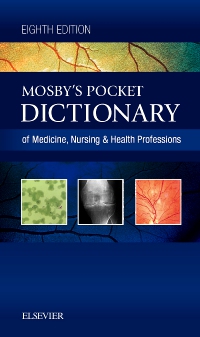
Mosby's Pocket Dictionary of Medicine, Nursing & Health Professions - Elsevier eBook on VitalSource, 8th Edition
by Mosby
Elsevier eBook on VitalSource
ISBN:
9780323414333
Copyright:
2017
Publication Date:
07-12-2016
Page Count:
1488
Imprint:
Mosby
List Price:
$34.99
Was
$34.99
Now $31.49
Or $0.00 with a valid access code
What does that term mean? How is it even pronounced? Make sense of the complex world of health care with Mosby's Pocket Dictionary of Medicine, Nursing & Health Professions, 8th Edition. This comprehensive, portable dictionary offers a unique, strong focus on nursing and health science terminology. Featuring over 56,600 authoritative definitions of diseases, procedures, equipment, drugs, and more, it ensures you have the most reliable health science information right at your fingertips. Word roots and pronunciations help you learn and correctly use medical terminology, and alphabetized screened thumb tabs make finding definitions quick and easy.
New Edition Expected Availability: 05-15-2023
Mosby's Pocket Dictionary of Medicine, Nursing & Health Professions - Elsevier eBook on VitalSource
Elsevier eBook on VitalSource
ISBN: 9780323833110
-
- Emphasis on nursing and health science terminology supports health science students and practicing professionals
- Over 56,600 definitions provide you with necessary information
- Revised by an experienced educator, Marie O’Toole, and an expert team of health professionals, nurses, and doctors, so definitions are brief, pertinent, and — most important of all — accurate!
- Practical alphabetical organization without subentries makes it easier for you to find terms
- British spellings assist you in recognizing alternate spellings
- Pronunciations for key terms help you use terminology correctly in everyday practice
- A Spanish/English Appendix and commonly used abbreviations, printed on the front and back endsheets, make dictionary an indispensable reference
- Alphabetized screened thumb tabs save you time locating terms
- Included etymologies build professional vocabulary and understanding of medical terminology
- Small trim size makes dictionary easy to transport
-
Commonly Used Abbreviations (Endsheets)
Guide to the Dictionary
Definitions A-Z
Appendix 1: English-Spanish Translation Guide
Appendix 2: American Sign Language and Manual Communication -
-
Ways of Reading
- The appearance of the text and page layout can be modified according to the capabilities of the reading system (font family and font size, spaces between paragraphs, sentences, words, and letters, as well as color of background and text)
- This e-publication is accessible to the full extent that the file format and types of content allow, on a specific reading device, by default, without necessarily including any additions such as textual descriptions of images or enhanced navigation
- No information about nonvisual reading is available
-
Conformance
- The publication was certified on 27-05-2026
-
Navigation
- Table of contents to all chapters of the text via links
- Page list to go to pages from the print source version
-
Rich Content
- No information is available
-
Hazards
- No information is available
-
Product Content
- No information is available
-
Legal Considerations
- No information is available
-
Additional Accessibility Information
- Page breaks included from the original print source
- For readers with color vision deficiency, use of color (e.g., in diagrams, graphics and charts, in prompts, or on buttons inviting a response) is not the sole means of graphical distinction or of conveying information
- E-publication includes basic navigation (usually less detailed than TOC-based navigation)
- Where links, controls or buttons are included in the content, the purpose or functionality of each link, control or button is apparent from the associated text alone - or where it is unclear, separate link, control or button descriptions are provided
- All (or substantially all) textual matter is arranged in a single logical reading order (including text that is visually presented as separate from the main text flow, e.g., in boxouts, captions, tables, footnotes, endnotes, citations, etc.). Non-textual content is also linked from within this logical reading order. (Purely decorative non-text content can be ignored).
- The language of the text has been specified (e.g., via the HTML or XML lang attribute) to optimise text-to-speech (and other alternative renderings), both at the whole document level and, where appropriate, for individual words, phrases or passages in a different language.
-
Ways of Reading
Was
$34.99
Now $31.49
Or $0.00 with a valid access code

 as described in our