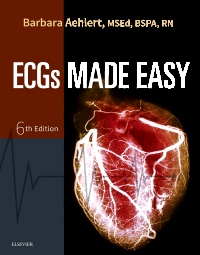

ECGs Made Easy - Elsevier eBook on VitalSource, 6th Edition
Elsevier eBook on VitalSource
Now $62.99
Understanding ECGs has never been easier than with ECGs Made Easy, 6th Edition! In compliance with the American Heart Association’s 2015 ECC resuscitation guidelines, Barbara Aehlert’s new edition offers clear explanations, a conversational tone, and a wealth of practice exercises to help students and professionals from a variety of medical fields learn how to accurately recognize and interpret basic dysrhythmias. Each heart rhythm covered in the book includes a sample ECG rhythm strip and a discussion of possible patient symptoms and general treatment guidelines. Other user-friendly features include: ECG Pearls with insights based on real-world experience, Drug Pearls highlighting the medications used to treat dysrhythmias, Clinical Correlation call-outs, Lead In applicatinos, Stop & Review questions, a comprehensive post-test with answers, and more. It’s everything you need to master ECG interpretation with ease!
New Edition Expected Availability: 09-21-2022

-
- NEW! 38 New cardiac rhythm strips have been added to the book for a total of 260 practice strips
- NEW! AHA compliance ensures the book reflects the American Heart Association’s 2015 ECC resuscitation guidelines
- NEW! Lead In boxes cover ECG principles, practical applications, indications, techniques, and interpretation
- NEW! Expanded coverage of ambulatory monitoring provides more in-depth guidance in this critical area
-
- Clear ECG discussions highlight what you need to know about ECG mechanisms, rhythms, and heart blocks, such as: How Do I Recognize It? What Causes It? What Do I Do About It?
- Introduction to the 12-Lead ECG chapter provides all the basics for this advanced skill, including determining electrical axis, ECG changes associated with myocardial ischemia and infarction, bundle branch block, and other conditions
- A comprehensive post-test with answers at the end of the book measures your understanding
- ECG Pearl boxes offer useful hints for interpreting ECGs, such as the importance of the escape pacemaker
- Drug Pearl boxes highlight various medications used to treat dysrhythmias
- Chapter key terms focus your attention on the most important information
- Chapter objectives tied to chapter text enable you to quickly review content that satisfies specific learning objectives
-
1. Anatomy & Physiology
2. Basic Electrophysiology
3. Sinus Mechanisms
4. Atrial Rhythms
5. Junctional Rhythms
6. Ventricular Rhythms
7. Atrioventricular Blocks
8. Pacemaker Rhythms
9. Introduction to the 12-Lead ECG
10. Post-Test -
-
Ways of Reading
- The appearance of the text and page layout can be modified according to the capabilities of the reading system (font family and font size, spaces between paragraphs, sentences, words, and letters, as well as color of background and text)
- This e-publication is accessible to the full extent that the file format and types of content allow, on a specific reading device, by default, without necessarily including any additions such as textual descriptions of images or enhanced navigation
- No information about nonvisual reading is available
-
Conformance
- The publication was certified on 27-05-2026
-
Navigation
- Table of contents to all chapters of the text via links
- Page list to go to pages from the print source version
-
Rich Content
- No information is available
-
Hazards
- No information is available
-
Product Content
- No information is available
-
Legal Considerations
- No information is available
-
Additional Accessibility Information
- Page breaks included from the original print source
- For readers with color vision deficiency, use of color (e.g., in diagrams, graphics and charts, in prompts, or on buttons inviting a response) is not the sole means of graphical distinction or of conveying information
- E-publication includes basic navigation (usually less detailed than TOC-based navigation)
- Where links, controls or buttons are included in the content, the purpose or functionality of each link, control or button is apparent from the associated text alone - or where it is unclear, separate link, control or button descriptions are provided
- All (or substantially all) textual matter is arranged in a single logical reading order (including text that is visually presented as separate from the main text flow, e.g., in boxouts, captions, tables, footnotes, endnotes, citations, etc.). Non-textual content is also linked from within this logical reading order. (Purely decorative non-text content can be ignored).
- The language of the text has been specified (e.g., via the HTML or XML lang attribute) to optimise text-to-speech (and other alternative renderings), both at the whole document level and, where appropriate, for individual words, phrases or passages in a different language.
-
Ways of Reading

 as described in our