ISBN:
9780323445573
Copyright:
2018
Publication Date:
02-23-2017
Page Count:
528
Imprint:
Mosby
List Price:
$81.99

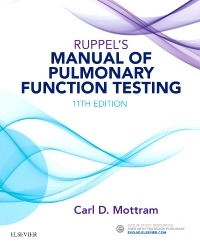
Ruppel's Manual of Pulmonary Function Testing - Elsevier eBook on VitalSource, 11th Edition
by Carl Mottram, BA, RRT, RPFT, FAARC
Elsevier eBook on VitalSource
ISBN:
9780323445573
Copyright:
2018
Publication Date:
02-23-2017
Page Count:
528
Imprint:
Mosby
List Price:
$81.99
Was
$81.99
Now $57.39
Or $0.00 with a valid access code
Use this authoritative guide as an on-the-job reference — and to prepare for the CPFT and RPFT credentialing examinations! Ruppel's Manual of Pulmonary Function Testing, 11th Edition provides comprehensive coverage of common pulmonary function tests, testing techniques, and the pathophysiology that may be evaluated by each test. It also includes information on equipment, computers, and quality assurance, so you can develop the testing skills you need to find and assess lung abnormalities and conditions including asthma, COPD, emphysema, and cystic fibrosis. Written by Carl Mottram, a well-known expert in pulmonary function procedures, this bestselling guide helps you get accurate test results every time.
New Edition Expected Availability: 03-21-2022

Ruppel's Manual of Pulmonary Function Testing - Elsevier eBook on VitalSource
Elsevier eBook on VitalSource
ISBN: 9780323762632
-
- NEW! UPDATED content reflects the latest guidelines, testing procedure recommendations, and interpretive strategies of the American Thoracic Society/European Respiratory Society as well as the newest guidelines for exercise testing from the American Thoracic Society/American College of Chest Physicians
- NEW! Practice tests on the Evolve companion website help you apply the knowledge learned in the text
- NEW! Summary Points at the end of chapters reinforce important entry-level and advanced-level concepts
-
- Entry- and Advanced-Level objectives prepare you for success on the Certified Pulmonary Function Technologist and Registered Pulmonary Function Technologist credentialing examinations, and follow the content guidelines suggested by the CPFT and RPFT exam matrices from the National Board for Respiratory Care (NBRC).
- How To boxes provide step-by-step guidelines to performing pulmonary function tests, taking the guesswork out of completing accurate and result-producing tests.
- PFT Tips highlight and reinforce the most important Pulmonary Function Testing information in every chapter.
- Case studies provide problem-solving challenges for common clinical cases, including each case history, PFT testing results, a technologist’s comments, and questions and answers.
- Convenient study features include key terms, chapter outlines, learning objectives, suggested readings, a glossary, and self-assessment questions.
- Authoritative, comprehensive resource conveys state-of-the-art information, and eliminates the need to search for information in other sources.
- Criteria for acceptability and repeatability are included in each test section, as well as interpretive strategies to help you adhere to recognized testing standards.
-
1. Indications for Pulmonary Function Testing
2. Spirometry
3. Diffusing Capacity Tests
4. Lung Volumes, Airway Resistance and Gas Distribution Tests
5. Ventilation and Ventilatory Control Tests
6. Blood Gases and Related Tests
7. Cardiopulmonary Exercise Testing
8. Pediatric Pulmonary Function Tests
9. Bronchoprovocation Testing
10. Specialized Test Regimens
11. Pulmonary Function Test Equipment
12. Quality Systems in the Pulmonary Function Laboratory
13. Reference Values and Interpretation Strategies
Appendix A: Answers to Self-Assessment Questions
Glossary
Index -
-
Ways of Reading
- The appearance of the text and page layout can be modified according to the capabilities of the reading system (font family and font size, spaces between paragraphs, sentences, words, and letters, as well as color of background and text)
- This e-publication is accessible to the full extent that the file format and types of content allow, on a specific reading device, by default, without necessarily including any additions such as textual descriptions of images or enhanced navigation
- No information about nonvisual reading is available
-
Conformance
- The publication was certified on 27-05-2026
-
Navigation
- Table of contents to all chapters of the text via links
- Page list to go to pages from the print source version
-
Rich Content
- No information is available
-
Hazards
- No information is available
-
Product Content
- No information is available
-
Legal Considerations
- No information is available
-
Additional Accessibility Information
- Page breaks included from the original print source
- For readers with color vision deficiency, use of color (e.g., in diagrams, graphics and charts, in prompts, or on buttons inviting a response) is not the sole means of graphical distinction or of conveying information
- E-publication includes basic navigation (usually less detailed than TOC-based navigation)
- Where links, controls or buttons are included in the content, the purpose or functionality of each link, control or button is apparent from the associated text alone - or where it is unclear, separate link, control or button descriptions are provided
- All (or substantially all) textual matter is arranged in a single logical reading order (including text that is visually presented as separate from the main text flow, e.g., in boxouts, captions, tables, footnotes, endnotes, citations, etc.). Non-textual content is also linked from within this logical reading order. (Purely decorative non-text content can be ignored).
- The language of the text has been specified (e.g., via the HTML or XML lang attribute) to optimise text-to-speech (and other alternative renderings), both at the whole document level and, where appropriate, for individual words, phrases or passages in a different language.
-
Ways of Reading
Was
$81.99
Now $57.39
Or $0.00 with a valid access code

 as described in our