ISBN:
9780323445870
Copyright:
2018
Publication Date:
05-24-2017
Page Count:
424
Imprint:
Saunders
List Price:
$109.99

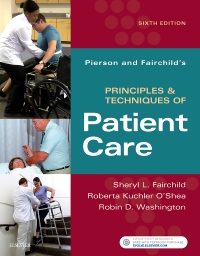
Pierson and Fairchild's Principles & Techniques of Patient Care - Elsevier eBook on VitalSource, 6th Edition
by Sheryl L. Fairchild, BS, PT, Roberta O'Shea, PT, DPT, PhD and Robin Washington
Elsevier eBook on VitalSource
ISBN:
9780323445870
Copyright:
2018
Publication Date:
05-24-2017
Page Count:
424
Imprint:
Saunders
List Price:
$109.99
Was
$109.99
Now $98.99
Or $0.00 with a valid access code
Master the basics of rehab patient care with Pierson and Fairchild’s Principles & Techniques of Patient Care, 6th Edition. This proven text not only provides clear "how-to" information on everything from positioning and draping to patient transfers and ambulation activities, but it also includes easy-to-understand rationales explaining the "why" behind these proven techniques. This new edition has been thoroughly updated to reflect the most current accepted patient care standards, principles, and techniques. Plus, additional video clips and expanded learning resources will help ensure you have a solid mastery of patient care in the rehabilitation setting.
New Edition Expected Availability: 05-05-2022

Pierson and Fairchild's Principles & Techniques of Patient Care - Elsevier eBook on VitalSource
Elsevier eBook on VitalSource
ISBN: 9780323933988
-
- NEW! Procedures index lists all of the procedures covered in the text to help you quickly locate procedure descriptions while working in the clinical setting
- NEW! Additional video clips demonstrate patient transfers, ambulation with aids, donning and doffing PPE, and maneuvering a wheelchair
- NEW! Video clip table of contents lists over 30 video clips in the front matter of the text
-
- Content based on the World Health Organization’s ICF model (International Classification of Functioning, Disability, and Health) — the model currently endorsed by the APTA and AOTA — ensures you are referencing information that stems from the most current theories and practice guidelines of physical and occupational therapy
- Procedures boxes with clear written instructions are accompanied by full-color illustrations on performing a variety of proven techniques and patient care tasks such as proper lifting techniques, patient transfers, basic wound care, and assessment of vital signs
- Insights into the rationales and physiological principles explain why specific techniques and procedures are used
- More than 800 full color photographs clearly demonstrate proper performance of techniques and procedures used in the assessment and management of patients in the rehabilitation setting
- Guidelines, principles, and precautions boxes throughout the text offer additional tips for optimal assessment and management of patients in the rehabilitation setting
- Self-study and problem solving (case study) activities conclude each chapter to help you understand important concepts and improve your decision-making and problem solving skills
- Video clips on companion Evolve website demonstrate the techniques and procedures described in the text
- Content on professionalism and the concept of professional values and ethics reinforce existing workplace guidelines and how to apply those guidelines to your patient interactions
- Online user resources on the companion Evolve website feature video clips and additional activities for you to hone your skills. (What additional activities?)
-
1. Preparation for Patient Care Activities
2. Approaches to Infection Control
3. Assessment of Vital Signs
4. Body Mechanics
5. Positioning and Draping
6. Basic Exercise: Passive and Active Range of Motion
7. Features and Activities of Wheelchairs
8. Transfer Activities
9. Assistive Devices, Patterns, and Activities
10. Special Equipment and Patient Care Environments
11. Basic Wound Care and Specialized Interventions
12. Incidents and Emergencies
13. Americans with Disabilities Act and Environmental Assessments -
-
Ways of Reading
- The appearance of the text and page layout can be modified according to the capabilities of the reading system (font family and font size, spaces between paragraphs, sentences, words, and letters, as well as color of background and text)
- This e-publication is accessible to the full extent that the file format and types of content allow, on a specific reading device, by default, without necessarily including any additions such as textual descriptions of images or enhanced navigation
- No information about nonvisual reading is available
-
Conformance
- The publication was certified on 27-05-2026
-
Navigation
- Table of contents to all chapters of the text via links
- Page list to go to pages from the print source version
-
Rich Content
- No information is available
-
Hazards
- No information is available
-
Product Content
- No information is available
-
Legal Considerations
- No information is available
-
Additional Accessibility Information
- Page breaks included from the original print source
- For readers with color vision deficiency, use of color (e.g., in diagrams, graphics and charts, in prompts, or on buttons inviting a response) is not the sole means of graphical distinction or of conveying information
- E-publication includes basic navigation (usually less detailed than TOC-based navigation)
- Where links, controls or buttons are included in the content, the purpose or functionality of each link, control or button is apparent from the associated text alone - or where it is unclear, separate link, control or button descriptions are provided
- All (or substantially all) textual matter is arranged in a single logical reading order (including text that is visually presented as separate from the main text flow, e.g., in boxouts, captions, tables, footnotes, endnotes, citations, etc.). Non-textual content is also linked from within this logical reading order. (Purely decorative non-text content can be ignored).
- The language of the text has been specified (e.g., via the HTML or XML lang attribute) to optimise text-to-speech (and other alternative renderings), both at the whole document level and, where appropriate, for individual words, phrases or passages in a different language.
-
Ways of Reading
Was
$109.99
Now $98.99
Or $0.00 with a valid access code

 as described in our