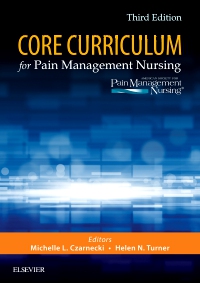

Core Curriculum for Pain Management Nursing - Elsevier eBook on VitalSource, 3rd Edition
Elsevier eBook on VitalSource
Now $67.19
Learn how to successfully work with patients in pain with The Core Curriculum for Pain Management Nursing, 3rd Edition. Written by the American Society for Pain Management Nursing (the primary nursing organization in pain management), this easy-to-read text covers the entire scope of pain management in a very user-friendly outline format. This new edition has been thoroughly updated to reflect the latest standards and scope of practice put forth by the ASPMN. Yet, it still retains its strong nursing focus as it explores the nurse’s role as a patient advocate in pain management and how that role changes from a Registered Nurse to a Clinical Nurse Specialist to a Nurse Practitioner. Both pharmacologic and non-pharmacologic methods of pain management are discussed, as is a wide variety of patient subsets beyond the traditional pediatric, adult, and geriatric patient. If you’re looking to pass the ASPMN credentialing exam and work successfully with all types of patients in pain, then this is the perfect text for you!
New Edition Expected Availability: 08-19-2024

Core Curriculum for Pain Management Nursing - Elsevier eBook on VitalSource
-
- NEW! Coverage of both pharmacologic and non-pharmacologic pain interventions has been updated to keep you abreast of the latest methods for both types of pain management.
- NEW! Thoroughly updated information reflects the latest standards and scope of practice as well as the blueprint for the ASPMN credentialing exam.
- NEW! Additional information on pain management in bariatric patients highlight important considerations that you need to know when caring for this specific patient population.
- NEW! Added illustrations and figures throughout the text make difficult concepts easier to understand.
-
- NEW! Nora AI - an AI-powered learning assistant exclusive to Elsevier ebooks on VitalSource's Bookshelf® platform - offers built-in AI learning support that provides personalized answers based on content from the Elsevier ebook
- Content written by the ASPMN (American Society for Pain Management Nursing), the primary nursing organization in pain management, ensures the material is authoritative and timely
- UNIQUE! Expansive patient coverage addresses not only adults, pediatric and geriatric patients, but also key subsets of patients — such as those who have concomitant addiction, those who have cancer, those who are under sedation for a procedure, and more
- Comprehensive coverage discusses important topics — such as the disparities in pain management, gender differences in pain and analgesia, the effect of depression on pain perception and management, the use of research, various theories of pain management, and more — to fully prepare you for your ASPMN credentialing exam and professional practice
- UNIQUE! Strong nursing focus thoroughly explores the nurse’s role as a patient advocate in pain management and how that role changes from a Registered Nurse to a Clinical Nurse Specialist to a Nurse Practitioner
- Unique outline format makes the text an accessible and easy-to-read reference
-
Section 1: Foundation of Pain Management Nursing
1. Foundations of Pain Management Nursing
2. Historical and Cultural Influences on Pain Perceptions, Barriers to Treatment and Disparities in Pain Care
3. Social, Political, and Ethical Forces Influencing Pain Management
4. Epidemiology of Pain
5. Opportunities and Complexities in the Future of Pain ManagementSection 2: Clinical Practice of Pain Management Nursing
6. Key Terms and Definitions for Pain Management Nursing
7. Theories of Pain
8. The Impact of Pain and Benefits of Pain Management
9. Physiology of Pain
10. Overview of Pain Management Pharmacology
11. Sex and Gender Differences within Pain Management
12. Pain Assessment
13. Acute Pain Management
14. Persistent Pain Management
15. Cancer Pain Management
16. Pediatric Pain Management
17. Gerontology Pain Management
18. Pain Management and Palliative Care
19. Depression, Anxiety and Pain
20. Substance Use Disorder and Pain
21. Complementary and Integrative Therapies for Pain Management
22. Procedural Sedation and AnalgesiaSection 3: Nursing Roles Involved in Pain Management
23. Research Utilization and Application in Pain Management
24. Making Change in the World of Pain Management
25. Implementing and Evaluating Pain Management Safety and Quality
26. Pain Management Education
27. The Role of the Advanced Practice Nurse in Pain Management -
-
Ways of Reading
- The appearance of the text and page layout can be modified according to the capabilities of the reading system (font family and font size, spaces between paragraphs, sentences, words, and letters, as well as color of background and text)
- This e-publication is accessible to the full extent that the file format and types of content allow, on a specific reading device, by default, without necessarily including any additions such as textual descriptions of images or enhanced navigation
- No information about nonvisual reading is available
-
Conformance
- No information is available
-
Navigation
- Table of contents to all chapters of the text via links
- Page list to go to pages from the print source version
-
Rich Content
- No information is available
-
Hazards
- No information is available
-
Product Content
- No information is available
-
Legal Considerations
- No information is available
-
Additional Accessibility Information
- Page breaks included from the original print source
- For readers with color vision deficiency, use of color (e.g., in diagrams, graphics and charts, in prompts, or on buttons inviting a response) is not the sole means of graphical distinction or of conveying information
- E-publication includes basic navigation (usually less detailed than TOC-based navigation)
- Where links, controls or buttons are included in the content, the purpose or functionality of each link, control or button is apparent from the associated text alone - or where it is unclear, separate link, control or button descriptions are provided
- All (or substantially all) textual matter is arranged in a single logical reading order (including text that is visually presented as separate from the main text flow, e.g., in boxouts, captions, tables, footnotes, endnotes, citations, etc.). Non-textual content is also linked from within this logical reading order. (Purely decorative non-text content can be ignored).
- The language of the text has been specified (e.g., via the HTML or XML lang attribute) to optimise text-to-speech (and other alternative renderings), both at the whole document level and, where appropriate, for individual words, phrases or passages in a different language.
-
Ways of Reading

 as described in our