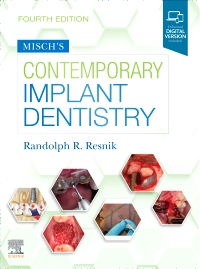

Misch's Contemporary Implant Dentistry Elsevier eBook on VitalSource, 4th Edition
Elsevier eBook on VitalSource
Dental implant surgery is an artform. To help students advance their skills and become masters of implant prosthetics, Misch's Contemporary Implant Dentistry, 4th Edition uses a multidisciplinary approach to cover the industry’s most current processes and procedures. The new edition of this text continues to provide comprehensive, state-of-the-art information on the science and discipline of contemporary implant dentistry. Covering the breadth of dental implant surgery, it includes full-color, in-depth coverage of both simple and complicated clinical cases, with practical guidance on how to apply the latest research, diagnostic tools, treatment planning, implant designs, and materials. New author Randolph R. Resnik, is an internationally known educator, clinician, and researcher in the field of Oral Implantology and Prosthodontics who will continue Dr. Misch’s legacy and teachings.
-
- Internationally known author, Randolph R. Resnik, DMD, MDS is a leading educator, clinician, author and researcher in the field of Oral Implantology and Prosthodontics.
- Surgical protocols provide the latest, most up-to-date literature and techniques that provide a proven system for comprehensive surgical treatment of dental implant patients.
- Thoroughly revised content includes current diagnostic pharmacologic and medical evaluation recommendations to furnish the reader with the latest literature-based information.
- Proven strategies and fundamentals for predictable implant outcomes
- Latest implant surgical techniques for socket grafting and ridge augmentation procedures
- Proven, evidence-based solutions for the treatment of peri-implant disease
- Includes the use of dermal fillers and botox in oral implantology
- Up-to-date information on advances in the field reflects the state-of-the-art dental implantology.
- Addition of an ExpertConsult site allows you to search the entire book electronically.
-
- Internationally known author, Randolph R. Resnik, DMD, MDS is a leading educator, clinician, author and researcher in the field of Oral Implantology and Prosthodontics.
- NEW! Surgical focus throughout text ensures each chapter has been reviewed to focus the content from the surgical viewpoint.
- Surgical protocols provide the latest, most up-to-date literature and techniques that provide a proven system for comprehensive surgical treatment of dental implant patients.
- Thoroughly revised content includes current diagnostic pharmacologic and medical evaluation recommendations to furnish the reader with the latest literature-based information.
- Proven strategies and fundamentals for predictable implant outcomes
- Latest implant surgical techniques for socket grafting and ridge augmentation procedures
- Proven, evidence-based solutions for the treatment of peri-implant disease
- Includes the use of dermal fillers and botox in oral implantology
- Up-to-date information on advances in the field reflects the state-of-the-art dental implantology.
- Addition of an ExpertConsult site allows you to search the entire book electronically.
- NEW! Internationally known author, Randolph R. Resnik is a leading educator, clinician, author and researcher in the field of Oral Implantology and Prosthodontics.
- Content reflects original author’s philosophy and surgical protocols for dental implants giving students a system for achieving predictable outcomes.
- Evidence-based approach to dental implant procedures features state-of-the-art guidance supported by the best available research evidence.
- Rich art program throughout text highlights and clarifies key clinical concepts and techniques with over 2,500 images, radiographs, full-color clinical photographs, line art, and diagrams.
- Definitive resource in implant dentistry provides students with authoritative state-of-the art guidance by recognized leaders in the field.
-
-
 Contemporary Implant Dentistry - Elsevier eBook on VitalSourceElsevier eBook on VitalSource
 -

-
 Misch's Contemporary Implant DentistryHardcover
-
-
Part I: Scientific Basis
1. Rationale for Dental Implants
2. Terminology in Implant dentistry
3. Functional Basis for Dental Implant Design
4. Bone Physiology, Metabolism, and Biomechanics
5. Biomaterials for Dental ImplantsPart II: Biomechanical Properties of Dental Implants
6. Clinical Biomechanics in Implant Dentistry
7. Stress Treatment Theorem for Implant Dentistry
8. Treatment Planning: Force Factors Related to Patient Conditions
9. Dental Implant SurfacesPart III : Fundamental Science
10. Medical Evaluation of the Dental Implant Patient
11. Radiographic Evaluation in Oral Implantology
12. Applied Anatomy for Dental Implants
13. Dental Implant Infections
14. Pharmacology in Implant DentistryPart IV: Treatment Planning Principles
15. Interactive Computed Tomography and Dental Implant Treatment Planning
16. Available Bone and Dental Implant Treatment Plans
17. Prosthetic Options in Implant Dentistry
18. Bone Density: A Key Determinant for Treatment Planning
19. Treatment Plans Related to Key Implant Positions and Implant NumberPart V: Edentulous Site Treatment Planning
20. Treatment Plans for Partially and Completely Edentulous Arches in Implant Dentistry
21. Preimplant Prosthodontic Factors Related to Surgical Treatment Planning
22. Single and Multiple Tooth Replacement: Treatment Options
23. Treatment Planning for the Edentulous Posterior Maxilla
24. The Edentulous Mandible: Fixed Versus Removable Prosthesis Treatment Planning
25. The Edentulous Maxilla: Fixed versus Removable Treatment PlanningPart VI: Implant Surgery
26. Basic Surgical Techniques and Armamentarium
27. Implant Placement Surgical Protocol
28. Ideal Implant Positioning
29. Maxillary Anterior Specific Implant Surgery
30. Mandibular Specific Anatomic Implications for Dental Implant Surgery
31. Dental Implant Surgery Complications
32 Immediate Implant Surgical Protocol
33. Immediate Load/Restoration in Implant DentistryPart VII: Soft and Hard Tissue Rehabilitation
34. Atraumatic Tooth Extraction and Socket Grafting
35. Bone Substitutes and Membranes
36. Particulate Membrane Grafting/Guided Bone Regeneration
37. Maxillary Sinus Anatomy, Pathology, and Graft Surgery
38. Intraoral Autogenous Bone Grafting
39. Extraoral Autogenous Bone Grafting for Dental Implant Surgery
40. The Use of Botox and Dermal Fillers in Oral ImplantologyPart VIII: Dental Implant Maintenance
41. Peri-Implantitis and Peri-Implant Mucositis: Diagnosis, Classification, Etiologies, and Therapies
42. Implant Maintenance: Long-term Implant Success -
-
Ways of Reading
- The appearance of the text and page layout can be modified according to the capabilities of the reading system (font family and font size, spaces between paragraphs, sentences, words, and letters, as well as color of background and text)
- This e-publication is accessible to the full extent that the file format and types of content allow, on a specific reading device, by default, without necessarily including any additions such as textual descriptions of images or enhanced navigation
- No information about nonvisual reading is available
-
Conformance
- No information is available
-
Navigation
- Table of contents to all chapters of the text via links
- Page list to go to pages from the print source version
-
Rich Content
- No information is available
-
Hazards
- No information is available
-
Product Content
- No information is available
-
Legal Considerations
- No information is available
-
Additional Accessibility Information
- Page breaks included from the original print source
- For readers with color vision deficiency, use of color (e.g., in diagrams, graphics and charts, in prompts, or on buttons inviting a response) is not the sole means of graphical distinction or of conveying information
- E-publication includes basic navigation (usually less detailed than TOC-based navigation)
- Where links, controls or buttons are included in the content, the purpose or functionality of each link, control or button is apparent from the associated text alone - or where it is unclear, separate link, control or button descriptions are provided
- All (or substantially all) textual matter is arranged in a single logical reading order (including text that is visually presented as separate from the main text flow, e.g., in boxouts, captions, tables, footnotes, endnotes, citations, etc.). Non-textual content is also linked from within this logical reading order. (Purely decorative non-text content can be ignored).
- The language of the text has been specified (e.g., via the HTML or XML lang attribute) to optimise text-to-speech (and other alternative renderings), both at the whole document level and, where appropriate, for individual words, phrases or passages in a different language.
-
Ways of Reading

 as described in our