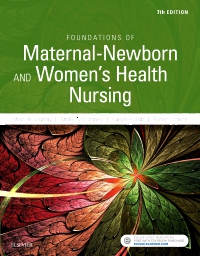

Foundations of Maternal-Newborn & Women's Health Nursing - Elsevier eBook on VitalSource, 7th Edition
Elsevier eBook on VitalSource
Now $99.89
Make sure you fully understand how to care for women and newborns! Foundations of Maternal-Newborn and Women's Health Nursing, 7th Edition integrates essential maternity information into the overall continuum of nursing care to show how to provide safe care in the clinical setting. With easy-to-understand language, this updated text uses evidence-based guidelines and step-by-step instructions for assessments and interventions to help you quickly master key skills and techniques. Also emphasized is the importance of understanding family, communication, culture, patient teaching, and clinical decision making. This edition reflects the latest QSEN competencies, and the accompanying Evolve website includes review questions to prepare students for the NCLEX® exam!
New Edition Expected Availability: 10-06-2022

Foundations of Maternal-Newborn & Women's Health Nursing - Elsevier eBook on VitalSource
-
- NEW! Reorganized content integrates complications into standard family care, includes new sections on obesity, and recommendations for infant safe sleep environment and reductions of SIDS risk
- NEW! Contributing content from known experts in the field of Maternal and Women’s health include a former AWHONN president
-
- Safety checks integrated into the content help you develop competencies related to safe nursing practice
- Unfolding case studies help you apply what you’ve learned to practice
- UPDATED Evidence-Based Practice boxes highlight the latest research and the most current QSEN (Quality and Safety Education for Nurses) practice guidelines for quality care
- Patient teaching boxes provide teaching guidelines, including communication guides, directed at patients and families
- Critical to Remember boxes highlight and summarize need-to-know information
- Critical Thinking exercises focus on clinical situations designed to test your skills in prioritizing and critical thinking
- Nursing Care Plans help you apply the nursing process to clinical situations.
- Chapter summaries appear at the end of each chapter and help you review core content in each chapter while on the go
- Updated Drug guides list important indications, adverse reactions, and nursing considerations for the most commonly used medications
- Procedure boxes provide clear instructions for performing common maternity skills, with rationales for each step
- UNIQUE! Therapeutic Communications boxes present realistic nurse-patient dialogues, identifying communication techniques and showing to respond when encountering communication blocks
- Knowledge check helps you assess your mastery of key content
- Glossary provides definitions of all key terms
-
PART I: FOUNDATIONS FOR NURSING CARE OF THE CHILDBEARING FAMILIES
1. Maternity and Women’s Health Care Today
2. Social, Ethical and Legal Issues
3. Reproductive Anatomy and Physiology
4. Hereditary and Environmental Influences on Childbearing
PART II: THE FAMILY BEFORE BIRTH
5. Conception and Prenatal Development
6. Maternal Adaptations to Pregnancy
7. Antepartum Assessment, Care and Education
8. Nutrition for Childbearing
9. Assessing the Fetus
10. Complications of Pregnancy
11. The Childbearing Family with Special Needs
PART III: THE FAMILY DURING BIRTH
12. Processes of Birth
13. Pain management during Childbirth
14. Intrapartum Fetal Surveillance
15. Nursing Care During Labor and Birth
16. Intrapartum Complications
PART IV: THE FAMILY FOLLOWING BIRTH
17. Postpartum Adaptations and Nursing Care
18. Postpartum Maternal Complications
19. Normal Newborn: Processes of Adaptation
20. Assessment of the Normal Newborn
21. Care of the Normal Newborn
22. Infant Feeding
23. High-Risk Newborn: Complications Associated with Gestational Age and Development
24. High-Risk Newborn: Acquired and Congenital Conditions
PART VI: WOMEN’S HEALTH CARE
25. Family Planning
26. Infertility
27. Women’s Health Care -
-
Ways of Reading
- The appearance of the text and page layout can be modified according to the capabilities of the reading system (font family and font size, spaces between paragraphs, sentences, words, and letters, as well as color of background and text)
- This e-publication is accessible to the full extent that the file format and types of content allow, on a specific reading device, by default, without necessarily including any additions such as textual descriptions of images or enhanced navigation
- No information about nonvisual reading is available
-
Conformance
- The publication was certified on 27-05-2026
-
Navigation
- Table of contents to all chapters of the text via links
- Page list to go to pages from the print source version
-
Rich Content
- No information is available
-
Hazards
- No information is available
-
Product Content
- No information is available
-
Legal Considerations
- No information is available
-
Additional Accessibility Information
- Page breaks included from the original print source
- For readers with color vision deficiency, use of color (e.g., in diagrams, graphics and charts, in prompts, or on buttons inviting a response) is not the sole means of graphical distinction or of conveying information
- E-publication includes basic navigation (usually less detailed than TOC-based navigation)
- Where links, controls or buttons are included in the content, the purpose or functionality of each link, control or button is apparent from the associated text alone - or where it is unclear, separate link, control or button descriptions are provided
- All (or substantially all) textual matter is arranged in a single logical reading order (including text that is visually presented as separate from the main text flow, e.g., in boxouts, captions, tables, footnotes, endnotes, citations, etc.). Non-textual content is also linked from within this logical reading order. (Purely decorative non-text content can be ignored).
- The language of the text has been specified (e.g., via the HTML or XML lang attribute) to optimise text-to-speech (and other alternative renderings), both at the whole document level and, where appropriate, for individual words, phrases or passages in a different language.
-
Ways of Reading


 as described in our