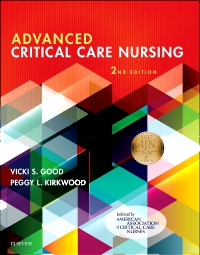

Advanced Critical Care Nursing - Elsevier eBook on VitalSource, 2nd Edition
Elsevier eBook on VitalSource
Now $93.09
Awarded third place in the 2017 AJN Book of the Year Awards in the Critical Care- Emergency Nursing category. Learn to effectively address life-threatening and potentially life-threatening patient conditions, with Advanced Critical Care Nursing, 2nd Edition. Endorsed by the American Association of Critical-Care Nurses (AACN), this comprehensive, nursing-focused text centers on the clinical reasoning process as it helps you comprehend, analyse, synthesize, and apply advanced critical care knowledge and concepts. The book is organized within the structure of body systems along with synthesis chapters that address patient conditions involving multiple body systems. Numerous illustrations and graphs plus unfolding case studies further aid your understanding and help you apply text content. In all, Advanced Critical Care Nursing is the must-have resource dedicated to helping you oversee or care for critical care patients in any practice setting.
-
- NEW! Updated information throughout reflects the latest evidence-based content as well as national and international treatment guidelines.
- NEW! Streamlined content places a greater focus on the need-to-know information for today’s high acuity, progressive, and critical care settings.
- NEW! Expanded coverage of emerging and infectious diseases and multidrug-resistant infections keep readers up to date with the most topical diseases, such as the Zika virus.
- NEW! Additional content on alternative settings for critical care now includes the eICU and remote monitoring.
- NEW! Full-color design clarifies important concepts and improve the book's usability.
-
- Body systems organization emphasizes core systems and advanced concepts.
- Consistent chapter format features numerous illustrations, charts, and graphs in each chapter to enhance understanding.
- Synthesis chapters address patient conditions that involve multiple body systems — a common occurrence in critical care nursing.
- Unfolding case studies with decision point questions are included at the end of all disorders chapters, providing opportunities to apply advanced critical care content to actual scenarios.
- Medication tables incorporate common classifications of critical care drugs for specific disorders, including drugs, actions, and special considerations.
-
-
 Advanced Critical Care NursingPaperback
-
-
UNIT I: INTRODUCTION
1. The Evolving Critical Care EnvironmentUNIT II: CARDIAC
2. Advanced Dysrhythmias
3. Acute Coronary Syndromes
4. Heart Failure
5. Cardiac Surgery
6. Valvular Disease and Surgery
7. Vascular Emergencies
8. Heart and Lung TransplantationUNIT III: PULMONARY
9. Acute Respiratory Failure and Acute Lung Injury
10. Mechanical Ventilation and Weaning
11. Thoracic SurgeryUNIT IV: NEUROLOGIC
12. Head Injury and Dysfunction
13. Cerebrovascular Disorders
14. Spinal Cord Injury
15. Special Neurologic Patient PopulationsUNIT V: GASTROINTESTINAL
16. Gastrointestinal Bleeding
17. Liver Dysfunction and Failure
18. Pancreatitis
19. The Gut in Critical Illness
20. Liver, Kidney, and/or Pancreas TransplantationUNIT VI: RENAL
21. Electrolyte Emergencies
22. Complex Acid-Base Disorders and Associated Electrolyte Imbalances
23. Acute Renal FailureUNIT VII: ENDOCRINE
24. Glycemic Control
25. Pituitary, Thyroid, and Adrenal DisordersUNIT VIII: HEMATOLOGIC
26. Blood Conservation / Blood Component Replacement
27. CoagulopathiesUNIT IX: MULTISYSTEM
28. Shock and End Points of Resuscitation
29. Optimizing Hemodynamics: Strategies for Fluid and Medication Titration in Shock
30. Trauma and Mass-Casualty Competencies
31. Systemic Inflammatory Response Syndrome and Multiple Organ Dysfunction SyndromeUNIT X: SPECIAL PATIENT POPULATIONS
32. Caring for the Immunocompromised Patient
33. Caring for the Patient in the Immediate Postoperative Period
34. Caring for the Critically Ill Pregnant Patient
35. Caring for the Pediatric Patient in an Adult Critical Care Unit
36. Caring for the Critically Ill Elderly Patient
37. Caring for the Critically Ill Patient with a Neuropsychiatric Disorder
38. Caring for the Bariatric PatientUNIT XI: SPECIAL CONSIDERATIONS IN CRITICAL CARE
39. Pain and Sedation
40. Comorbid Conditions
41. Oncologic Emergencies
42. Chemical Dependency
43. End-of-Life CareAppendix A: Answers to Decision Point Questions
-
-
Ways of Reading
- The appearance of the text and page layout can be modified according to the capabilities of the reading system (font family and font size, spaces between paragraphs, sentences, words, and letters, as well as color of background and text)
- This e-publication is accessible to the full extent that the file format and types of content allow, on a specific reading device, by default, without necessarily including any additions such as textual descriptions of images or enhanced navigation
- No information about nonvisual reading is available
-
Conformance
- No information is available
-
Navigation
- Table of contents to all chapters of the text via links
- Page list to go to pages from the print source version
-
Rich Content
- No information is available
-
Hazards
- No information is available
-
Product Content
- No information is available
-
Legal Considerations
- No information is available
-
Additional Accessibility Information
- Page breaks included from the original print source
- For readers with color vision deficiency, use of color (e.g., in diagrams, graphics and charts, in prompts, or on buttons inviting a response) is not the sole means of graphical distinction or of conveying information
- E-publication includes basic navigation (usually less detailed than TOC-based navigation)
- Where links, controls or buttons are included in the content, the purpose or functionality of each link, control or button is apparent from the associated text alone - or where it is unclear, separate link, control or button descriptions are provided
- All (or substantially all) textual matter is arranged in a single logical reading order (including text that is visually presented as separate from the main text flow, e.g., in boxouts, captions, tables, footnotes, endnotes, citations, etc.). Non-textual content is also linked from within this logical reading order. (Purely decorative non-text content can be ignored).
- The language of the text has been specified (e.g., via the HTML or XML lang attribute) to optimise text-to-speech (and other alternative renderings), both at the whole document level and, where appropriate, for individual words, phrases or passages in a different language.
-
Ways of Reading

 as described in our