
ISBN:
9780323483841
Copyright:
2021
Publication Date:
03-06-2020
Page Count:
394
Imprint:
Elsevier
List Price:
$65.99

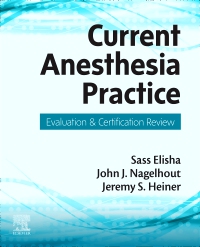
Current Anesthesia Practice - Elsevier eBook on VitalSource, 1st Edition
by Sass Elisha, EdD, CRNA, FAANA, FAAN, John J. Nagelhout, CRNA, PhD, FAAN and Jeremy S. Heiner, EdD, CRNA, FAANA
Elsevier eBook on VitalSource
ISBN:
9780323483841
Copyright:
2021
Publication Date:
03-06-2020
Page Count:
394
Imprint:
Elsevier
List Price:
$65.99
Was
$65.99
Now $58.07
Or $0.00 with a valid access code
This is the exam review nurse anesthetists have been waiting for! Expertly written by the leading author team of Elisha, Nagelhout, and Heiner, Current Anesthesia Practice: Evaluate Your Knowledge, 1st Edition helps prepare nurse anesthetists for the NCE and CPC exam. It is the ONLY certification review text for nurse anesthetists, making it an invaluable study tool while prepping for the NCE or the new CPC exam. Four comprehensive chapters cover foundational concepts: Airway Management; Applied Pharmacology; Applied Human Physiology, Pathophysiology and Anesthesia Case Management; and Anesthesia Equipment and Technology. Answers to review questions throughout the book are found in the appendix.
-
- UNIQUE! The ONLY Certification Review text for nurse anesthetists
- UNIQUE! Written by the leading experts in nurse anesthesia, Elisha and Nagelhout
- Prepares students for both the current CRNA licensure exam and the new CPC exam
- UNIQUE! End-of- section Knowledge Check questions with answers provided in the back of the book
-
- UNIQUE! The ONLY Certification Review text for nurse anesthetists
- UNIQUE! Written by the leading experts in nurse anesthesia, Elisha and Nagelhout
- Prepares you for both the current CRNA licensure exam and the new CPC exam
- UNIQUE! End-of- section Knowledge Check questions with answers provided in the back of the book
-
1. Airway Management
•Anatomy
•Physiological Concepts
•Pathophysiologic Concepts
•Airway Blocks
•Airway Assessments
•Airway Equipment, Management of Devices, and Procedures
•Airway Management Concepts
2. Pharmacology
•General Principles of Pharmacodynamics and Pharmacokinetics
•Inhalation Anesthetics
•Anesthesia Induction Medications
•Induction Agents
•Opiates
•Neuromuscular Blocking Agents
•Anticholinesterase Agents
•Selective Muscle Relaxant Binding Agent
•Anticholinergics
•Autonomic Nervous System – Sympathomimetic Amines
•α-Receptor Blocking Agents
•β-Adrenergic Blocking Agents
•Bronchodilators
•Calcium Channel Blockers
•Antihypertensive Agents
•Vasodilators
•Antiarrythmics
•Digitalis
•Diuretics
•Nonsteroidal Anti-inflammatory Agents
•Miscellaneous Analgesics
•Local Anesthetics
•Oral Antacids
•Antiparkinsonian Drugs
•Antibiotics
•Anticoagulants
•Antiemetics
•Histamine Receptor Antagonists
•Antiepileptic Drugs
•Dantrolene
•Herbal Supplements
•Insulin
•Oral Hypoglycemics
•Intravenous Dyes
•Lipid-Lowering Agents
•Phosphodiesterase Inhibitors
•Psychopharmacology
•Corticosteroids
•Uterotonics
3. Human Physiology, Pathophysiology and Anesthesia Case Management
•Cardiovascular System
•Respiratory
•Neurologic System
•Thermoregulation
4. Anesthesia Equipment and Technology
•Infection Control: Disinfection
•Monitoring Modalities
•Anesthetic Gas Machine
•Standards for Preanesthesia Evaluation and Informed Consent
Appendix A: Knowledge Check Answers -
-
Ways of Reading
- The appearance of the text and page layout can be modified according to the capabilities of the reading system (font family and font size, spaces between paragraphs, sentences, words, and letters, as well as color of background and text)
- This e-publication is accessible to the full extent that the file format and types of content allow, on a specific reading device, by default, without necessarily including any additions such as textual descriptions of images or enhanced navigation
- No information about nonvisual reading is available
-
Conformance
- No information is available
-
Navigation
- Table of contents to all chapters of the text via links
- Page list to go to pages from the print source version
-
Rich Content
- No information is available
-
Hazards
- No information is available
-
Product Content
- No information is available
-
Legal Considerations
- No information is available
-
Additional Accessibility Information
- Page breaks included from the original print source
- For readers with color vision deficiency, use of color (e.g., in diagrams, graphics and charts, in prompts, or on buttons inviting a response) is not the sole means of graphical distinction or of conveying information
- E-publication includes basic navigation (usually less detailed than TOC-based navigation)
- Where links, controls or buttons are included in the content, the purpose or functionality of each link, control or button is apparent from the associated text alone - or where it is unclear, separate link, control or button descriptions are provided
- All (or substantially all) textual matter is arranged in a single logical reading order (including text that is visually presented as separate from the main text flow, e.g., in boxouts, captions, tables, footnotes, endnotes, citations, etc.). Non-textual content is also linked from within this logical reading order. (Purely decorative non-text content can be ignored).
- The language of the text has been specified (e.g., via the HTML or XML lang attribute) to optimise text-to-speech (and other alternative renderings), both at the whole document level and, where appropriate, for individual words, phrases or passages in a different language.
-
Ways of Reading
Was
$65.99
Now $58.07
Or $0.00 with a valid access code

 as described in our